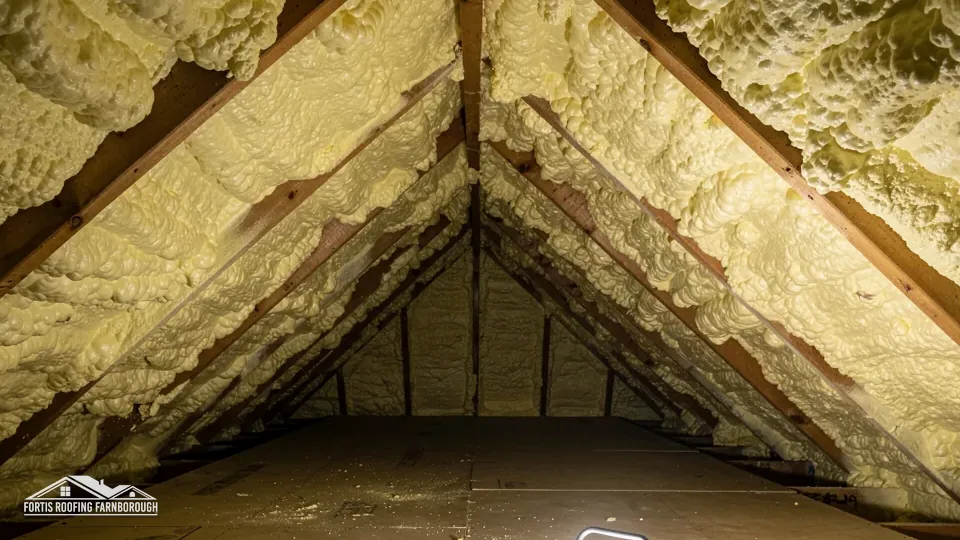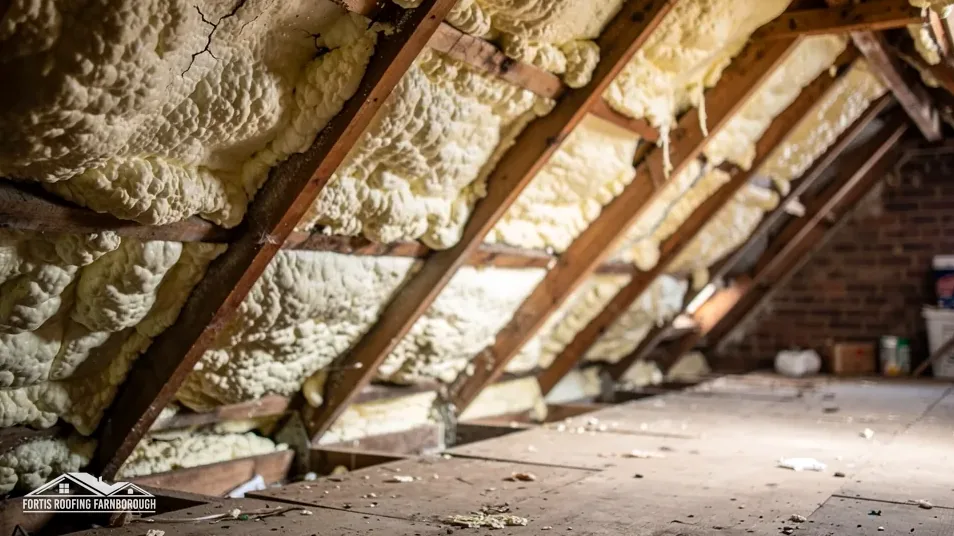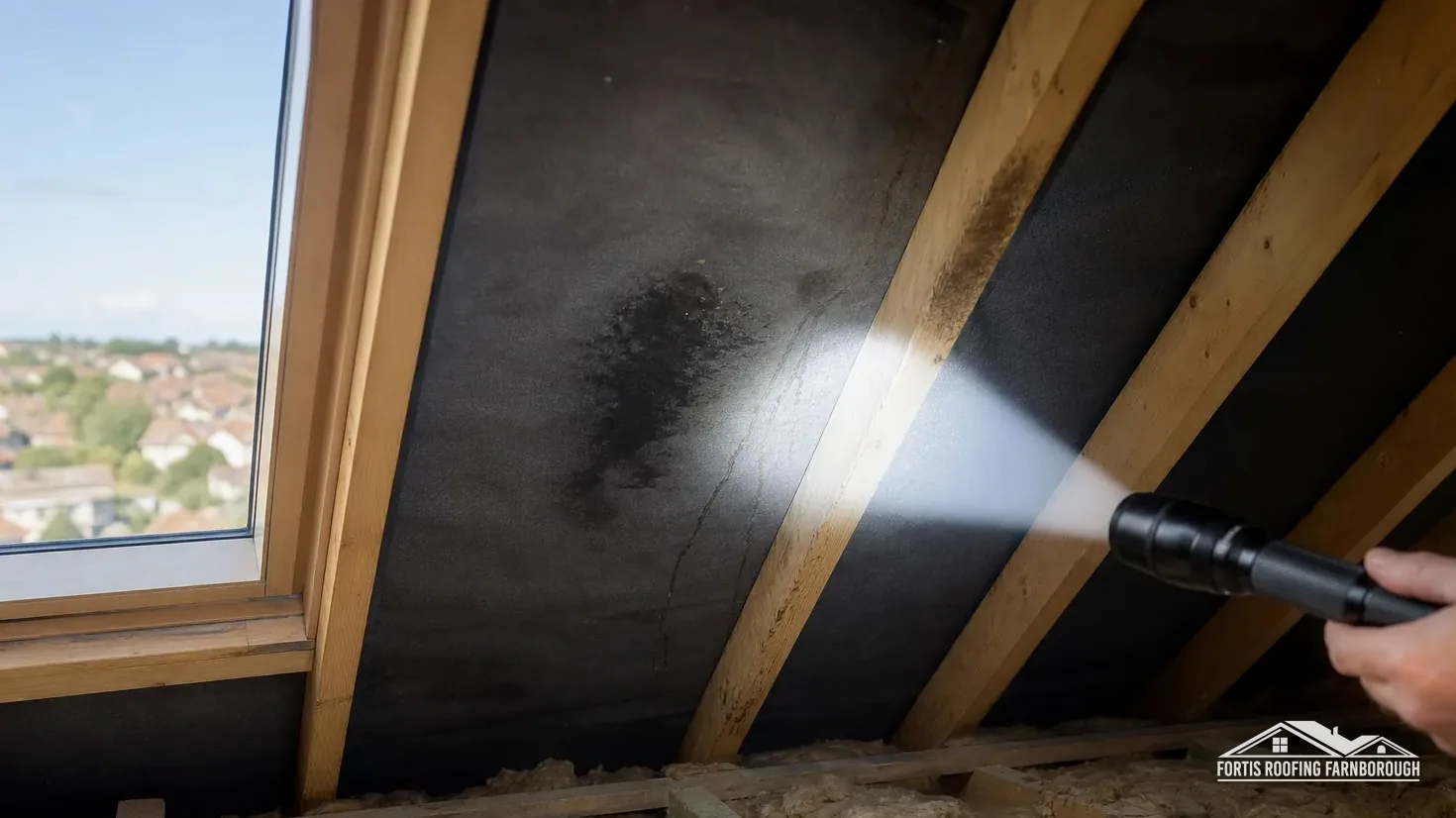
Before deciding to leave, partly remove or fully remove spray foam, you need to know what you have. That is what a survey is for. It identifies the type of foam, measures how much of the roof it covers, checks the roof timbers where they can be reached and looks at the ventilation and the covering. It turns a worry into a set of facts.
The RICS consumer guide to spray foam, issued in March 2023, is the main published source for owners. It cautions that timber under foam escapes full inspection, and it sends owners to their mortgage provider. A survey helps with the first of those points, within the limit the guide itself names.
Below: what a spray foam survey covers, the tools a surveyor uses, what it cannot reveal, what the report contains, who should carry it out, how it fits a sale or remortgage and what to do with the results.
What a survey is for
A survey has a modest aim: to establish facts that an owner, a buyer or a lender can rely on. It does not diagnose every possible fault, and it does not offer guarantees.
Questions it answers
- What type of foam is in the roof, and where?
- How much of the roof does it cover, and how thick is it?
- What can be seen of the timbers, the underlay and the covering?
- Are there signs of moisture, leaks or condensation?
- Is the roof ventilated, and does the foam block it?
- What paperwork exists, and does it match what is there?
Questions it cannot fully answer
The central one is the state of timbers buried under foam. RICS points out that foam over the roof structure stops a full inspection. A survey can sample and infer, and the report says what was assumed.
Who wants one
Owners worried about their roof, buyers whose surveyor flagged foam, sellers preparing for a sale and anyone remortgaging. Each has a slightly different purpose, and the report should be written with that in mind.
A first step
A survey comes before any decision on removal, so that the choice rests on evidence. Our guide to why people are removing spray foam sets out the reasons owners give.
Before the visit
Gather what you can, including the invoice, the data sheet for the product, any earlier surveys and a note of when you first noticed anything odd. Clear the way to the hatch and tell the surveyor about any leaks, stains or smells. The more the surveyor knows in advance, the more useful the visit.
What the surveyor looks at
A thorough survey covers the loft, the roof from outside and the rooms below, and it follows a set sequence.
The foam
The surveyor identifies the type, open-cell or closed-cell, by appearance and by pressing it, and measures the thickness at several points. They note where it is applied, on the underlay, the rafters, the back of the tiles or in the eaves, and whether it is continuous or patchy. Our guide to open-cell against closed-cell spray foam explains the types.
The visible timbers
Wall plates, rafter ends, purlins and any timber that sits outside the foam are examined for rot, beetle and staining. These give an indication of the condition of the rest.
Signs of moisture
Stains on or near the foam, damp or musty smells, rust on fixings and condensation marks are noted. Rooms below are checked for ceiling stains and mould.
Ventilation
The eaves, ridge and any vents are checked to see whether the foam blocks them. The loft hatch is checked for a draught seal.
The covering
From outside, the surveyor looks for slipped or cracked tiles, flashing faults and gutter problems that could be sources of water.
The paperwork
Any installer documents, data sheets and building control records are reviewed and compared with what is there. A mismatch is a finding in itself.
Photographs are taken throughout, with locations noted.
Sequence on the day
The surveyor usually starts outside, to see the covering and the line of the roof, then goes into the loft and finishes in the rooms below. Working that way means that what is seen outside can be matched to what is found inside, and signs on a ceiling can be traced to a place on the roof.
Tools and methods
A surveyor uses a small set of tools to learn as much as possible without damaging the foam or the roof.
Visual inspection and probing
The first tool is a careful look, with a good torch, from every accessible angle. Gentle probing of exposed timber shows whether it is firm or soft.
Moisture meter
A moisture meter reads the dampness of timber, either by pins pressed into the surface or by a sensor held against it. Readings come from many points, the coldest areas and the ground near flashings or valleys included, each logged with date and weather conditions. A pattern means more than one figure.
Thermal imaging
A thermal camera can show temperature differences on the surface, which sometimes point to gaps in insulation, thermal bridges or damp areas. It is a guide and not proof, and interpretation needs experience.
Borescope
A small camera on a flexible probe can be pushed through a small hole to look behind foam or into the eaves. It gives a limited view and leaves a small hole to be made good.
Limited opening-up
With permission, a small section of foam can be cut away at a selected point to expose the timber behind. It gives a direct look at a sample location, and the report states where and why.
What is not done
Surveyors do not strip foam off in bulk as part of a survey. That is removal, and it is a separate job with its own price.
The limits of a survey
A good surveyor is clear about what the survey cannot show. Those limits are part of the value of the report.
Hidden timbers
Most of the structure may be covered. Samples tell you about the points checked and give a basis for inference about the rest. They cannot prove that unseen timbers are sound.
Concealed leaks
A leak above the foam may be invisible from below. Staining may be absent until water has spread. The surveyor looks for signs and says what could be hidden.
Moisture variation
Timber moisture varies with the season and the weather. A reading in a dry spell may be lower than one after weeks of rain. The date and conditions are recorded for that reason.
Interpretation
Instruments give numbers, and judgement turns them into findings. Two surveyors may read the same set differently, and a cautious one may recommend further investigation where another would not.
No guarantees
A survey is a statement about a roof at a moment, not a guarantee of its future condition or of a lender's decision. Lenders are a matter for your own mortgage provider.
Why this matters
A report that overclaims is worse than none. Look for clear statements of what was seen, what was inferred and what was not accessible. Our guide to whether spray foam can damage roof timbers explains the underlying risk.
Recommendations are not orders
The recommendation section is advice. A report that says further investigation is warranted does not oblige you to act, though a buyer or lender may take it seriously. Weigh the advice against your plans, and ask the surveyor to explain the reasoning.
The report you should receive
The outcome of a survey is a written report. A useful one is clear, organised and honest about its limits.
Contents
- The address, date, weather and the surveyor's name and role.
- The foam: type, extent, thickness and method of application, as far as known.
- The condition of visible timbers, with photographs and notes.
- Moisture readings, with locations, dates and an interpretation.
- Observations on ventilation, the covering and signs of leaks.
- A review of the paperwork.
- A clear statement of limits: what was not seen or could not be assessed.
- Recommendations: leave and monitor, investigate further, remove in part or in full.
Plain language
The report should say in ordinary words what the findings mean for you, not leave you to decode jargon. A summary on page one helps.
Photographs
Numbered, labelled and dated, with a simple plan of the roof showing where each was taken.
Using it
Give a copy to your solicitor, buyer or lender as needed. Our guide to what your surveyor needs after spray foam removal covers the follow-on record if you remove the foam.
Independence
A report from someone with no stake in the outcome carries more weight than one from the installer of the foam.
Timing
Surveys take a few hours on site, with a report following. If a sale or remortgage has a deadline, say so at the start. A rushed report is a worse report, and a survey commissioned early leaves room to act on what it finds.
Choosing a surveyor, cost and next steps
The right person and the right brief make a survey worth having.
Who should do it
Someone with experience of roofs and of spray foam, who is independent of any foam installer, and who will state their qualifications and the limits of the work. A chartered surveyor is one route, and a specialist roofing contractor who surveys properly is another. Ask what instruments will be used and what the report will contain.
The brief
Say why you want it: a sale, a remortgage, a worry about damp, or planning removal. State what documents you have. Agree whether limited opening-up is allowed and who makes good.
Cost
MyJobQuote's typical UK average for a roof survey is around £300 (Oct 2026), with table rows of £100 to £200 and £200 to £350. That is for a general roof survey, and a spray foam survey with moisture readings and a written report may take longer. Ask for a written price before you commit.
Our approach
The price is one written total with VAT shown, and the report comes with photographs and a plain-language summary. Our spray foam removal service starts with this survey, and the result tells you whether to leave, monitor or remove.
After the survey
Decide on the evidence. If the timbers look sound and your lender is content, you may do nothing. If they raise concerns, the next step is investigation or removal.