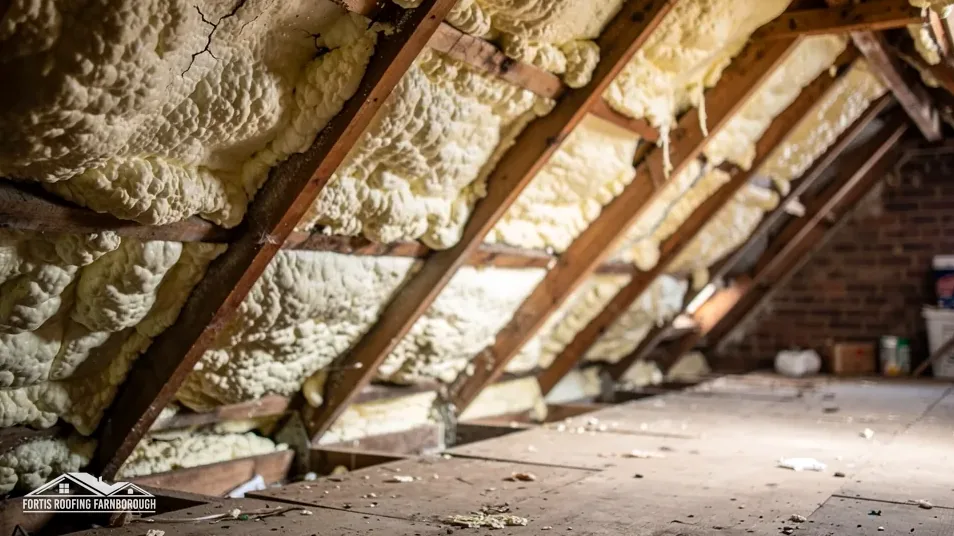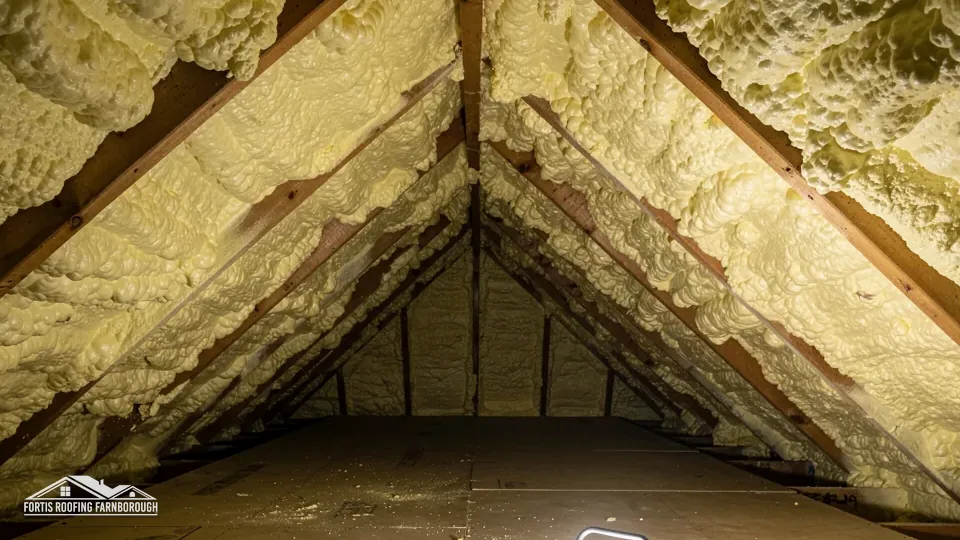
Anyone looking for a price on spray foam removal soon finds that there is no neat figure to quote. The reason is that the job is not one job. Foam sprayed thinly on the underlay of a roomy loft is a different task from foam sprayed thick across rafters and battens in a low roof with a tight hatch. The work, the time, the waste and the risk are different, and so is the price.
What can be said is what moves the price, in what direction and why. That gives an owner a way to read a quote, to see why two quotes differ and to ask the right questions. It also protects against the two usual traps: a low price that leaves out the awkward parts, and a vague price that grows once the work starts.
This guide sets out the factors that decide the cost, what a complete quote should cover, how re-insulation and repairs fit in, how VAT and grants apply, what to ask and how the written price is fixed, for homes in Farnborough, Aldershot, Fleet and the surrounding villages.
What drives a removal quote
A handful of factors set the time and equipment a job needs. Each changes the total, and they stack up.
Area and thickness
More foam takes more time to remove, whether it is a large roof or a thick layer. Depth matters because each layer has to be cut, scraped or ground away, and the waste grows with volume.
Type of foam
Open-cell foam is softer and can be cut and scraped more easily, and closed-cell foam is harder and bonds more firmly. Our guide to open-cell against closed-cell spray foam explains the difference. Hard foam takes longer.
How it was applied
Foam sprayed to the underlay, to the rafters, to the back of the tiles or into the eaves differs in how hard it is to reach and to free. Foam that has run into corners and gaps is slower to clear than a clean, even coat.
Access
A low roof, a small hatch, a cramped eaves space or a dormer makes the work slower and harder on the operatives. Moving equipment and waste through a small hatch takes time.
Condition of the roof beneath
Once the foam is out, timbers, underlay and tiles are exposed. Rot, damp, damaged underlay and cracked tiles add repair work, and the extent cannot be known until the foam is gone.
Waste and disposal route
Removed foam has to be bagged and carried out, and taken to a suitable disposal route. A large volume adds trips and cost.
Protection of the house
Foam removal makes dust and fragments, so the loft hatch, landing and any rooms below are protected, and belongings are taken out of the loft beforehand. Setting up and taking down that protection is time you pay for within the total.
Why a survey comes first
A price from a photograph or a phone call is a guess. A survey replaces the guess with measurements and observations, and it is the basis for a single written price.
What the survey looks at
- The extent of the foam: which parts of the roof and how much.
- The thickness and the type, as far as can be told.
- The access: hatch size, headroom, floor boarding and eaves space.
- The visible condition of timbers, underlay and tiles.
- Signs of leaks, damp or staining.
- The state of ventilation and any installer paperwork.
Limits of a survey
A survey sees only what is exposed. RICS points out that a roof structure sprayed with foam cannot be seen in full, so some findings wait until the foam is off. A good surveyor says which parts are assumed and which are known, and what could change the price. Our guide to spray foam surveys explains what is checked.
Photographs and record
Photographs and notes from the survey are part of the evidence behind the price. They show what the contractor saw and what was assumed, and they help if a dispute arises.
What you get
A written view of the job, with the price as one total after the survey, stated with VAT. The scaffold or access equipment the work needs, the waste route and the finishing are covered within it.
If the survey cannot see something relevant, it says so, and says how a change will be handled.
What a complete quote covers
Quotes for spray foam removal vary in what they include, and the gaps are where disputes arise. A complete quote answers these questions.
The work
- Which areas of foam are being removed, and how much of each?
- What method is used, and what protection goes in the house?
- How clean is the finish on the timbers, and what residue is acceptable?
Waste
- How is removed foam bagged, carried out and disposed of?
- Is the disposal in the price?
Inspection and reporting
- Will the exposed timbers be inspected and photographed?
- Will you receive a written report?
- Will moisture readings be taken?
Repairs
- What happens if rot or damage is found?
- Is there an agreed route for pricing extra work, and a promise that nothing is added without your agreement?
Re-insulation
- Is re-insulation inside the quote, or left to a later stage you arrange?
- What U-value will it achieve, and how will ventilation be handled?
Terms
- VAT shown and the rate.
- Payment stages, not a large deposit up front.
- Your right to cancel if you sign at your own address.
If a quote does not answer these, ask. A contractor who can reply clearly has thought it through.
Method and equipment
The quote should say how the foam will be taken off, whether by hand tools, powered tools or both, and how dust will be controlled. A method suited to the foam and the timbers saves them from scarring, and the cleanest finish costs more time than a quick scrape.
Timescale
The programme depends on the volume of foam and the number of operatives. Ask for the working days, what happens on each and when the loft will be usable again. A vague programme is a warning sign.
Repairs and re-insulation: the costs that follow
Removal rarely ends the project. The work that comes after depends on what the roof shows, and it can be as large as the removal.
Repairs
Rotten timbers are cut out and replaced, perished underlay is renewed, damaged tiles are replaced and flashings are reset. Some of this can be anticipated, and some is only found with the foam off. The quote sets out how such work will be agreed and priced.
Repair or re-roof
If the evidence shows the roof is failing widely, a re-roof may be the better value than a long list of repairs. Our guide to repairing or re-roofing after spray foam removal explains how the decision is made. Published costs for context: Which? gives £7,000 to £21,000 ex VAT for a full roof on a three-bedroom house (Nov 2025), and MyJobQuote lists an average repair at about £650 in 2026 (Oct 2026). Those are typical UK ranges and are not prices for spray foam work.
Re-insulation
Putting insulation back is usually part of the project. It must meet Part L if it counts as renovation, with Table 4.3 setting 0.35 W/(m²·K) as the threshold and 0.16 as the improved figure, and a payback relaxation in paragraph 4.13. The roof also needs ventilation matched to its underlay.
Why keep it together
Doing removal, repair and re-insulation as one plan means one scaffold or access set-up, one visit sequence and one price. Split between contractors, it risks gaps and overlaps.
VAT, grants and funding
Money-saving routes exist, though they apply narrowly, and it pays to check the detail.
VAT
The standard rate is 20%. Energy-saving materials installed between 1 May 2023 and 31 March 2027 are zero-rated under HMRC Notice 708/6, and from 1 April 2027 the reduced rate of 5% applies. Re-insulation with qualifying materials may fall within that. The removal of foam and general roof repairs are not covered by a reduced rate, so do not assume a quote can be reduced to 5%. Check how any quote treats VAT.
Grants
No national grant exists for a new roof, although insulation schemes do exist and change. ECO4 runs to 31 December 2026, GBIS closed on 31 March 2026, and Warm Homes: Local Grant, aimed at households on £36,000 a year or less, covers insulation. Whether any applies to re-insulating after foam removal depends on the scheme rules and your circumstances. Check the current terms before relying on one, and never assume eligibility.
Insurance
Insurance does not generally pay to remove foam that was installed deliberately. Check your policy and the installer's warranty. If the foam installer is still trading, ask whether a claim or remedy is available under their terms.
Mortgage lenders
On lending, RICS directs owners to their own mortgage provider, and the answer may shape whether removal is needed. Our guide to selling a house with spray foam covers the sale side.
Comparing quotes and keeping control of the price
Because the job is hard to price, quotes can differ widely. A few habits help you compare fairly and keep the final bill in line.
Same brief for everyone
Where possible, arrange the surveys close together, so each contractor sees the loft in the same state, and keep a note of what each was told.
Give every contractor the same loft and the same information, and ask each to survey in person. Citizens Advice advises collecting at least 3 written quotes.
Read what is included
The lowest quote may leave out waste disposal, inspection, repairs or re-insulation. Match the contents before comparing the totals.
Watch the extras
A fixed price that excludes everything unexpected is not fixed. Ask how extras are handled and insist that nothing is added without your agreement and a clear explanation.
Staged payments
Pay by stage, not all in advance, and be wary of large deposits. If you sign at your own address after a survey, the usual 14-day cancellation right applies.
Our approach
What we give is one written figure after the survey, VAT shown, with a specification of what is and is not included. Should removal turn up more than could be seen, photographs and options reach you before anything extra is added.
For consumer advice
The Citizens Advice consumer helpline is 0808 223 1133. Our spray foam removal service begins with the survey.