The short answer
Slates crack for a few common reasons: weight from a foot or a ladder, impact from a branch or a dropped tool, water freezing in an existing flaw, movement in a roof that has settled, and poor-quality slate that was weak from the start. A single crack is a simple repair, but a pattern of cracks points to a cause that needs finding.
Weight, impact and foot traffic
Slate is hard but brittle. It resists weather well, yet it snaps under a point load, and the commonest source of damage is a person. Someone stepping across a slate roof to reach a chimney, clear a gutter or fit an aerial loads thin stone that is supported only at head and tail. Cracks run across the slate just below the course above, where it spans between supports.
Ladders cause a similar pattern. A ladder leant on the eaves or the lowest slates, or the foot of a roof ladder, can fracture slates under it, and the cracks may not be visible from the ground. Tradesmen who work at the roof without a platform can leave a trail of damage behind them.
Falling objects are the other cause. A branch in a gale, a dropped tool, a satellite dish fixing or a thrown ball can crack a slate cleanly across. A star-shaped crack or a chip with fresh, pale edges suggests a recent impact.
The lesson is to keep people off a slate roof. A roofer who has to work on one spreads the load with a roof ladder or boards, or works from scaffold. Our answer on a slate roof survey explains how we inspect without walking over fragile slates.
Frost and weathering
The smallest flaw is enough. Water enters a hairline crack or a layer joint in the slate, and when the temperature falls below freezing it expands as it turns to ice. That pushes the crack wider. The next thaw lets more water in, and repeated cycles open the flaw until the slate splits.
Met Office averages for South Farnborough from 1991 to 2020 show around 53 air-frost days a year, so freeze and thaw cycles are a normal part of the climate here. That is context, not a prediction for any one winter. Sound slate is little troubled by frost, and the effect is greatest on slates that already have a flaw.
Slate with poor quality layers shows the problem earlier. A slate that is thin, laminated or taken from a weaker vein can flake and split with age, which is a different failure from a clean impact crack. Our answer on slate delamination describes it.
Moss and lichen play a part by holding moisture against the surface. They do not crack sound slate, but a mat of moss on a flawed one keeps water in the crack. Cleaning has to be gentle: Marley does not recommend jet washing, which can harm the surface and cut the slate's expected life.
Movement and fixings
A slate can crack because the roof under it moves. Rafters that have sagged, battens that have shrunk or rotted, and walls that have settled all change the line of the roof, and slates laid flat on the old shape are stressed as it shifts. Cracks then run in a pattern along the line of the movement, not at random.
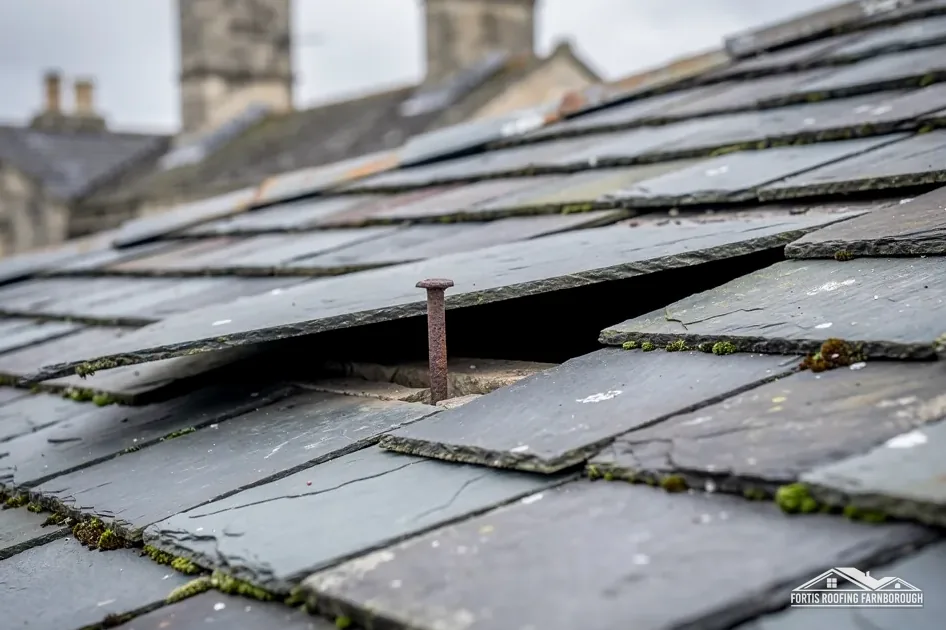
Fixings matter. A nail driven too hard can crack a slate at the hole, and one driven at an angle can lever the slate. A slate that is held too tightly cannot move with temperature and cracks as it expands and contracts. Slates fixed with iron nails that have rusted can slip, bang against their neighbours and chip.
The roof's pitch also affects loads. Natural slate, per BS 5534 as reported by Cupa, has a minimum pitch of 20 degrees, and a roof below that is more likely to let water back up under the slates. A leak into the timbers then adds rot to the list of causes.
When cracks appear in several places, or on one slope only, look at the structure. A roofer should check the battens and rafters from the loft before replacing slates, because replacing slates on a moving roof only repeats the damage.
Replacing a cracked slate
A single cracked slate is a simple repair. The broken slate is released by cutting the nails with a slate ripper, and a new or reclaimed slate matching it in size and thickness goes in. The course above hides the nail line of the replacement, so a tingle or a hook supports it. Our answer on the slate tingle explains the fixing.
The match matters. Welsh and Spanish slate differ in colour and weathering, and a new slate among old ones stands out for a while. A reclaimed slate often blends in better. HomeBuilding (Sep 2025) lists reclaimed Welsh slate at "50-80 years" typically, which is a useful second life.
Waiting has a cost. A cracked slate lets water reach the battens and underlay, and a small leak that runs for months can rot timber and stain ceilings. If a slate has cracked and rain is getting in, a temporary fix such as a tingle or sealed patch can hold until the permanent repair.
At the survey the cracked slate, its neighbours and the loft side are photographed while the cause is traced. The evidence reaches you with a plain account and a single written total, and any sign of a wider fault is reported. See slate roofing for the full service.