The short answer
Delamination is when a slate splits along its natural layers and flakes or peels apart. It is caused by weaknesses in the stone, by water and frost working into the layers, and by age. A delaminating slate cannot be repaired, so it is replaced, and widespread delamination means the covering is close to worn out.
What delamination is and why it happens
Slate is a metamorphic rock that formed under pressure, and its grain runs in flat planes. That is what lets it be split into thin sheets for roofing. The same planes are its weakness: if water gets between them, the slate can part along them as thin flakes or slivers, usually starting at the exposed lower edge.
Several things drive it. Quality is the first. Slate varies by quarry and by vein, and some contain weaker layers, bands of softer material or tiny mineral flaws, so a poor slate delaminates early while a good one lasts for a century. That is why the source of the slate and its product data matter.
Water and frost are the second. Water enters the layers through the edges and nail holes, freezes and expands, and pushes the layers apart. Each freeze and thaw widens the gap. Moisture also reacts with minerals in some slate, producing rust-coloured staining or a powdery surface.
Age is the third. Even good slate wears, and HomeBuilding (Sep 2025) gives typical lives of "100+ years" for Welsh slate and "75-100 years" for Spanish natural slate. Those are typical ranges, and a slate near the end of its range will show it first at the edges.
Signs to look for
From the pavement, delamination shows as a rough, flaky surface, with slates that look dark and patchy or have pale edges where layers have peeled. Fragments of slate, thin as wafers, collect in gutters or on the ground below, and a roof that sheds flakes after each frost is delaminating.
Close up, the edges of the slate look layered, like the pages of a book. The surface may be soft and powdery, and it can be scratched with a fingernail. A slate that has delaminated sounds dull when tapped, where a sound slate rings. Slates may also bow or lift at the corners as the layers separate.
Inside the loft, daylight at the laps, fragments on the battens and damp marks below all count as evidence. A roof with delaminating slates soon lets water in, because each failed slate thins and leaves a gap.
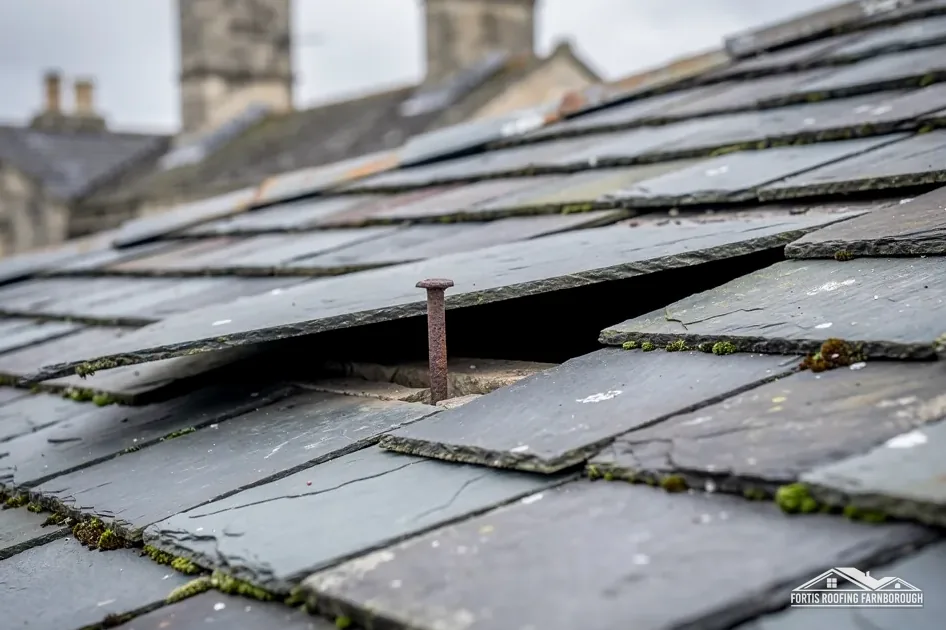
Do not confuse delamination with other faults. A crack from an impact is a clean break across the slate, as our answer on cracked slates explains. A slate that has slipped from a rusted nail is intact but loose, which is nail sickness. A stain from lichen or moss is surface growth. Each has a different cause and fix.
We photograph each type at the survey so the diagnosis is clear.
Why a delaminating slate is replaced
There is no way to mend a slate that has parted along its layers. Glue and sealant do not hold the flakes for long, and the structure that gave the slate its strength is gone. The only fix is to take it out and fit another, as our answer on the slate tingle describes for a single replacement.
The question is how many. A scattering of delaminated slates among healthy ones is a repair job, using reclaimed or new slates of matching size and thickness. Where the slates round them are also weakening, the repair chases a spreading fault, and each lift of an old slate risks breaking its neighbour.
When delamination is widespread, the better route is to re-slate. The roof is stripped, new battens, underlay and fixings are laid, and any slates that pass the sort go back with replacements for the rest. If most of the slates fail the sort, a new covering is the sensible route.
Whatever the route, do not let cleaning or pressure make it worse. Marley does not recommend jet washing, which can damage slate surfaces, and a delaminating slate is the last candidate for it.
Our answer on reusing roof slates explains the sorting.
Testing the roof and planning the work
The survey answers how far the fault has spread. Each slope is photographed from below and, with safe access, a sample is lifted of slates from several places, including the exposed and the sheltered sides. We check the faces and edges, tap for soundness and look at the nails and battens. A sample from one slope does not describe the rest, so we take it from each.
From that, we can advise whether the roof needs a handful of replacements, a re-slate of a slope, or a new covering. If new slate is being chosen, the quarry source matters, and a supplier's data on quality and test results is worth asking for.
Matching and approvals apply as usual. Heritage settings may restrict the choice of slate, so ask the council where a house is listed or in a conservation area. On approvals, the Planning Portal gives a two-part test of 25 per cent of the building envelope and 50 per cent of the roof, and a heavier covering needs a structural check.
You see the photographs, the sample results and a plain account of the options. The route you choose is priced as one written total. See slate roofing for the rest of the service.