The short answer
Yes, if they are sound. Slates are lifted by hand and checked one by one, then the good ones are graded by size and thickness and relaid over fresh battens and membrane. Some always break or fail the sort, so the shortfall is made up from reclaimed slates of the same type. Slates that are flaking, soft or splitting are discarded.
Sorting and grading by hand
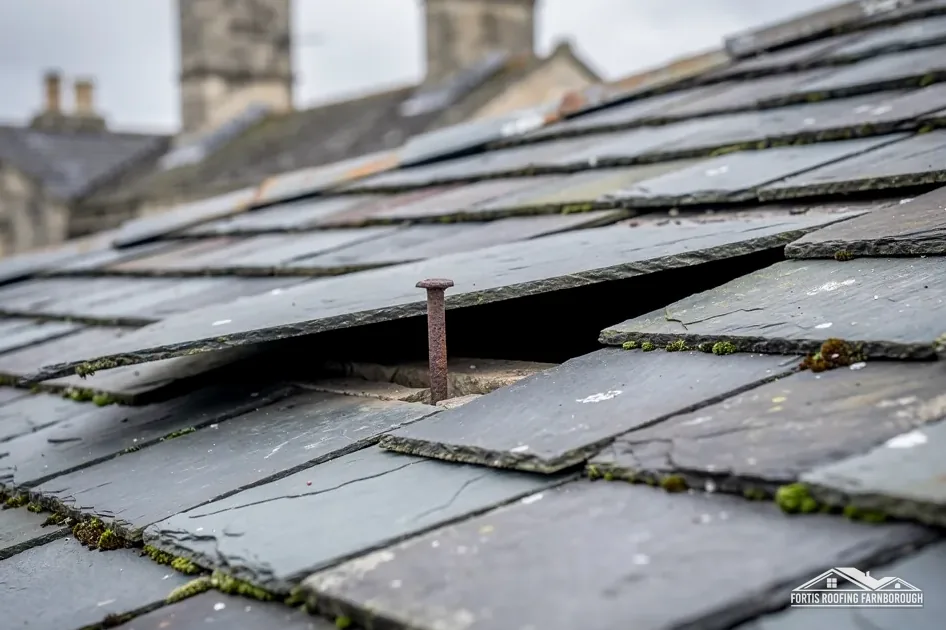
Each slate is nailed to a batten, and the nails must be cut before it can come away. A slater slides a slate ripper under the course, hooks the nail and cuts it, then lifts the slate away. Done carefully, most slates come off whole, but old fixings and a stuck-on layer of moss make it slow work.
Once down, every slate is looked at. A sound slate rings when tapped, has a clean, even surface and a straight edge, and holds its nail holes. A dull sound means a hidden crack. A slate that is flaking in layers, called delamination, or has gone soft and powdery at the edges has nothing left to give. A slate with enlarged nail holes or a broken head will not hold a fixing.
Sound slates are then graded. Natural slates vary in size and thickness even within a batch, and a roof is laid in courses of reducing length from eaves to ridge. The slater sorts them into piles by length and width, with the largest at the eaves and the smallest at the top, so the roof lays flat and each lap is right.
Our answer on slate roof surveys explains what we look for before a strip begins.
Breakage and what to allow for
Some loss is certain. Slates split when they are lifted, when the nails are cut, or when they are carried and stacked. Old slates are more brittle than new ones, and ones that have been repaired before, with tingles or hooks, can break at the old fixing point. The roof may also have broken slates already, which are counted as gaps.
A fair allowance is set from a sample. We lift a handful of slates from different parts of the roof at the survey, check them and judge how the rest are likely to behave. We then expect to reuse the sound ones and make up the difference. We cannot name a figure before the strip, since the real count comes only when the slates are on the ground.
Nail sickness is the other factor. Where the original iron nails have rusted through, slates have slipped, and the roof may look worse than the slates deserve. Slates freed from rusted nails are often reusable, and the fix is new, longer-lasting fixings.
The sorted stock is shown to you on the day, with photographs. You can see how many slates are good, how many are rejected, and how many will be needed to complete the roof.
Making up the numbers with reclaimed slate
The shortfall is made up with other slates. The first choice is reclaimed slate of the same type, thickness and colour, taken from another roof. It weathers the same way as yours and blends in. On an old roof, the best place for the replacements is on the less visible slopes, with the original slates kept for the front.
New slate is the second option. Natural slate from quarries in Wales, Spain and elsewhere can match closely in size, but not always in colour or weathering, and a new slate on an old roof stands out for some years. Fibre-cement slate is a different material, and our guide to natural and fibre-cement slate sets out the differences.
HomeBuilding (Sep 2025) lists these typical lives for supply-only slate: Welsh slate "100+ years", Spanish natural slate "75-100 years", and reclaimed Welsh slate "50-80 years". A reclaimed slate arrives having used up part of its life, and these ranges are typical, never promised.
Matching is covered more fully in our answer on matching slates. In a conservation area or on a listed building, a council may expect a close match or the original slate, so put the question to planning first.
When re-using is the wrong call
Reuse suits a roof whose slates are in good shape but whose battens, underlay or fixings have failed. It does not suit a roof whose slates are delaminating, because there is little worth putting back. If the sort rejects a large share of the slates, the cost of reclaimed or new slate, plus the labour, may favour a fresh covering.
Weight is a check. Per the Planning Portal, a covering 15 per cent or more heavier calls for approval and an engineer's look, so swapping slate for a heavier material is not casual. Reusing slate avoids that question.
The roof's pitch matters too. BS 5534 indicates a minimum pitch of 20 degrees for natural slate, according to Cupa, so a low roof may need a different fixing method. Our slate roofing page covers the wider service.
We give you the evidence before you choose: photographs of the slates, the sorted stock and an honest view of what is left in them. Whichever route you pick is priced as one written total. Where reuse wins, you will hear that, and where it does not, you will hear why.