The short answer
A repair slate has to match its neighbours in size, thickness, origin and colour. Size and thickness are matters of fit, because a wrong slate lets rain in. Colour is a matter of appearance, and new slate among weathered slate stands out. Reclaimed slate often blends best, and a worn slope is sometimes better re-slated than patched.
Size and thickness decide the fit
Slates are made in a range of sizes, named by length and width, and a roof is laid with a specific size or a graded set. A replacement slate that is shorter than its neighbours reduces the headlap, the amount each course overlaps the one beneath, and a smaller headlap lets rain driven by wind work its way in. A slate that is too wide leaves gaps at the side joints.
Thickness matters as much. An over-thick slate lifts the course above it and opens a path for gusts, while an over-thin one may crack beneath the slates above or under a footstep. Hand-split old slates vary, and an even thickness across the roof is itself a mark of a more modern product.
The pitch of the roof sets minimum headlaps, and the data sheet or the slater's guide for the slate gives them. BS 5534 indicates that the minimum pitch for natural slate is 20 degrees, according to Cupa, and a lower pitch changes the design altogether.
We measure before we choose. At the survey we measure the length, width and thickness of the existing slates, count the courses and note whether the roof uses graded sizes. Our answer on slate headlap explains how the overlap works.
Colour and origin
Slate is a natural stone, so no two quarries produce quite the same one. Welsh slate runs from blue-grey to purple and green, Spanish slate is often a flatter grey-black, and each ages differently. A new slate looks darker and more uniform than weathered ones, and the contrast fades slowly over years.
Origin matters for more than looks. Different slates absorb water differently, and they can weather at different rates. HomeBuilding (Sep 2025) lists Welsh slate at "100+ years" and Spanish natural slate at "75-100 years" typically, so the two are not interchangeable in the long run. The two are compared in our slate guides.
Fibre cement and artificial slates are a different material again. They imitate natural slate at lower cost, but they differ in colour change, surface and life, and a patch of them on a natural slate roof is conspicuous.
Where the roof is old, matching is a hand job. A slater picks colours from the stock to blend with each course, and places the best matches in the most visible spots. A repair is easiest where the roof has a spread of tones, because a slightly different slate hides in the variation.
If the roof is in a conservation area or listed, the council may set the standard for the match.
Reclaimed slate and where to put the new
Reclaimed slate is the best way to match an old roof. It comes from another building, is already weathered, and has the same character. A good supplier can offer slates of a given origin and size, and reclaimed Welsh slate is listed by HomeBuilding (Sep 2025) at a typical "50-80 years", which is a worthwhile second life.
Availability limits it. The size or colour wanted may not be in stock, and old slates sold on may have chips or nail holes that make them unsuitable. A good reclaimed slate costs more than its age suggests, because sorting and handling are labour.
Where only new slate will do, the position is the craft. Replacements go on the least visible slope, such as the rear or a side not seen from the road, with the best original slates moved to the front. On a roof with only one visible slope, new slates can be spread through the course, so no single patch stands out.
Sound slates sometimes come from another part of the same roof. Taking them from a hidden slope and filling that slope with new slate is a common trick. Our answer on reusing roof slates explains the sort.
When re-slating the slope is the better buy
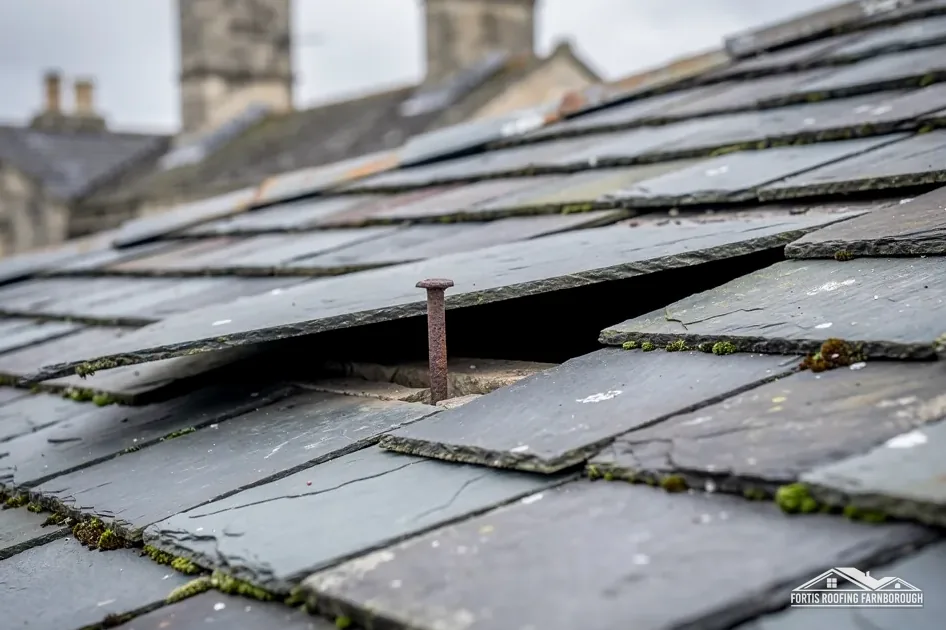
A repair is a patch, and patches have limits. If many slates need replacing, the roof is a mosaic of old and new that looks poor and still has failing fixings holding the old ones. Rotten battens, or nails rusting right across the slope, mean repairs chase a fault that keeps spreading.
Re-slating the whole slope with sound slates and new fixings is then the better investment. The slope is stripped, new battens and underlay are fitted, the best slates are re-laid, and reclaimed or new slate fills the gaps. The finished slope is even in look and sound underneath. Our guide to re-slating a roof covers the process.
For approvals, the Planning Portal gives a two-part test of 25 per cent of the building envelope and 50 per cent of the roof. Separately, a covering 15 per cent or more heavier calls for Building Regulations approval and a structural check, so matching with a heavier slate needs thought.
You see the photographs of the roof, the measured sizes and a plain view of repair against re-slating. Each route comes as a single written total. See slate roofing for the wider service.