The short answer
HomeBuilding (Sep 2025) lists fibre cement at a typical 30-40 years, well below natural slate. Treat it as a typical service range, never a promise. Ageing shows as moss, surface erosion, curling edges and cracks. Fibre cement laid before 2000 may contain asbestos, so a roof that old is checked before anything is cut or broken.
What the published range says
Fibre cement slates are manufactured from cement reinforced with fibres, pressed into thin sheets and cut to size. They are lighter and cheaper than natural slate, and they imitate its look. In HomeBuilding & Renovating's materials table of 30 September 2025, fibre cement (Eternit) tiles carry a typical life of "30-40 years".
That sits far below natural slate. The same table gives Welsh slate "100+ years", Spanish natural slate "75-100 years" and reclaimed Welsh slate "50-80 years". Clay tile comes in at "60-80 years" and plain concrete at "40-50 years". Treat each figure as a typical service range, with no warranty implied for any given roof.
Real roofs vary. Exposure to rain and frost, the pitch, the ventilation beneath, the quality of the original product and the standard of fixing all change how long a covering lasts. A roof kept clean and maintained may outlast the range, and one laid on a poor base may fall short.
The figure helps with planning. A fibre cement roof now 25 years old is short of its published range, and one at 35 is in the zone where decisions about repair or replacement come due. Our answer on natural and fibre-cement slate compares the two materials in more detail.
Signs that a fibre cement roof is ageing
Weathering leaves marks you can see from the ground. Moss and lichen build up, particularly on the shaded side, and they hold water against the surface. The surface becomes rough, darker or patchy as the finish erodes. Colour fades, and streaks run below ridge and flashings where water has carried dirt.
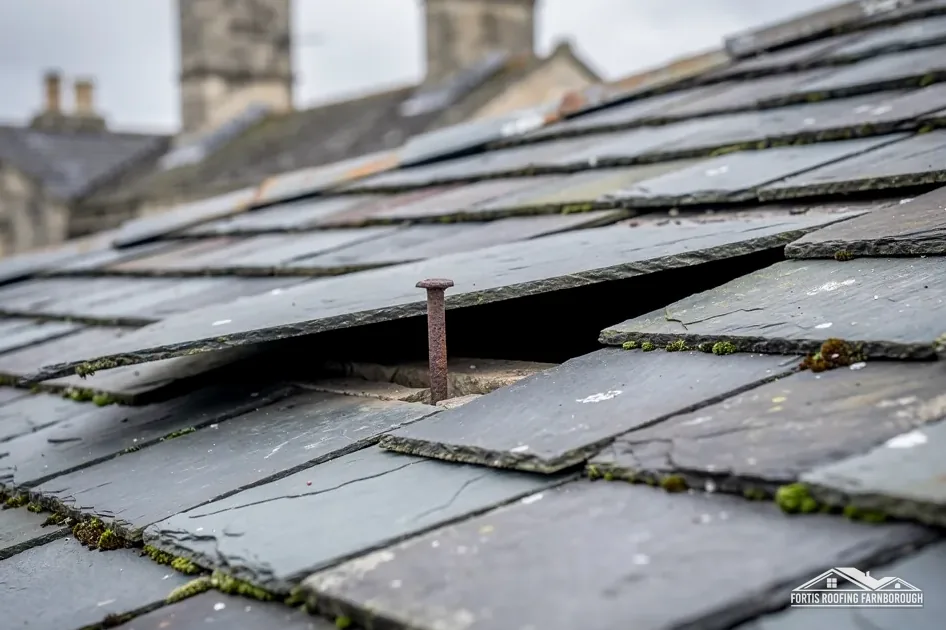
Closer in, the slates themselves show wear. Edges chip and crumble, corners snap, and slates curl or warp. Cracks appear across the slate, often near the fixing. Slates may slip because the fixings have corroded or the slate has weakened around the hole, leaving gaps through which rain can reach the battens.
Inside the loft, look for daylight at the laps, damp patches on the underside, staining on the timber and, in an older roof, no underlay or a torn one. A roof with several of these signs has reached the stage where repair is a short-term answer.
Moss removal needs care. Marley advises against jets on slate or tile, and on weakened fibre cement they can do real harm. A soft brush and gentle methods are safer.
Our answer on moss on a slate roof covers the cleaning question.
Asbestos in older fibre cement
Age brings a safety question. Fibre cement made before 2000 can contain asbestos. Before 2000, asbestos was in use, and HSE advises assuming it is present in a building built or refurbished then. It also calls asbestos cement roofing always fragile. A roof of that age should not be broken, drilled, scrubbed or walked on until a competent person has identified the material.
The rules depend on the work. Under HSE guidance, asbestos cement lifted off with care and kept whole is non-licensed work, while substantial breakage turns it into notifiable non-licensed work. Waste goes in double wrapping with a label and a consignment note, and asbestos sits outside the household exemption.
If your fibre cement roof dates from before 2000, or you do not know its age, tell us at the first call. A sample can be tested, and the survey is done without disturbing the slates. If asbestos is present, the route for the repair or replacement is settled before work starts.
Newer fibre cement slates are made without asbestos, and the maker's literature for the product will say so. When in doubt, treat the roof as suspect and ask.
Our answer on slate roofing sets out the other covering options.
When ageing tips the balance
A few broken or slipped slates on an otherwise sound roof are a repair. The slates are matched, replaced and secured with a fixing suited to the roof. The difficulty is that fibre cement slates are no longer made in the sizes or colours of older products, so a match is not always available, and a patched roof can look mottled.
When ageing is widespread, repairs stop paying. Cracking across many slates, brittle edges, failing fixings and rotting battens beneath all point to re-covering the roof. The covering can then be natural slate, a new fibre cement slate where it is suitable, or another material, subject to weight and pitch.
Weight is a check. Where a new covering is 15 per cent or more heavier, the Planning Portal brings in Building Regulations approval and a structural check. Replacing fibre cement with natural slate adds weight, so the rafters are looked at first.
The decision belongs with the evidence. At the survey we photograph the slates, the fixings and the loft side, and explain what we found. Whichever route you pick comes as one written total, and where a repair will give good years yet, you will hear that first.