Slate has a reputation as an expensive covering, and the published figures bear it out in the upfront price. They also point to something less often said: the slate itself is only part of the bill, and the type of slate chosen can move the total by thousands. A Spanish slate and a Welsh slate look alike from the road and sit at opposite ends of the supply-price table.
The sources used here are national guides, and each describes a particular job. MyJobQuote gives an average for fitting a slate roof. HomeBuilding & Renovating lists slate supply-only prices by the square metre, plus a whole-roof range for a defined house. Which? gives a range for a whole roof on a three-bed house, in any covering. None is a Fortis price, and none is a price for your roof.
Below: each figure with its date, how slate type changes the sum, what drives the rest of the cost, where reclaimed slate and repairs fit, whole-life cost and what a written quote should contain, for slate roofs around Farnborough.
The published figures, with dates
Four figures carry most of the weight. They are not like for like, and each needs its description beside it.
| Source | What it describes | Figure |
|---|---|---|
| MyJobQuote (Oct 2026) | Typical average for a fitted slate roof | around £7,800 |
| HomeBuilding (Sep 2025) | Welsh slate on a 65 m² three-bed semi | might reach £18,000 |
| HomeBuilding (Sep 2025) | Plain concrete tiles on the same semi | between £10,000 and £15,000 |
| Which? (Nov 2025) | Three-bed house re-roofed in any covering | £7,000 to £21,000, ex VAT |
What the pattern shows
The MyJobQuote average sits near the bottom of the Which? range. The HomeBuilding figure for Welsh slate sits above its own concrete range by a few thousand pounds, which is the premium for the material on that house. The figures agree on the direction: slate costs more.
Why they do not line up exactly
Each source describes a different job. HomeBuilding's range includes labour, scaffolding and insulation on a defined house. Which? surveyed Trusted Traders and states its prices exclude VAT. MyJobQuote's number is a platform average, with no statement of whether VAT is included.
Slate is not the whole story
A quoted price for a slate roof can swing widely on one decision alone: whether the slate is Welsh, Spanish or reclaimed. The same house, laid by the same crew, can come in thousands apart. That is why a quote that names only slate, without type and origin, is hard to rely on, and why the specification should be read as carefully as the total.
Using the figures
Treat them as a range to check a quote against, and expect your own roof to sit above or below depending on its size, shape and condition.
How the type of slate moves the sum
The slate itself is a clear lever on cost. HomeBuilding's supply-only prices per square metre show its range.
| Slate | Supply price per m² | Typical life |
|---|---|---|
| Spanish natural slate | £72 | 75 to 100 years |
| Reclaimed Welsh slate | £90 | 50 to 80 years |
| Welsh slate | £185 | 100+ years |
Allowing for waste
Slate is cut to fit at edges, valleys and hips, and some slates break in handling, so more is ordered than the plan area suggests. The allowance depends on the roof's shape and the slate, and a roof with many cuts needs more. A supplier or roofer will give a figure for your roof, and it is one reason a quote cannot be read straight off a price per square metre.
A worked comparison
HomeBuilding's example house has about 65 m² of roof. At those supply prices, new Welsh slate costs about two and a half times as much to buy as Spanish, and reclaimed Welsh sits between them. These rates are for the slate alone, not a quote, and a real roof needs more material than its plan area because of laps and wastage.
Reading it sensibly
The gap between Spanish and Welsh is large, and so is the gap in expected life. Our guide to Welsh against Spanish slate sets out the comparison. Reclaimed slate sits between on price and below both on life, and our guide to reclaimed roof slates explains the trade-off.
Where the money goes beyond slate
Labour, underlay, battens, fixings, lead, scaffolding and waste make up the remainder, and each has its own cost. Slate is heavy and slow to lay, and the skill involved is part of the cost.
What drives the rest of the cost
Beyond the slate, a handful of factors move the figure on a real house.
Roof size and shape
Area is the main driver, and complexity comes next. A plain gable is faster than a roof with hips, valleys, dormers and a chimney, because each junction needs cutting and lead.
Pitch and access
Steep roofs and tall houses need more scaffold and slower, more careful work. Where scaffolding occupies public highway, the Highways Act 1980 requires the highway authority's licence, and that goes into the price.
What is under the old covering
Rotten battens, failed rafters and old underlay that has to go all add work. The survey allows for whatever is visible, and anything found when the roof is opened is explained to you before it is added.
Lead and detail
Valleys, flashings, soakers and chimney work in lead add materials and labour. Lead flashing can last for over 80 years, according to MyJobQuote, so reusing sound lead saves money, and renewing failed lead is part of a good job.
Fixings and battens
Stainless steel or copper fixings and treated battens cost more than the cheap alternatives, and they are what keep a slate roof sound. Our guide to slate hooks against nails explains the fixings.
Extras
Gutters, fascias and soffits, new chimney pots, ventilation and insulation can all be added to or left out of a quote. Check what is included.
Re-slating, repair and reusing your own slates
A fresh slate roof is not always called for, and the lower-cost routes can be the better buy where the slates are sound.
Re-slating with your own slates
If the existing slates are in good condition, they can be stripped, sorted and hung again over new battens and underlay with better fixings. The cost is mainly labour, underlay, battens and fixings, with a smaller bill for replacement slates to make up losses. Our guide to re-slating a roof explains the process.
Repairs
Single slates can be replaced with hooks, clips or tingles, and the work is priced by the visit and the access. The guides publish nothing for slate repair as such, so the survey sets that figure.
Partial work
Re-slating a single failed slope can be a fair compromise, as long as the others are sound and the new slate matches. It costs less now and may leave a second job for later.
When a new roof is right
If the slates are brittle, delaminating or already broken in large numbers, a re-hang would waste money, and a new covering, in slate or another material, is the honest answer. A survey says which.
VAT and energy
The standard rate is 20%. Insulation installed with the roof as an energy-saving material is zero-rated until 31 March 2027, and then 5%, which does not make a re-slate itself 5%.
Which route fits depends on evidence from the loft and the roof, so a survey with photographs comes first.
What a fair quote contains
A written quote for a slate roof is a document that should let you see what is being done and compare it with another. A few items make the difference.
What it should state
- The slate: type, origin, size and grade, or the reuse of existing slates and the allowance for replacements.
- The underlay, battens and fixings, with their materials.
- The ridge, hip, valley and flashing details, and the lead code or other material.
- Scaffold, with the licence where one is needed, and waste removal.
- The pitch, the head-lap and the standard followed, such as BS 5534.
- VAT: included, and at what rate.
One total
The survey ends in one written total. It covers the access, materials and work the survey says the job needs. It does not arrive as a menu of separate charges, and nothing is added on the day without your agreement.
Comparing
Compare two slate quotes by checking that the slate type, the fixings and the scaffold match. A figure that is far lower usually uses a cheaper slate, fewer fixings or no scaffold.
Your rights
Where you sign a contract at home following a survey, the usual 14-day right to cancel applies, counted from the day after you agree, and Citizens Advice recommends at least 3 written quotes.
Next step
Our slate roofing service opens with an inspection of the roof and loft.
Whole-life cost against upfront price
A fair comparison of slate with other coverings looks at what the roof costs over the years it lasts, not only on the day it goes on.
The lives on offer
HomeBuilding (Sep 2025) gives Welsh slate 100+ years, Spanish natural slate 75 to 100 years, clay tile 60 to 80 years and plain concrete tile 40 to 50 years. A fibre cement tile is put at 30 to 40 years. Each of these is a typical range, never a pledge, and bad fixing can shorten any of them.
What it means in practice
A covering that lasts twice as long can cost nearly twice as much to fit and still be the cheaper roof to own, since the next re-roof, with its scaffold, labour and disruption, is pushed decades away. For an owner planning to stay, the longer life has real value. For one who will sell within a few years, the premium may not come back, though a sound slate roof is a selling point.
Maintenance
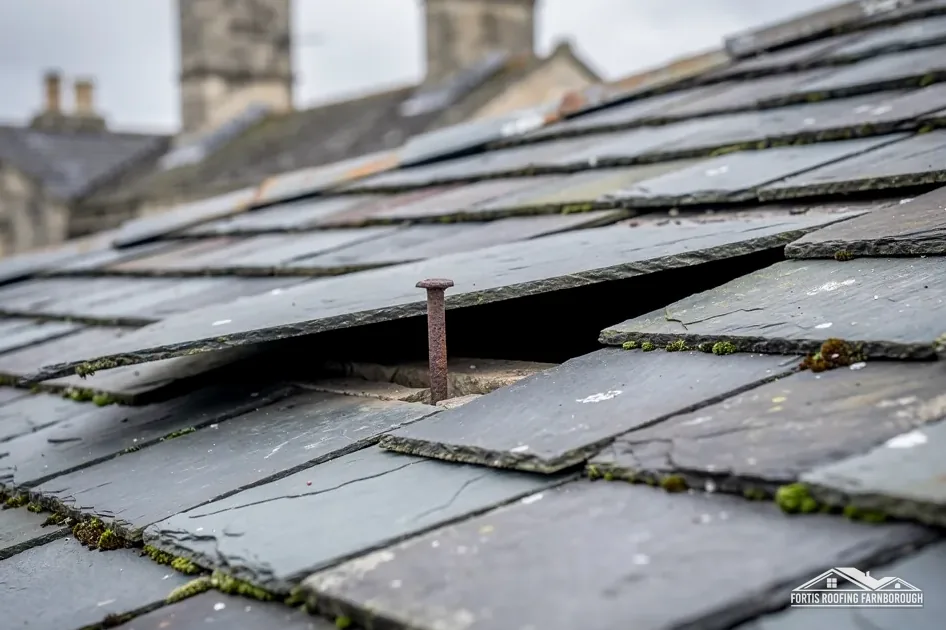
A slate roof needs little regular work: occasional checks for slipped slates, gutters cleared, lead and ridge looked at. Repairs are small if they are caught early. A roof that is neglected can lose its fixings and need a re-slate sooner than its slate would suggest. Our guide to nail sickness on slate roofs explains how that happens.
What not to conclude
A longer life does not mean slate is always the better buy. Weight, pitch, consent and budget all bear on the choice, and some roofs cannot take slate at all. The survey weighs those, and the written price puts a figure on each route so the choice stays with you, made on the facts.