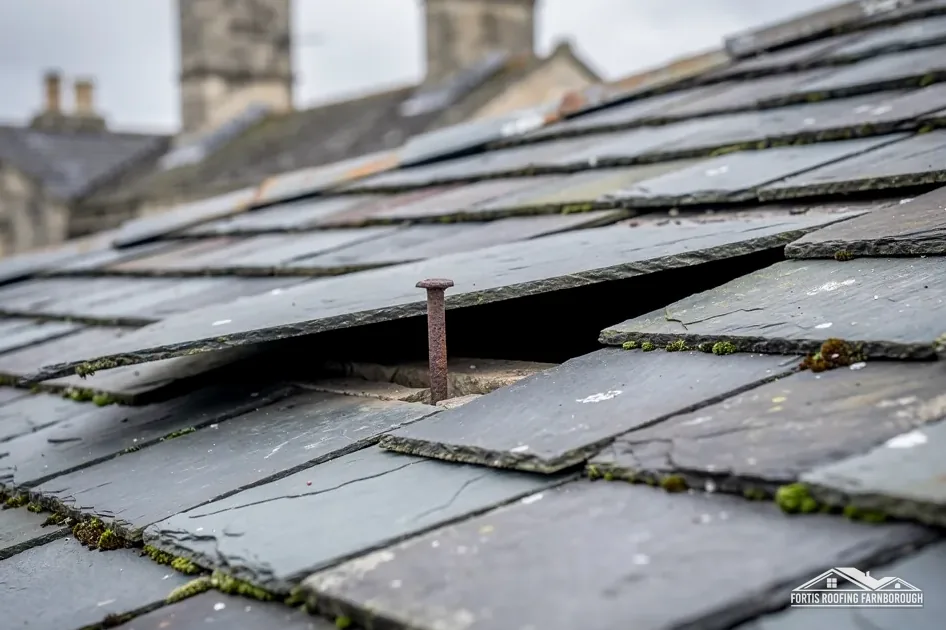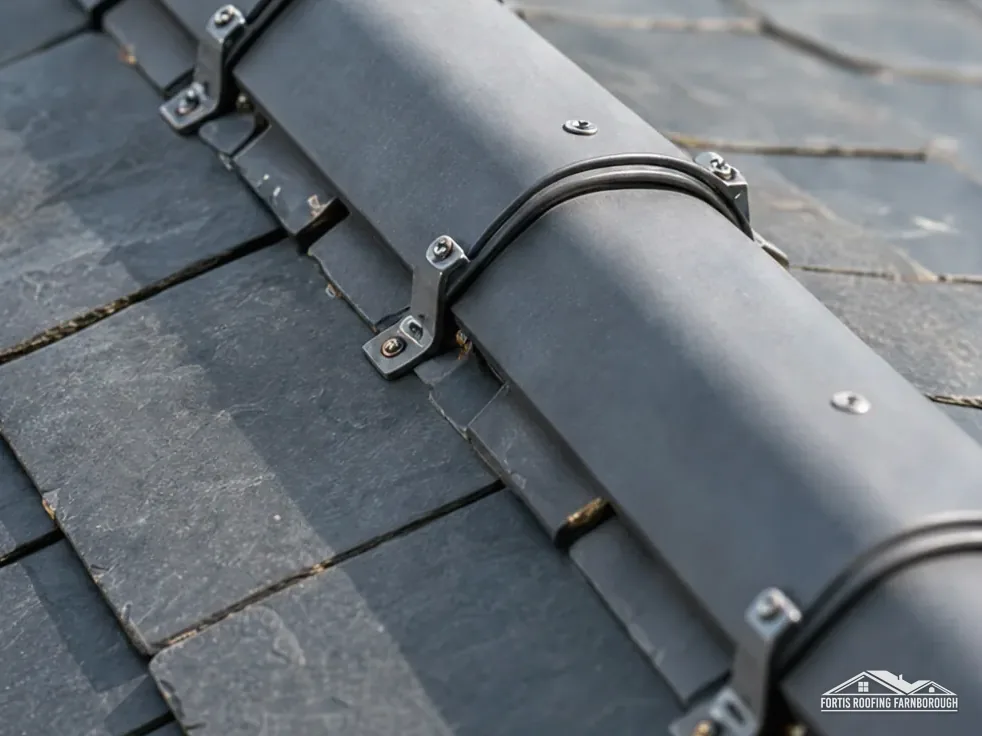
Two natural slates dominate the choice for a new or re-covered roof in this part of England. Welsh slate is quarried in Wales and has a long history on British roofs. Spanish slate is imported from Spain and sold at a much lower price. Both are genuine natural slate, split from rock, and from the road they can look much alike.
HomeBuilding & Renovating publishes both a typical life and a supply-only price per square metre for each. Welsh slate is listed at 100+ years and £185 a square metre. Spanish natural slate is listed at 75 to 100 years and £72. Those figures describe the stone alone, and they are typical ranges, not promises.
The guide compares them on life, supply price, appearance, grade, and consent in conservation areas, shows what the difference does to a whole roof and offers a way to decide, for houses near Farnborough.
Welsh and Spanish in one table
The cleanest comparison starts with the numbers in the same source and the same month.
| Measure | Welsh slate | Spanish natural slate |
|---|---|---|
| Typical life | 100+ years | 75 to 100 years |
| Supply-only price per m² | £185 | £72 |
The price gap
On those published rates, Welsh slate is roughly two and a half times the supply price of Spanish. On a whole roof that gap is paid on every square metre, before waste, cuts, labour and everything else are added. A per m² rate is a guide and not a quote.
The life gap
Welsh slate is listed above Spanish at the top of the range, 100+ against 75 to 100 years. A Spanish roof that reaches the top of its range matches a Welsh roof at the bottom of its own. The honest reading is that the lives overlap and Welsh has a higher ceiling.
Reading the premium
Paying £113 more per square metre for Welsh slate buys a higher published ceiling on life and, for many owners, the look of the traditional material. Whether that premium pays off turns on your length of stay in the house and the purpose the roof serves. A landlord, a family planning to move and a long-term owner will each weigh it differently.
What the figures do not say
They do not say which slate is better for a given house, since quality varies within each type and workmanship counts as much as the stone. They also do not include reclaimed slate, which sits between at £90 and 50 to 80 years. Our guide to reclaimed roof slates covers it.
Treat the table as a starting point, and ask for the actual product, grade and origin in any quote.
Look, colour and consistency
From the street, slate is slate. Close up, the two differ in colour range, texture and how consistent the pieces are.
Colour
Welsh slate comes in a range of blue-greys, with some purple and green tones depending on the quarry. Spanish slate is generally a darker grey, with a more uniform look from piece to piece, though colour varies with the supplier. The difference is subtle on a new roof and more noticeable in sun and rain, when slate changes with the light.
Texture and thickness
Welsh slate is often split to a fine, smooth face with a natural sheen. Quality Spanish slate can be as good, though grades vary, and thickness can be less even in cheaper stock. A roofer who handles both will tell you which batch is which.
Consistency
A uniform colour suits a modern house and a clean, regular look. A wider range of tones gives a traditional roof its character. Neither is better in itself. It is a choice of look.
Supply and delivery
Welsh slate comes from quarries a few hundred miles away by road, while Spanish slate comes from abroad and arrives through importers. Stock levels and lead times change, and a particular size or grade may be out of stock when you want it. Ordering early, with a margin for waste and spare slates for later repairs, avoids a rushed substitution.
Weathering
Both weather to a softer finish over time. A quality slate keeps its colour for decades, while a poor one can fade, stain or develop rust spots from iron minerals in the stone. The grade and the supplier matter.
Matching an existing roof
If you are re-covering part of a roof, match matters most. A roofer looks at the old slate and picks the closest new or reclaimed one. Our guide to Victorian slate roofs covers older houses where the match is hardest.
See a sample on a real roof, if you can, and not only in a showroom.
Quality, grade and what to ask
The name on the slate tells you where it was quarried and little more. Grade tells you what you are getting, and quality varies a lot within each type.
Why grade matters
Slate is graded for thickness, flatness, strength and freedom from defects. A top grade is thinner, flatter and stronger, and it costs more. A lower grade may be thicker, uneven or prone to breakage, and it may not meet its published life. The life figures assume sound slate.
Questions for the supplier or roofer
- What is the origin, the quarry and the grade?
- What is the slate's thickness and size, and what is the head-lap at my pitch?
- Is there a test certificate or data sheet for the product?
- How many slates in a delivery are normally set aside as unfit?
- Can I see a sample from the actual batch?
Water absorption and strength
Good roofing slate absorbs little water and resists frost. The data sheet should state its tested properties. A slate that soaks up water splits in a hard frost, and frost is a regular part of winter here, so resistance to it counts.
Fixing and pitch
Whichever slate you choose, the rules on pitch and fixing are the same. For both slates, 20 degrees is the BS 5534 minimum pitch, and Cupa will not have hooks used under 25 degrees. Our guide to slate hooks against nails explains the choice.
A well-fixed Spanish roof beats a badly fixed Welsh one, and the reverse holds just as well.
Conservation areas and listed buildings
Where a house is in a protected setting, the choice may not be only yours.
Conservation areas
Rushmoor has nine designated conservation areas, and other councils in the surrounding area have their own. Re-roofing a house is normally within Class C permitted development, but an Article 4 direction can restrict works in some areas. Some councils, Basingstoke and Deane among them, press for original slate to be kept in protected areas, so find out what yours expects.
What officers look for
Conservation officers generally want the new slate to match the character of the old in colour, size, texture and laying pattern. Welsh slate has long been used on older roofs and is often the easiest match. Spanish slate may be accepted where it matches well, and a sample is the best way to settle the point.
Listed buildings
Listing leaves a house its Class C right and adds a separate need for consent where its character is touched, and a change of slate type could touch it. Raise it with your local planning authority first, and file the reply. Our guide to replacing the roof on a listed building sets out the route.
No consent needed
Away from conservation areas and listing, you can choose on cost and look, within Building Regulations and the rule that a covering 15 per cent or more heavier needs approval.
Deciding, and what it does to the bill
The decision comes down to budget, horizon and setting. A few questions help.
Questions to ask yourself
- How long will I own the house? A long stay favours the longer life.
- Is the house in a conservation area or listed?
- How much of the roof am I re-covering, and what does the rest look like?
- What does the gap in price mean for the whole job?
What it does to the bill
A fitted slate roof averages about £7,800 in MyJobQuote's guide (Oct 2026, typical UK range). HomeBuilding gives Welsh slate on a 65 m² semi as potentially reaching £18,000 (Sep 2025), against £10,000 to £15,000 for plain concrete tiles. Spanish slate would sit lower than Welsh, though the guides publish no whole-roof figure for it, so your quote settles it.
The longer view
Our guide to slate roof cost sets out what moves the price. A longer-lived covering may cost more now and save a later re-roof, while a lower price now suits a shorter horizon.
Our recommendation
We say what each choice means for your house and leave the decision to you. A sample on site, and the data sheet for each slate, make the comparison fair.
After the survey you receive one written price, VAT shown and the scaffold included. Our slate roofing service covers both slates.
Laying, handling and workmanship
The stone is only half of the result. Slate is laid by hand, one piece at a time, and the skill of the slater shows in the finished roof.
Sorting and blending
Slate from a pallet is not identical. A careful slater sorts it by thickness and tone, laying the thickest at the eaves and spreading colour variation so no patch stands out. Spanish slate, which is more uniform, needs less blending. Welsh slate, with a wider range, rewards it.
Cutting and holing
Slates at hips, valleys and abutments are cut to fit, and a clean cut leaves a crisp edge. Holes for nails are made with a punch or drill, set at the right distance from the head and sides so the slate does not split. Poor holing is a common cause of early failure.
Head-lap and gauge
The overlap between courses depends on the pitch and the slate. The maker gives the lap, and a shallow roof needs more. A roofer who lays to the wrong lap lets wind-driven rain through, however good the slate.
Fixings and battens
Fixings of copper or stainless steel, nails or hooks as the pitch allows, go onto sound treated battens. A cheap fixing on a premium slate is a false economy, and the nails usually give out before the stone does. Our guide to how long a slate roof lasts explains why.
Checking the finished roof
A final check of lines, laps, cuts and fixings comes before the scaffold is struck, and spare slates are left with you. The same workmanship standard applies whichever slate is chosen.