Ask how long a slate roof lasts and the answer is usually a big number. HomeBuilding & Renovating gives Welsh slate 100+ years, Spanish natural slate 75 to 100 years and reclaimed Welsh slate 50 to 80 years. They are among the longest published lives for any roof covering, and they are typical ranges for the stone, not a guarantee that any particular roof will reach them.
The trouble with a single number is that a roof is more than its slate. It is slates, nails or hooks, battens, underlay, lead flashings, ridge details and gutters, and each has its own life. A slate roof that is 70 years old may have slates with decades left and fixings that are nearly finished.
This guide sets out the published figures, explains why the parts age at different rates, how to judge the years left in a roof you own or are buying, what shortens a slate roof's life and what extends it, and when the sensible step is a repair, a re-fix or a new covering, for slate roofs around Farnborough and the neighbouring towns.
The published lives
HomeBuilding & Renovating (updated 30 September 2025) gives typical lives for the main slates in its table of roof coverings.
| Slate | Typical life |
|---|---|
| Welsh slate | 100+ years |
| Spanish natural slate | 75 to 100 years |
| Reclaimed Welsh slate | 50 to 80 years |
Reading the table
The ranges describe the slate when it is properly fixed and looked after. New Welsh slate is at the top. Spanish natural slate is a step below on the published figure. Reclaimed slate was used on a previous roof, so its remaining life is shorter.
For comparison
The same source gives clay tile 60 to 80 years, plain concrete tile 40 to 50 years and fibre cement tile 30 to 40 years. Slate heads the list, and that is a large part of why people choose it.
What these figures are not
None of them is a warranty. A warranty covers a product or a job, which is a different promise from a typical life, and a typical life can be missed either way. A slate roof can fail at 40 years because of poor fixing and pass 100 years because it was well made and cared for.
How to use them
Treat them as a guide to where a roof is likely to be in its life, and use a survey to decide whether it is. Our guide to natural against fibre cement slate shows how the lives compare across slate types.
Why the nails fail before the slate
The weak link in a slate roof is almost never the stone. A slate is a hard, dense rock that does not rot, rust or absorb much water. Its life is limited mainly by what holds it up.
Fixings
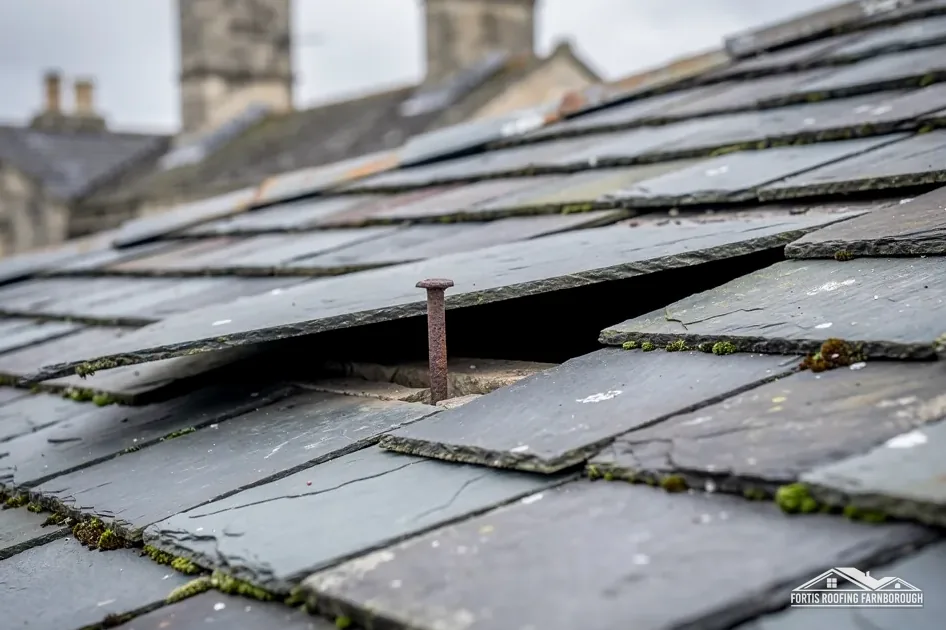
Each slate is fixed by two nails driven through its head into a batten, or by a hook or clip at its lower edge. Older roofs often used iron or steel nails, which corrode in the damp space under the slates. When they go, the slates slip. That is nail sickness, and it often appears long before the slate wears out on a roof built with ordinary steel nails. Our guide to nail sickness on slate roofs describes it.
Battens
Timber battens carry the load. If water gets past the covering, or damp air condenses on the underside, they soften and split, and the slates lose their hold. Battens are often the second part to go.
Underlay
The underlay catches any water driven under the slates. Old felt turns brittle and splits. A roof with no sound underlay depends entirely on the slates for weather protection.
Lead
Lead flashings, valleys and soakers last well, and lead flashing, MyJobQuote says, can last for over 80 years. They can still fail from movement or poor detailing, and they sit at the places where leaks start.
Weather and exposure
Where a roof stands, and what surrounds it, affects how fast its parts age. A roof under trees stays damp and grows moss. One on an open site meets more wind at the edges and ridge. A north slope dries slowly, so its battens and nails can age faster than those on the south side, and surveys often find failures clustered on the shadiest face.
The gap
The result is that a slate roof's working life is set by its fixings and battens, which can be renewed, and not by its slates, which can be reused. That is the basis of re-slating.
How to judge the years left
A good part of a slate roof's condition shows from outside and from the loft, and a survey firms it up.
From the garden
Look for slipped slates, gaps, a wavy roofline and fallen slates that are whole. A few slipped slates on an otherwise even roof is a minor sign. Many, spread across slopes, is a stronger one. Moss and lichen are not themselves a sign of age, since slate carries them without harm.
From the loft
Take a torch to the loft hatch on a dry day and study the underside. Orange rust streaks, nail stubs dangling from the battens, dark or soft timber, split underlay and daylight all say the supporting parts are failing. Clean, dry battens and sound felt suggest the roof has years left.
The roofer's tests
A roofer lifts sample slates at several points and looks at the nails, tests battens with a probe and checks lead and ridge details. The results go into a written view with photographs.
What age adds
A roof at 50 to 80 years with original steel nails is likely to be near the end of its fixings, whatever its slate. A roof at 100 years that has been re-fixed once may have a long life ahead. Age tells you where to start looking, and the evidence settles the matter.
Buying a house
If you are buying, ask for a roof survey with photographs. Our guide to roof checks when buying a house covers what a buyer should look for.
What shortens a slate roof's life
Several things bring a slate roof to the end of its useful life early. Most are avoidable.
Poor fixing
Slates nailed too tightly, with nails that miss the batten, or with the wrong length or metal, fail early. The same goes for hooks used on a roof that is too shallow. Cupa rules out hooks below 25º, and for natural slate itself BS 5534 sets 20º as the floor.
Walking on the roof
Slate is brittle, and feet crack it. Repeated access by unqualified people, for aerials, cleaning or gutter work, breaks slates and loosens fixings. A roofer uses boards and ladders to spread the load.
Rough cleaning
Scraping and jetting can scar slate faces and force water under the laps. Marley lists high-powered jetting as not recommended for slate or tile, because it can cut the covering's life considerably.
Neglected gutters and lead
Overflowing gutters soak the eaves, and failed lead lets water into the structure. Both rot timber and fixings from below.
Poor ventilation
Condensation in the roof space rots battens and corrodes nails. Eaves ventilation matters, and an underlay change or blocked eaves can cause problems.
Bad repairs
Sealant used in place of a proper fix, mismatched slates and nailed repairs through the covering above can all shorten a roof's life. Our guide to repairing a slate roof explains the right methods.
Fixing and care drive these failures, and the slate itself plays a smaller part, which is why a poorly fixed new roof can fail before a well-kept old one.
What extends a slate roof's life
The same logic works in reverse. A few habits and decisions keep a slate roof sound for much longer.
Good fixings from the start
Copper or stainless steel nails, or suitable hooks on a steep enough roof, remove the usual first failure. A roof laid with them can outlast the nails of an older one by decades.
Sound battens and underlay
New treated battens and a good underlay with proper eaves ventilation keep the support system healthy. Where a roof is re-slated, renewing both is the point of the job.
Regular checks
Glance at the slopes from the garden after storms and each spring and autumn. Photograph the roof from the same places each year. Catch slipped slates early, so that one is not a dozen.
Clear gutters and a dry roof edge
Cleared gutters and sound lead keep water out of the eaves and joins. Trimmed trees reduce shade and moss.
Proper access
When someone has to go on the roof, use a roofer with the right access gear, not a ladder and a quick walk across.
Prompt repair
A tingle or clip on a single slipped slate costs little, and it avoids water getting to the battens. MyJobQuote gives around £7,800 for fitting a slate roof (Oct 2026, typical UK range), which shows what is at stake if small faults are left until a whole new roof is the answer.
Our slate roofing work puts these habits into practice.
Repair, re-slate or replace
When a slate roof shows its age, the choice is between three routes. A survey tells you which fits your roof.
Repair
If failures are few and local, individual slates are re-fixed with hooks or tingles and lost ones replaced. It is the lowest-cost route and suits a roof whose supporting parts are mostly sound.
Re-slate
Where nails are failing widely but the slates are sound, the slates come off, are sorted, and the sound ones go back on fresh battens and underlay with durable fixings. That gives the roof a fresh start and keeps the original material. Our guide to re-slating a roof explains the work.
Replace
If the slates are cracked, laminating or breaking in large numbers, a new covering is the honest answer. It may be slate or another material, depending on the house and consent.
Costs, as a guide
HomeBuilding gives Welsh slate on a 65 m² semi as possibly reaching £18,000 and plain concrete tiles at £10,000 to £15,000 (Sep 2025). Our guide to slate roof cost sets out more.
The decision
The survey gives you photographs of the nails, battens and slates, with a written view on the years left. One total price follows for the route you choose.