Natural slate is one of the longest-lasting roofing materials there is. The stone itself can outlive the house, and HomeBuilding's typical life for Welsh slate is 100+ years. A slate roof that fails after sixty or seventy years is often not failing because of the slate. It is failing because of the small fixings that hold each slate in place.
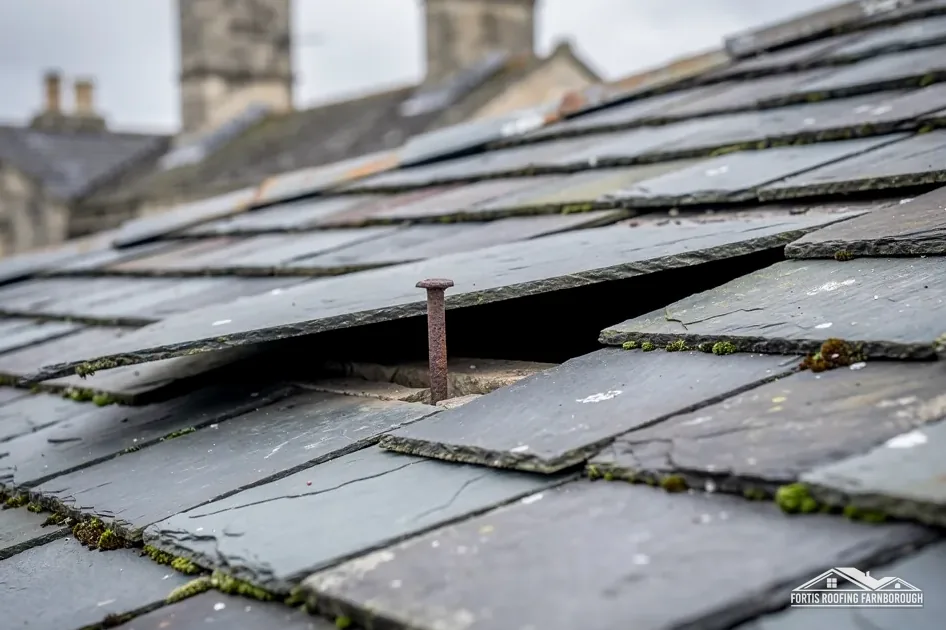
Each slate is held by nails driven through it into the batten behind. Over decades, damp and air work on the metal. Ordinary steel rusts, and the nail shank thins until it snaps or loses its grip. The slate is then held by little more than the slate above it, and it begins to slide. This is nail sickness, and the name describes it well: the slate is healthy and the fixing is ill.
This guide explains how nail sickness happens, how to recognise it from the ground and the loft, why spot repairs work up to a point, how tingles are used, when the right answer is to re-slate and what to ask a roofer, for slate roofs in Farnborough, Aldershot and the surrounding area.
How a slate is held and how it fails
A slate roof is built in overlapping rows, called courses, from the eaves upward. Every slate hangs on a batten, a timber lath running across the rafters, and two nails through holes near its head hold it there. The slate above covers the nail heads, which is what keeps them dry.
The fixings
On a well-built roof, the nails are made of a metal that resists corrosion, such as copper or stainless steel. On older roofs, they were often iron or steel, sometimes galvanised, and those are the ones that fail. The nail sits in a damp, oxygen-rich space under a cold slate, which is exactly where rust thrives.
How the nail fails
Rust starts at the surface and works inward. The shank narrows where it passes through the slate and the batten. Eventually, the nail head snaps off or the shank breaks under the weight of the slate and the push of the wind. Nothing visible happens at that point: the slate still sits in place, held by friction and the slate above.
The slip
Later, a gale, a heavy frost or the weight of someone's foot moves the loosened slate, and it slides down until it catches on the course below. A slate that has slipped leaves a gap above it and an overlap that is too short below, and rain can find the way in.
Why it spreads
The nails across a slope are of the same age and metal, so they tend to fail around the same time. One slipped slate is often the first of many. Our guide to how long a slate roof lasts sets out why the fixings give out before the stone does.
Spotting nail sickness
Climbing is unnecessary. Most of the clues can be read from the lawn and from the loft hatch.
From the garden
- Slates that sit lower than their neighbours, leaving a ragged line in the course.
- Visible gaps showing the dark batten or underlay beneath.
- Slates on the ground, in the gutter or in flower beds that are whole and unbroken.
- Slates that look tilted outward at the bottom edge.
- A pattern that appears more at the eaves, edges or exposed corners.
A telling sign is that the fallen slates are intact. A slate that has been broken by frost or impact is a different problem. A whole slate on the ground, with nail holes in its head, is a slate whose fixings have let go.
From the loft
Pick a dry day, carry a torch, keep to the joists and study the back of the slates and the battens. Rust-stained batten surfaces, orange streaks, bent or snapped nail shanks hanging from the battens and slate fragments on the underlay all point to the same thing. Daylight at a slipped slate is another clue.
What to avoid
Do not walk on a slate roof to check. Slate is thin and breaks under weight, and the nails may already be failing. A roofer uses a roof ladder or boards to spread the load. Our guide to repairing a slate roof explains what can be fixed once the pattern is clear.
If you see slipped slates on more than one slope, treat it as a pattern and not as an accident.
Tingles and single-slate repairs
For a roof with a few failed fixings and sound slates, repair is possible, and it can add years to the roof's life.
Replacing or refixing a single slate
A slipped slate can be slid back into place and held. Because the nail heads are hidden under the slate above, the usual method is to use a slate hook or clip, or a tingle, which fixes the slate without nailing through the covering above. The broken fixing is removed where possible and the batten checked.
What a tingle is
A tingle is a strip of metal, usually lead or copper, nailed to the batten and folded up over the lower edge of the slate to hold it in place. It is visible from below as a small tab at the bottom of the slate. It is a traditional and effective repair for a slipped slate where a conventional re-nail is not possible.
Hooks and clips
Modern stainless-steel hooks and clips do the same job as a tingle with a different look. Cupa, a slate supplier, advises no hook fixings below a 25º pitch, and BS 5534 puts the floor for natural slate at 20º. Our guide to slate hooks against nails goes into the choice.
Limits of repair
Each repair deals with one slate. If the nails are failing across a slope, repairing slate by slate means paying for many visits and leaving the next failures in place. A repair is best for a roof where the problem is isolated.
The £75 to £400 Which? range (Nov 2025, ex VAT) is for tiles and not slate, and a slate repair depends on slate size and access.
Why the nails go before the slate
It seems odd that a material that lasts a century is let down by a fixing that costs pennies. The reason is simple: the two do not age at the same rate.
Slate is stable
Natural slate is a fine-grained rock that barely absorbs water and does not rot or rust. HomeBuilding (Sep 2025) gives typical lives of 100+ years for Welsh slate, 75 to 100 years for Spanish natural slate and 50 to 80 years for reclaimed Welsh slate. Those are ranges, not promises, though they show that the stone is rarely the limit.
Metal is not
Iron and steel rust whenever they meet water and air. The nail is in the damp, shaded space between the slate and the batten, kept wet by every shower and by condensation. The slate protects the nail from direct sun and wind, and it also traps moisture around it.
Timber battens age too
Where water has got in, the batten softens, and a soft batten holds even a sound nail poorly. A roof with failing nails often has battens in the same state. Our guide to battens that need replacing shows how to judge the timber.
The gap in lifespans
A well-made slate roof might outlast several sets of nails. When the original iron nails give out, after fifty or sixty years, the roof can go on, but only if the slates are re-fixed with better nails. That is why a re-slate of a sound roof is usually a re-fix, not a re-cover with new slate.
When it is time to re-slate
There comes a point where repairs cost more in total than a proper job, and nail sickness is one of the clearest signs of it.
Signs that point to re-slating
- Slipped slates on several slopes, or in many places on one slope.
- Rust-stained battens and snapped nails visible in the loft.
- Repairs already made, and new slips appearing beside them.
- Soft battens or torn, perished underlay.
- Slates that are otherwise sound and worth reusing.
What re-slating involves
The slates are stripped, sorted, and the sound ones set aside. The battens are inspected and renewed where needed, a new underlay is laid, and the slates are re-hung with fixings that will outlast the next generation. Broken or lost slates are replaced with matching ones. Our guide to re-slating a roof goes through the process.
Why it is good value on a sound roof
Reusing existing slates keeps the original material and the look, and the new work is the fixing, underlay and battens. Against a new roof in another covering it is frequently the better buy, and the character of the house survives.
What national guides say about cost
A typical UK average for a fitted slate roof is about £7,800 in MyJobQuote's guide (Oct 2026). HomeBuilding gives Welsh slate on a 65 m² semi as potentially reaching £18,000 (Sep 2025). Those figures are for new slate roofs, and the cost of a re-fix depends on the condition of the slates and the area.
The survey ends in a single written price, VAT shown.
What we check and how we decide
A survey for nail sickness looks beyond the slipped slates to the condition of the fixings across the whole roof.
On the roof and in the loft
We use proper access to avoid damaging slates, and we lift a sample of slates at several points to see the nails. A rusted or snapped nail on a test slate, on the main slopes and not just at the slip, tells us the extent of the problem. In the loft, we check the battens, underlay and any lead.
Reading the evidence
Test slates tell a clear story. A shiny nail shank that is still thick means the fixings have years left. A flaky, orange, thinned shank, or a nail that comes away in the hand, means they do not. The survey notes how many tested slates fall in each group and where on the roof they sit, since a pattern at the exposed edges differs from one across the whole roof.
Photographs
We photograph the nails, the battens and the slates. You see the rust and the snapped shanks for yourself, which makes the decision between repair and re-slating one you can judge, not one you take on trust.
Pitch and fixing
The pitch of the roof matters to how slates are fixed. For natural slate BS 5534 sets 20º as the minimum pitch, and Cupa's 25º limit applies to hooks. On the shallower slopes nails are used, and the batten has to be sound enough to hold them.
Lead and details
Flashings, valleys and soakers are checked, since lead lasts well and can be reused, while failed lead is renewed. Chimneys and ridges are looked at too.
What you receive
A written view on repair or re-slate, with photographs and one price for the route you choose. Our slate roofing work starts with that survey, and the roof's own evidence decides the plan.