A slipped, cracked or missing slate does not mean a slate roof is finished. These roofs are built to be repaired, and a good slater can lift a slate out from the middle of a slope, replace it and leave the courses either side untouched. Repairs of that kind are one of the great advantages of slate over a covering that has to be replaced in sections.
The question is whether repair is still the right answer. A few failed slates on a healthy roof is a repair job. Many failed fixings across the roof is a different problem, and patching it slate by slate means paying for a series of visits while the next failures wait. Telling the two apart means checking the nails, the battens and the pattern of failure.
This guide explains how single slates are replaced, how tingles and hooks work, what is repaired at the ridge, valleys and lead, what repair cannot fix, what national guides publish on the cost of roof repairs and when repair gives way to re-slating, for slate roofs around Farnborough.
Replacing a single slate
The usual repair is to replace one slate that has cracked, slipped or been lost. It looks simple, and it takes a trained hand, because a slate is fixed under the courses above it and cannot just be lifted out.
The difficulty
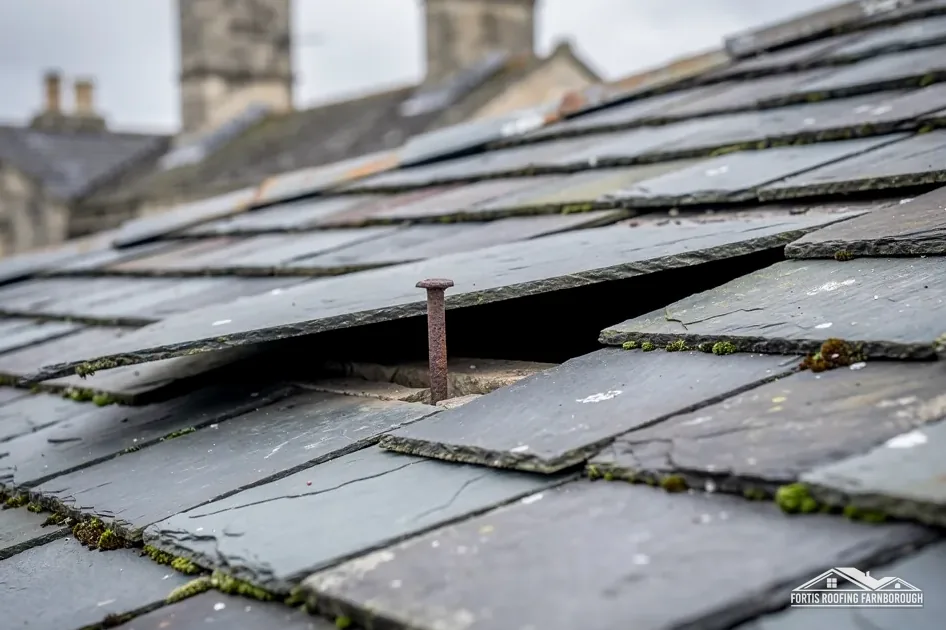
Each slate is nailed through its head, and the nail heads are covered by the slate two courses up. To remove a broken slate, its nails have to be cut or drawn without lifting the courses above, and a new slate has to be fixed without nails going through the covering above it.
The method
A slate ripper, a long flat tool with a hooked end, is slid under the slate to find the nails and cut them. The broken slate comes out. The new slate, of the matching size, is slid into place, and it is held by a hook, clip or tingle fixed to the batten, since there is no way to nail it in the usual place.
Matching
The replacement should match the original in size, thickness and colour. A new slate beside a weathered one will look brighter for a few years. Reclaimed slate matches better. Our guide to reclaimed roof slates sets out the pros and cons.
Checking beneath
While the slate is out, the batten and underlay below are checked. A rotten batten or torn underlay beneath a slipped slate is common, and fixing the slate alone would leave the cause in place. Our guide to slipped roof tiles explains the same logic for tiles.
A single replaced slate is a small job, and the access, not the slate, is often the main cost, so it makes sense to bundle repairs into one visit.
Tingles: the traditional fix
A tingle is a narrow lead or copper strip, shaped by hand, that fastens a slate to the batten beneath it. It is one of the oldest repairs in a slater's kit and one of the most dependable.
How it works
One end is nailed to the batten, in the gap between two slates of the course below. The other end is bent up and over the lower edge of the loose slate, so that the slate cannot slide. From the ground it is seen, if at all, as a small tab at the slate edge.
Where it is used
A tingle suits a slate whose original nails have failed but which is otherwise sound. The slate goes back into its place and the tingle keeps it there, without anyone touching the courses above. It also holds a new replacement slate.
Material
Soft metals that resist corrosion are chosen so they can be folded without cracking. A tingle in the wrong metal, or one too thin, will fail, so material and thickness count. A lead tingle tucked under the course above sits in the sheltered conditions in which MyJobQuote says lead flashing can last for over 80 years.
Limits
A tingle answers one slate. It does nothing about nails failing right across a slope, and a roof with dozens of them is telling you its fixings are going. The next question is then whether to re-slate. Our guide to nail sickness on slate roofs explains the pattern.
Hooks and clips
Stainless-steel hooks and clips are the modern route to the same result. Each is fastened to the batten and grips the lower edge of the slate.
How a hook is used
The hook is nailed or screwed to the batten in the gap between slates, and its curved tip grips the edge. The slate is not marked, and it is held firmly against sliding. A clip works in a similar way with another shape.
Pitch limits
Hooks depend on a slope steep enough to seat the slate against its batten. Cupa says not to use them below a 25º pitch, and BS 5534 gives 20º as the least for natural slate. On a roof between 20º and 25º, repairs use tingles, or nails where they can be placed, and not hooks.
Choosing between them
The roofer weighs pitch, slate and appearance. A period roof may call for a tingle on looks alone, while a steeper modern roof often takes hooks. Our guide to slate hooks against nails goes into the full comparison.
Quality of the fixing
The metal must resist corrosion and be sized for the slate. An undersized hook lets go, and a plain steel one rusts. Ask which is being fitted, and expect a plain answer.
Appearance
Hooks and tingles are small, but certain angles of light show them. Where the look matters, ask to see a sample first. A mixed roof of tingles and hooks, repaired over the years, is common and does no harm.
Ridge, hips, valleys, lead and gutters
Slate roofs fail at the details as often as in the field of slates, and repairs there are common.
Ridge and hips
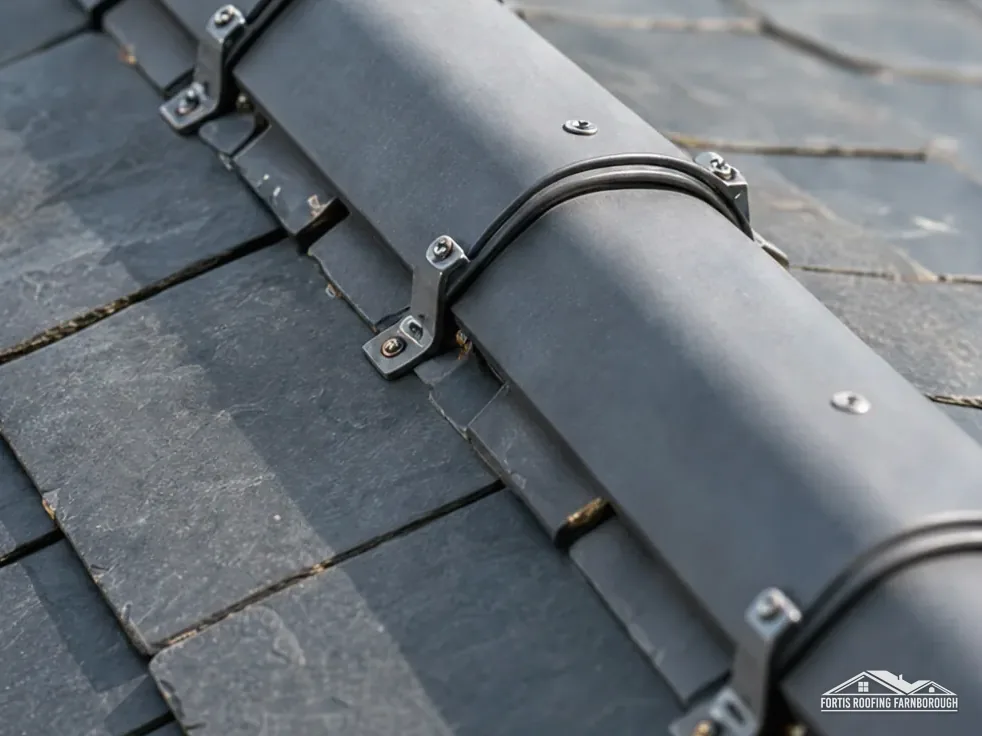
Ridge and hip pieces on a slate roof may be clay, concrete, stone or lead-covered. Mortar bedding cracks, and pieces loosen. Marley's account of the 2014 revision of BS 5534 is that mortar on its own stopped being enough for ridge and hip tiles, so repairs add mechanical fixing. Our guide to dry ridge or mortar explains the options.
Valleys
The lead lining of a valley wears and can split at joints and bends. Repairs patch or replace sections and re-cut the slates on each side.
Flashings and soakers
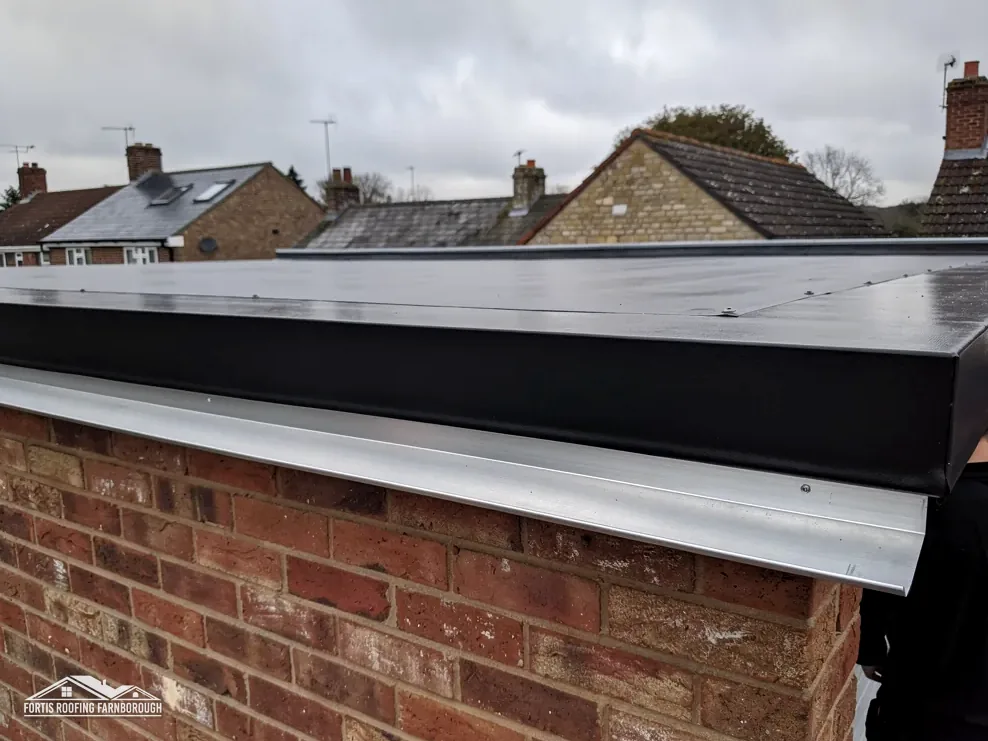
Lead flashings at chimneys and walls can lift, and soakers can slip. They are re-dressed or renewed. Sealant used as a long-term fix is not recommended, as it dries and cracks.
Chimneys
The stack is checked for pointing, flaunching and pots, since a failing chimney sheds water into the roof around it.
Gutters and fascias
Overflowing gutters soak the eaves and rot the boards, and the first course of slates at the eaves is the most exposed. Clearing and repairing the gutters is part of keeping the roof sound.
Cost context
MyJobQuote's average repair is around £650 in 2026 (Oct 2026, typical UK range), while Which? lists £80 to £300 ex VAT for a new ridge tile (Nov 2025). Slate-specific repair prices vary with access and extent, and the survey sets them.
What repair cannot fix
Repair has limits. Knowing them helps you avoid paying for patches on a roof that needs more.
Widespread nail failure
If the nails are rusted across the roof, replacing slates one by one treats each symptom and leaves the cause. Each repair costs a visit, and the next slate to slip is already waiting. A re-slate replaces the fixings across the whole roof in one go.
Failed battens
Slates cannot be held by soft, split timber. If the battens have rotted over a large area, they must be renewed, which means stripping that area.
Perished underlay
A torn or brittle underlay lets water through whenever a slate slips. It can only be renewed with the slates off.
Delaminating or brittle slate
Where the slates themselves are flaking or breaking, repair is pointless, since the stone has run out of life and a new covering is needed.
Roofs with a poor pitch
A roof below the minimum pitch for slate will leak whatever is done. The remedy is a change of design or covering, not a repair.
Frost and old repairs
Slate that has been repaired with the wrong materials, such as cement, mastic or a patch of mismatched tile, can hide further damage. Those repairs often have to be undone before a proper one can be made, and the cost of that is a reason to do the job right the first time.
Structural movement
A sagging ridge, spreading walls or a failing rafter need structural attention before any roofing repair.
A roofer who says a repair is enough when the evidence says otherwise is selling a short-term fix, and one who proposes re-slating for a single slipped slate is overselling. The survey, with photographs, shows which you have.
From repair to re-slate: how to decide
The line between repair and re-slating is a matter of pattern and arithmetic.
Signs that favour repair
- A small number of slipped or cracked slates, in one area or scattered at random.
- Sound battens and underlay when tested.
- Nails on test slates that are still thick and clean.
- A roof within the long end of the published range for its slate.
Signs that favour re-slating
- Slipped slates on more than one slope, spreading in a pattern.
- Rusted or snapped nails on test slates away from the failures.
- Soft battens, or torn underlay.
- Repairs already made and new failures beside them.
The arithmetic
When repeat repairs, each with its own access cost, add up to a large share of a re-slate, the re-slate wins on value. Our guide to re-slating a roof explains the work, and our guide to slate roof cost shows the published figures.
A word on timing
Repairs are cheaper when they are done early. A slipped slate left through a wet winter lets water onto the batten and underlay, and what was a one-slate job can become a batten-and-underlay job. If a roof has had a gale or a hard frost, a quick look from the garden for slipped or fallen slates pays for itself.
What you get from a survey
Expect photographs of the nails and battens, a map of the failures and a written opinion setting repair beside re-slating, each with its price. Our slate roofing service starts there, and the decision is yours.