The short answer
A slate roof ridge can be finished with clay or concrete ridge tiles, stone, or lead, bedded in mortar, held by dry-fix fittings, or both. Marley explains that BS 5534's 2014 revision ended reliance on mortar alone to resist uplift, so a mechanical fixing is now expected. Dry-fix ridge, hip and verge systems are tested under BS 8612.
Ridge materials on slate
The ridge crowns the roof, where the two slopes meet. The slates stop just short of it, and a ridge covering closes the gap. On slate roofs the choice of covering is partly practical and partly a matter of looks.
Clay ridge tiles are the traditional choice in many regions, in half-round, angled or crested profiles, and they weather to a colour that sits well against slate. Concrete ridge tiles are cheaper and heavier, and some are made to look like clay. Stone ridges, in local stone, appear on older and higher-status buildings. Lead-wrapped ridges, where a roll of lead sheet is dressed over a timber core, are used on some roofs and in places where a clay ridge would look wrong.
Hip lines, where two slopes meet at an outward angle, take the same coverings. A hip needs a secure fixing at its base, since the weight of the tiles tends to slide down the slope.
The matching of the ridge to the slate counts. A colour, profile and size that suit the roof keep its look, and a heavy ridge on a light roof can overstress the rafters beneath. In a conservation area or on a listed building the council may have a view, and the original ridge detail may be part of what is protected.
Why mortar alone is no longer enough
For generations ridge tiles were bedded in a bed of mortar and nothing else. Mortar copes well with squeezing and badly with pulling, so it resists a ridge tile being pressed down far better than being lifted. In a gale a ridge tile is lifted, and mortar alone holds on only by its grip on the tile and the bed.
Marley says the 2014 revision of the slating code, now BS 5534:2014+A2:2018, ruled out trusting mortar by itself to hold ridge and hip tiles against uplift. Marley also notes that installing to BS 5534 is not required by law, but a careful roofer follows the code.
Mortar has not been outlawed. It remains in use, but never as the only restraint. A mechanical fixing, a clip, a strap, a screw or a bolt, holds the ridge to the roof, with mortar used to seal and bed the joints, or with a dry-fix system in place of it.
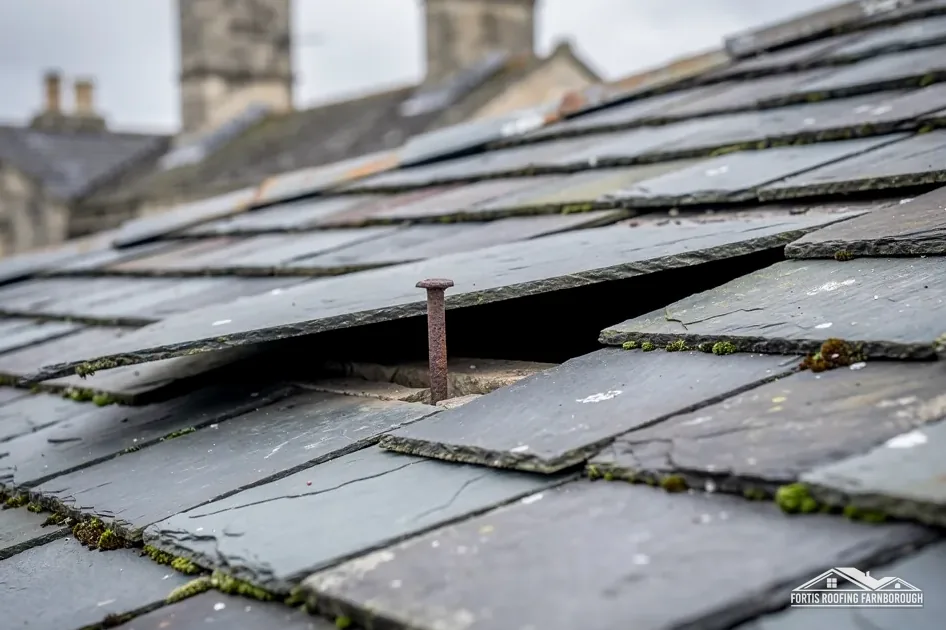
The result is a ridge that stays on the roof when the mortar has aged. Old mortar cracks, crumbles and lets tiles shift, so a ridge that is only mortared eventually becomes loose. Our answer on a leaking slate roof notes a loose ridge among the common causes.
Dry ridge and BS 8612
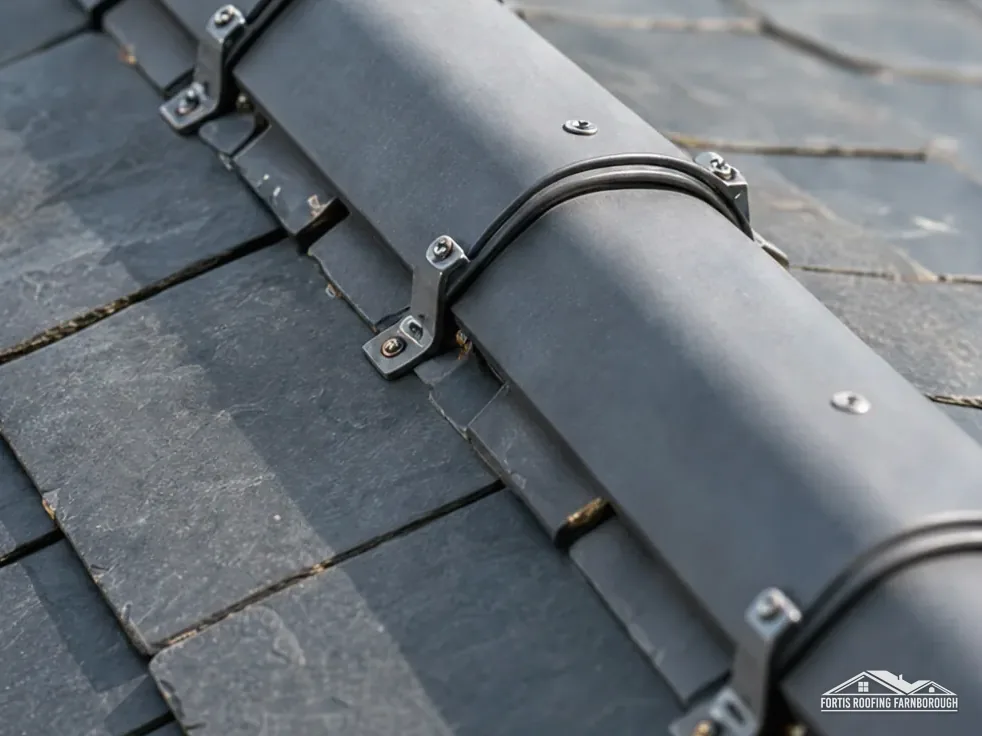
A dry-fix system replaces mortar with mechanical parts. A continuous rail is fixed along the apex, the ridge tiles clip or screw to it, and a ventilated, flexible seal runs under each tile to keep the weather out. The system fixes the ridge firmly, does not crack with temperature, and can include ventilation for the roof space.
BS 8612:2018 is the current test standard for these dry-fixed systems, according to Marley. A product that has been tested to it has been shown to hold under defined loads, which is a better basis than appearance. A roofer fitting dry-fix should name the system and follow the maker's fixing instructions, including the number and type of fixings.
Dry systems cost more in materials but save the labour of bedding, and they are easier to renew. They suit new work and re-roofs, and many repairs. On an older roof with a mortar ridge, converting to dry-fix is a way to bring the top line up to the current approach.
Not every ridge suits dry-fix. Stone ridges and some decorative clay profiles may be bedded and mechanically fixed another way, and a conservation area may favour the look of mortar. The right method depends on the roof, and the survey decides it.
What we check and what goes in the scope
The ridge gets a close look at the survey. We check for cracked or missing mortar, loose or slipped ridge tiles, rust stains from old fixings, and gaps where the ridge meets the last course of slates. In the loft we look for daylight at the top and for damp or staining below.
If a ridge needs work, the scope states the covering, the method of fixing and whether the system is dry-fix to BS 8612 or bedded with mechanical fixings under BS 5534. The ridge's ventilation is noted too, because some dry systems allow air movement at the top of the roof, which matters for the type of underlay.
Ridge work is high and exposed. It is done from scaffold or a safe platform, and not by walking on slate. A ridge that has slipped can shed tiles onto paths and cars, so a loose ridge is treated as a safety matter.
The price depends on the length of ridge and hips, the covering chosen and the access. MyJobQuote (Oct 2026) puts ridge work in a typical UK range of £225 to £550. See slate roofing for the service as a whole.