The short answer
Slate roofs usually leak at a weak point and not across the whole surface. The common causes are slipped slates from rusted nails, cracked or flaking slates, failed lead flashings at chimneys and valleys, a torn or missing underlay, and gutters that overflow. Tracing the water to its entry point comes before any repair, because the stain is rarely where the fault is.
Slipped slates, nail sickness and cracks
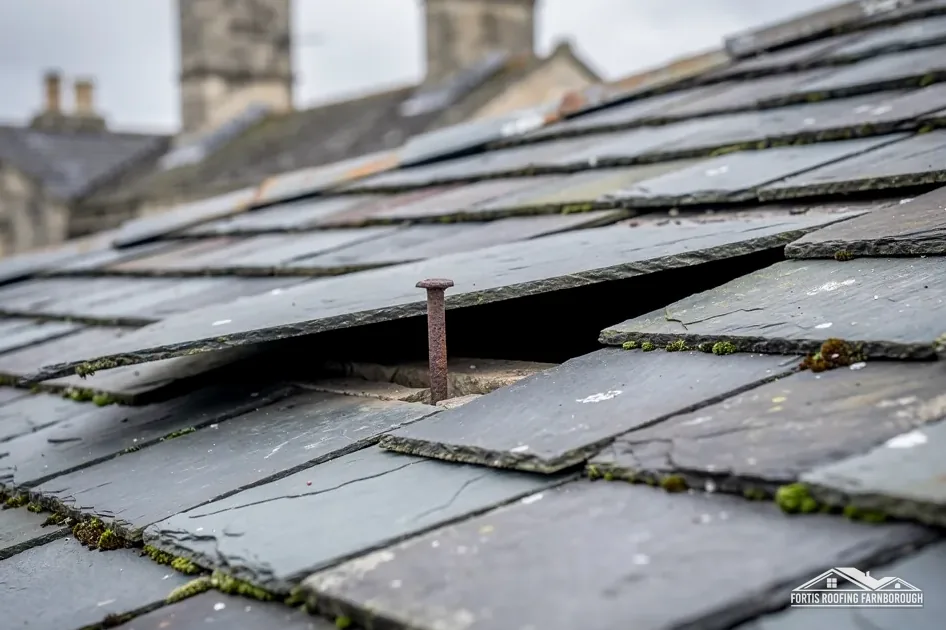
The leading cause is a slate that is no longer where it should be. Slates are held by nails, and iron nails rust over the decades. When a nail rots away, the slate slides down and leaves a gap, and the nail sickness spreads, because every other slate on that slope hangs from nails of the same age. Our guide to nail sickness describes it.
Cracks and flaking are the next group. A slate broken by a foot or a branch, or one that has split into layers, lets water straight through. These are easy to miss from below, because the broken slate may still sit in its place and look whole.
Check the gutters, too. A gutter that overflows sends water down the wall and sometimes up under the lowest slates, and a blocked valley can spill over its edge. What looks like a roof leak may begin at a blocked outlet.
Wind-driven rain is a pattern worth noting. If the stain appears only in storms from one direction, the slate may be laid with too little head-lap for its pitch, or it may be on a pitch near the minimum. Cupa reads BS 5534 as a 20 degree floor for natural slate, so a low roof has little margin.
A moss mat or leaf litter can also hold water against the laps and keep them wet.
Flashings, valleys and the junctions
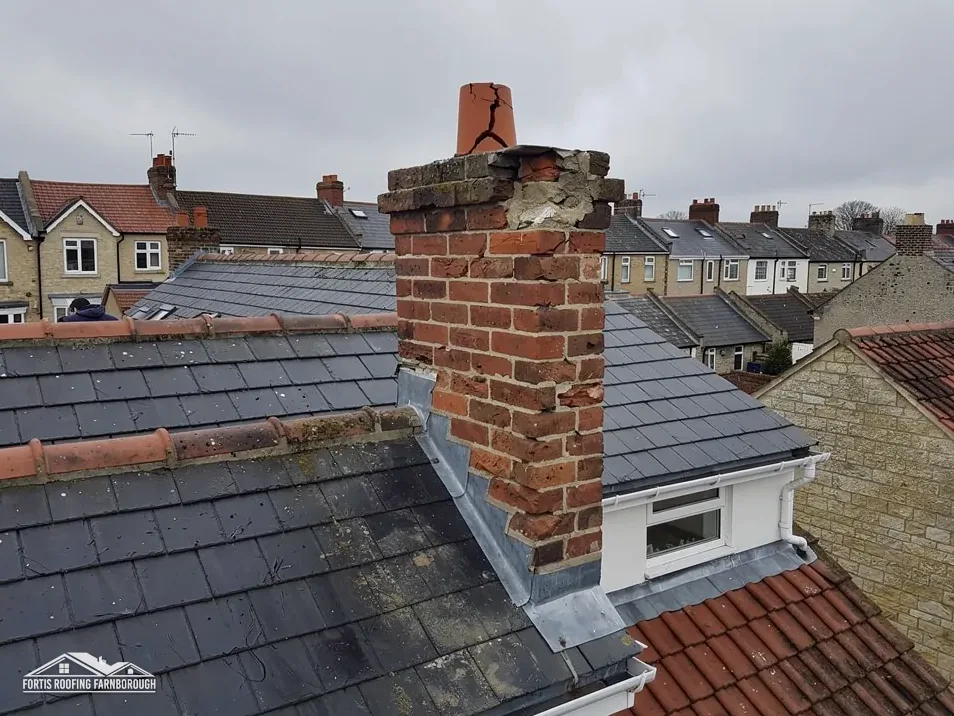
The joints between a slate roof and anything else are more prone to leaks than the slates themselves. Lead flashings seal around chimneys, along walls and at valleys and roof windows. Lead lasts a long time, and MyJobQuote says it "can last for over 80 years", yet it can split at folds, lift in the wind, or be dislodged by past repairs.
A chimney is a usual culprit. Water can find a gap in the flashing or in the flaunching (the mortar cap on the top) and drip inside the chimney breast. The chimney repair hub covers that side.
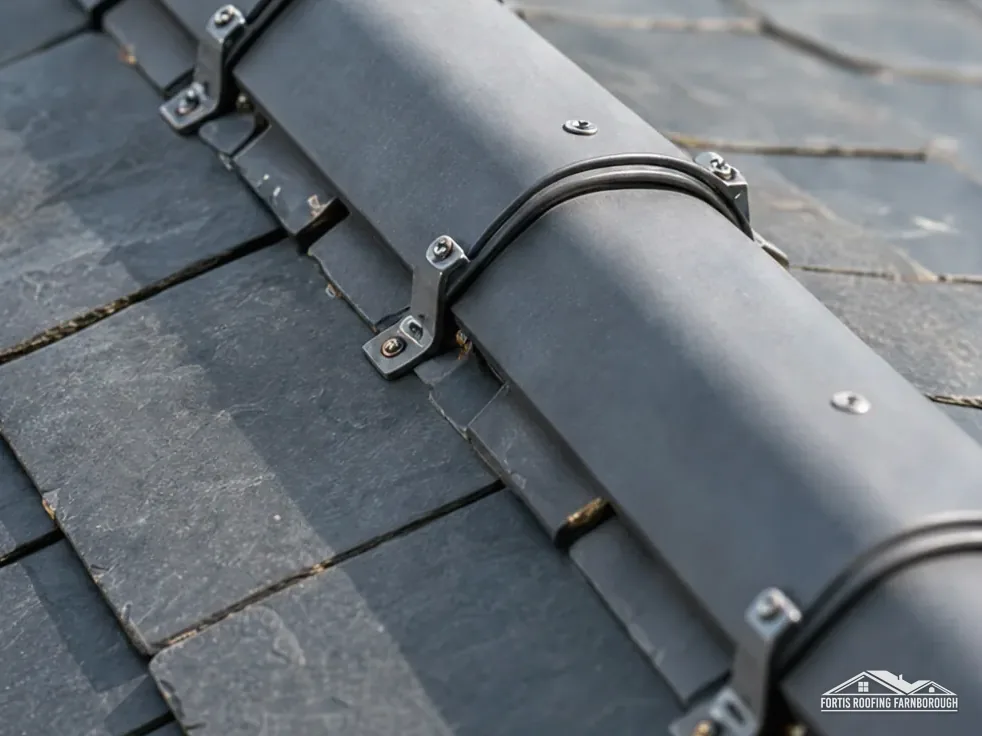
A valley is the line where two slopes meet and shed their water into one channel. A cracked lead lining, or slates cut badly at the edges, will let the combined flow run into the roof. The ridge matters as well, since a loose ridge tile or failed bedding at the top lets rain in along the whole run.
Roof windows and rooflights bring their own flashings. A poorly fitted kit on a slate roof leaks around the frame, as our answer on a roof window in a slate roof explains.
These junctions are inspected closely at the survey, and each is photographed.
Underlay and what lies beneath
Under the slates, a membrane catches water that gets past. Many older slate roofs have none, or an old felt that has perished, so the first line of defence is the slates themselves and any failure goes straight through. Where there is a membrane, it can be torn, rotted at the eaves or lifted at the laps, and water that passes the slates can then reach the timber.
The type of underlay affects how the roof behaves. Marley's eaves figures for HR (non-breathable) underlay are 25mm up to 15 degrees of pitch and 10mm above it, while breathable LR underlay can rely on a tight ceiling. A roof with condensation problems can look as though it is leaking when it is not. Our answer on felt under a slate roof sets out the options.
Distinguishing a leak from condensation matters. Condensation turns up on cold mornings, in damp rooms, spread over the underside of the roof. A leak follows rain, and shows as a stain or drip in a particular place.
In the loft, rot, wet insulation, rusted nails showing on the underside and daylight through the laps all tell their own story. A hose test, with water applied in stages from the eaves upward, can confirm the entry point.
Finding the cause and making it safe
If water is coming in now, the first step is to limit the damage. Move belongings, catch drips and, if you can reach it, look in the loft for where the water runs. We make the roof safe first, stopping the water, and look for the cause once things are dry.
The survey works from the stain upward. We photograph the ceiling and loft, follow the rafters and battens to the highest wet point, then inspect the slates, nails, flashings and gutters above it, so the repair matches a documented cause.
Many slate leaks are small repairs: replacing a slipped slate with a tingle, renewing a flashing, clearing a valley. Our answer on the slate tingle covers the first. Where leaks come from nails failing across a slope, the repair is wider, and re-slating may be the better buy.
If you want to claim on insurance, tell the insurer first, keep photographs and receipts, and read your policy's own storm definition. We cannot promise what a policy will pay.
See slate roofing for the wider service. Pricing comes as one written total once the cause is known.