The short answer
Yes. Winter slating is possible when the work is planned around the forecast, the roof is covered at the end of each day, and the slates are not worked on in ice or hard frost. Delays are normal, and they protect the roof. A covered, dry roof matters more than the calendar date.
Choosing the days
The Met Office climate station at South Farnborough, averaged over 1991 to 2020, records about 715 mm falling in a year over 118 wet days, with around 53 air-frost days. These are averages, not a forecast, yet they show that dry winter days exist and frost is part of the season.
The weather a slating job needs sets the plan, not the calendar. A section is stripped only when the forecast allows enough dry hours to re-cover it, and work waits when the outlook is wet or icy. A booking made for the winter is therefore a window and not a promise of a start date.
The big limits are rain, ice and wind. Rain soaks the underlay, battens and the inside of the house if the roof is open. Ice and frost make slate slippery and put people at risk on the slope and the scaffold. Strong wind makes it unsafe to carry and lay slates and to work at the edge.
We check the forecast the evening before and again in the morning. If it looks wrong we do not start, and the programme moves. That is a better trade than a rushed job that leaves the roof open to a storm.
Our answer on rain during a roof replacement covers what happens when the weather turns.
Cover overnight and a dry house
Winter slating has one firm rule: no open roof after the last person leaves. The strip is done in sections small enough to be re-covered before dark, with underlay laid and slates fixed as the work moves up. Anything unfinished is sheeted over with a waterproof cover held against the wind.
Cover is cut and ready before the first slate comes off, with heavy-duty sheeting, battens and weights on site from the start. It is checked on leaving and again if a storm is forecast.
The house below is protected too. Furniture under the work is moved or covered, and loft belongings that must stay dry are cleared. Wet insulation is a poor insulator and can keep timbers damp for months.
Materials get the same care: slates are stored off the ground and covered, and battens and membrane rolls are kept dry, because damp underlay is harder to lay flat and damp battens can shrink after they are fixed. Scaffold boards are checked for ice before anyone climbs, and gutters and downpipes are kept clear so that water from the cover has a path away from the wall.
Frost, ice and cold slate
Slate is a stone, and cold does not harm it. The risks lie in handling and fixing. Ice on the surface makes slates slippery, and a slate that is frozen to its neighbours can crack if it is prised apart. Frost on the battens makes nailing less certain, and a frozen scaffold board is a slip hazard.
The solution is to wait. In a hard frost or with ice on the roof, work is paused until the surface has cleared. A thaw in the morning may allow a late start, and the day's task is reduced to match.
Fixings and materials also have working conditions. Membranes, sealants and adhesives have a range of temperatures set by their makers, and sub-zero conditions can stop them bonding or curing. We read the data sheets for what is going on the roof and avoid working outside them. Lead flashing is dressed in cold weather with extra care, since lead handles differently when frozen.
Walking on slate is risky in any season, and the winter makes it worse. Roof ladders, platforms and scaffold spread the load and give safe footing, so old, brittle slate is not walked on.
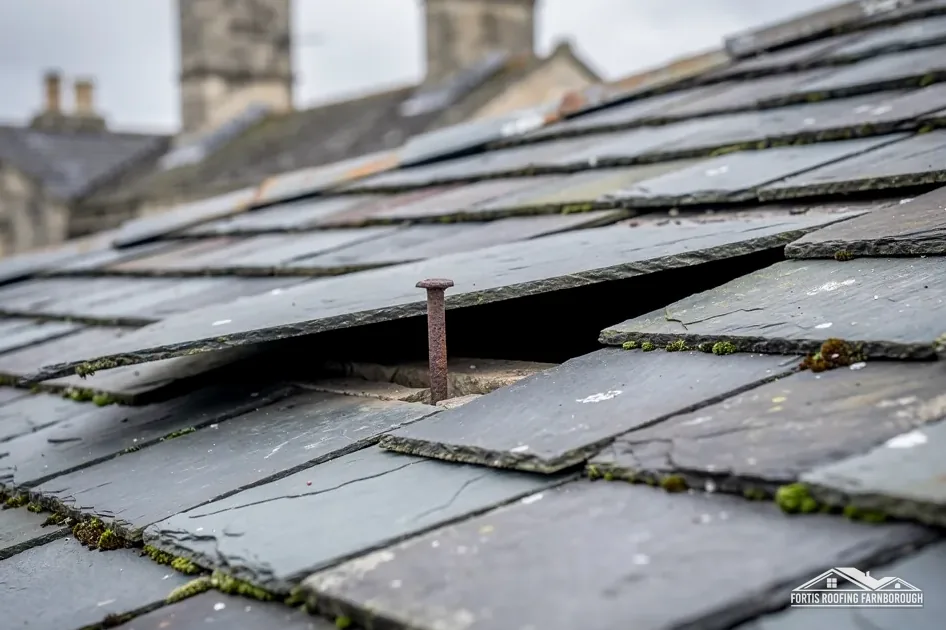
Frost also matters to the roof being replaced. Water in cracked or delaminating slates can freeze and split them further, which is why winter can expose slates that were already failing, as our answer on slate delamination describes.
Is winter a good or bad time?
Neither, on its own. Winter has shorter days, less predictable weather and more interruptions. It also has advantages. Roofers may have more availability, and a roof that is failing before the winter is better repaired before the worst of the weather than after it.
Summer gives longer, drier days and an easier programme for a large job, and a re-slate planned months ahead can wait for it. A roof that is leaking now should not wait: it can be made safe at once and re-slated when conditions suit. The cost of delay can outweigh the benefit of a better season.
Planning and consents run on their own timetable. A listed building or conservation area may need consent before the slates come off, and a decision can take longer than the weather allows for. Basingstoke and Deane, for one, wants original slate kept in its Article 4 areas, so the right slate has to be found first.
The programme comes with its weather conditions stated, and a postponed visit is agreed in advance, with one written price. See re-slating a roof for the process in order, and slate roofing for the wider service.