The short answer
On a listed building, repairs that match the existing slate in size, type and fixing are often treated as maintenance, but replacing the covering or changing the material normally needs listed building consent. Class C permitted development still exists for a listed house, though it does not replace consent. Ask the council's conservation officer before any work.
Consent and what it covers
Section 7 of the Planning (Listed Buildings and Conservation Areas) Act 1990 says that works that change a listed building in a way that touches its special character need listed building consent. A roof is a major part of a building's character, and in many listed houses the slate covering is original or old.
The wording turns on effect. A repair that replaces a broken slate with an identical one, using the same fixing, leaves the character untouched and is usually treated as ordinary maintenance. Re-slating a whole slope, changing the size or source of the slate, adding a roof window or altering the ridge and verge details can affect character, and they need consent.
The point to hold onto is that two systems apply. Listed houses are not excluded from Class C of the General Permitted Development Order 2015, so a re-covering may be permitted development for planning, yet listed building consent is needed in addition for work that affects character. One permission never substitutes for the other.
Where the council is unsure, it can say. Many councils will tell you whether a particular repair needs consent, and an informal answer in writing is worth having. We do not decide that for you, because the decision belongs to the council.
Matching the slate
Councils usually want a close match. That means the same material, so natural slate for natural slate, the same source where it can be identified, the same size and thickness, and the same texture and colour. Welsh and Spanish slate differ in look and weathering, and swapping one for the other is a visible change. Our answer on matching slates for a repair covers the detail.
The best match is often the roof's own slates. Sound slates lifted from one area can be re-laid, and reclaimed slate from a similar roof makes up any shortfall. HomeBuilding (Sep 2025) lists reclaimed Welsh slate at "50-80 years" typically, so reclaimed stock offers a useful second life, within that range.
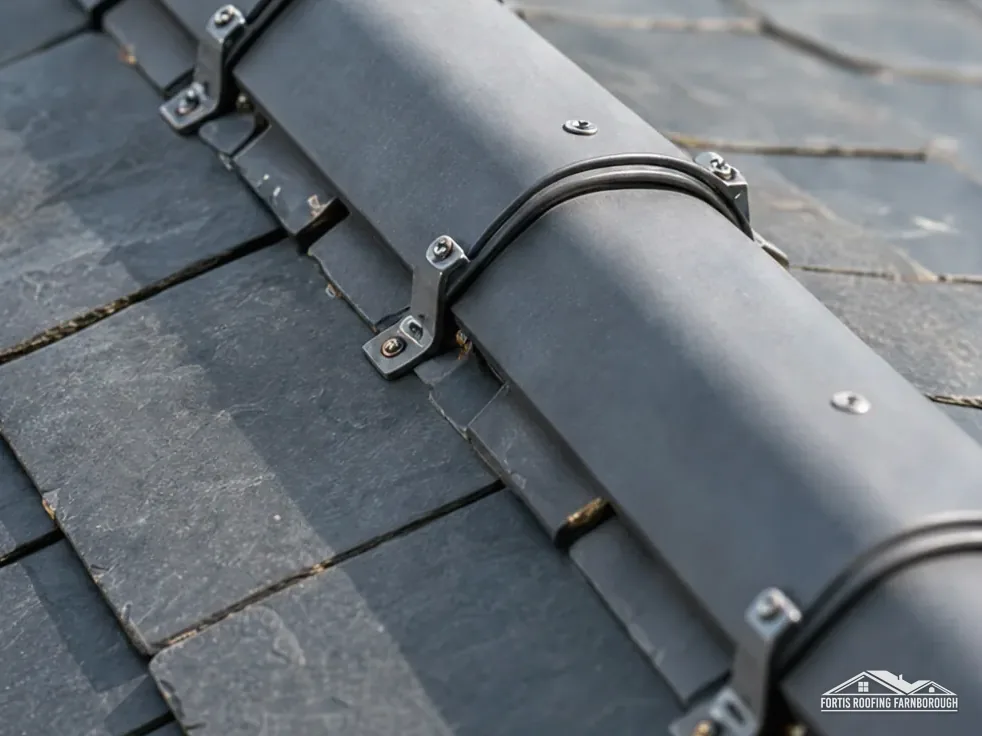
Other features need the same care. Slates of graded sizes, diminishing from eaves to ridge, are a feature of many old roofs, and a uniform modern slate looks different. Lead flashings, ridge details and the way the verge is finished are part of the character, and the council may ask for them to be kept or reproduced.
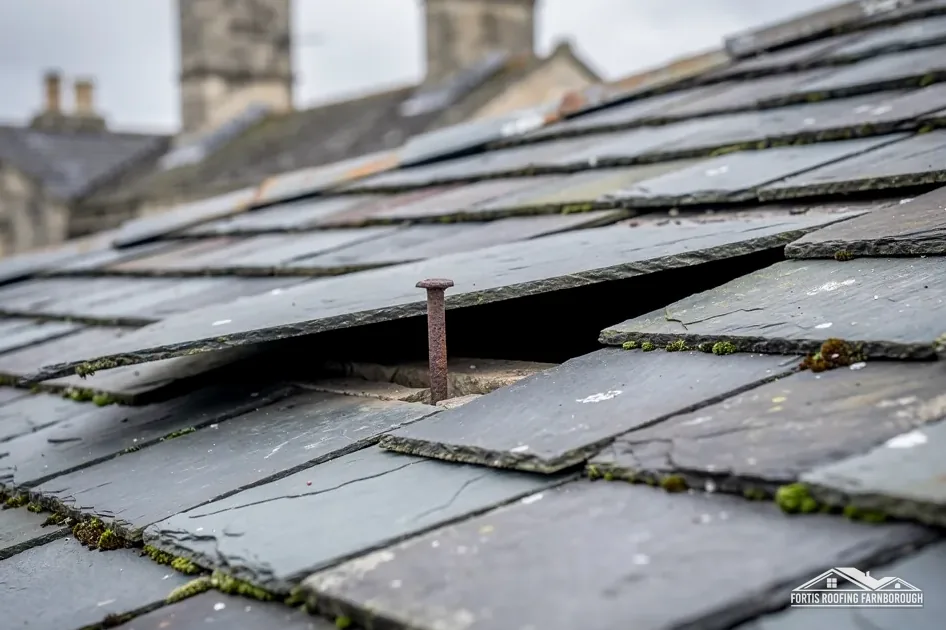
Fixings are part of the story. Old roofs may have iron nails that have rusted, and repairing with copper or another non-rusting fixing is generally better practice while keeping the slate itself. The conservation officer can say what they would accept.
A conversation before the scaffold
Start with the conservation officer. A short conversation, or a pre-application enquiry where the council offers one, tells you whether the work needs consent, what the council will want to see, and how long a decision may take. Doing this before ordering slate and booking scaffold avoids paying for work that has to be redone.
An application usually needs photographs of the roof, a description of the work, the proposed materials and any drawings. We help with the facts: the condition of the slates, the nail failures, the sizes and the structure beneath, with survey photographs. The application and the decision are for you and the council.
Other layers may also apply. A listed house in a conservation area, or one covered by an Article 4 direction, has further checks. Basingstoke and Deane, for instance, wants original Welsh slate and clay tiles kept in its directed areas. Our answer on slate roof surveys explains the inspection that comes before an application.
A church in use follows another route: faculty for the Church of England, the denomination's own system for Roman Catholic and some other churches, and listed building consent for Unitarian and Quaker buildings. A scheduled monument needs scheduled monument consent.
Working on a listed slate roof
Old slate is fragile, and the work is slower. Slates are lifted by hand, sorted and recorded, and the roof is accessed from scaffold or a protected platform so nobody walks on brittle stone. Each slate removed is photographed and numbered where the council asks for it.
The plan sticks to what was approved. If the stripped roof reveals rotten timbers, a different covering beneath or a feature nobody expected, we stop and tell you, because a change to the approved work can need further agreement. It is better to pause for a day than to do something that has to be undone.
Building Regulations apply separately. A re-covering that renews a substantial part of the roof can bring in building control and the energy rules, though listed status can modify some energy requirements, and your building control body can advise. The Planning Portal's test of 25 per cent of the envelope and 50 per cent of the roof is the national guide.
You receive the photographs and a plain account of the findings, and one written price follows, with materials, fixings and the consent route named. See slate roofing for the rest of the service.