The short answer
For many owners, yes, because natural slate outlasts most coverings. HomeBuilding (Sep 2025) lists Welsh slate at a typical 100+ years, against 40-50 years for plain concrete tile. The price is higher at the start, so the case rests on how long you will stay, the house, and whether the roof structure can carry it.
Lifespan against cost
Published figures put the trade-off in plain terms. HomeBuilding & Renovating (30 September 2025) tabulates typical lives: Welsh slate "100+ years", Spanish natural slate "75-100 years", reclaimed Welsh "50-80 years", clay "60-80 years", plain concrete "40-50 years", fibre cement "30-40 years". Read them as ranges, never guarantees.
On price, the sources give different pictures, and we name them. For a three-bedroom semi with a 65 square metre roof, HomeBuilding quotes "between £10,000 and £15,000" in plain concrete tiles, labour, scaffold and insulation included, while Welsh slate on that house "might reach £18,000". MyJobQuote (Oct 2026) puts a fitted slate roof at "around £7,800" on average.
The gap in those figures comes from different assumptions about the house, the slate and what is included, so they cannot be set side by side. They do show that slate sits at the higher end of the range and that a quote depends on the material you choose.
The supply-only prices per square metre in the same HomeBuilding table are £72 for Spanish natural slate, £185 for Welsh slate and £90 for reclaimed Welsh slate. None of this is a quote for your house, which only a survey can price.
Weight and the roof structure
Slate is a heavy covering, and the roof has to be able to carry it. If a house has been roofed in slate since it was built, the structure was designed for the load. If you are changing from a lighter covering, the timbers need checking, and the Planning Portal ties a covering 15 per cent or more heavier to Building Regulations approval plus a structural check.
That is a good reason to have the structure looked at before choosing. Sagging rafters, rotted battens and a dipped ridge all show a roof under strain, and putting slate on top does not cure that. We check the timbers from the loft and photograph what we find, and where it is doubtful, we recommend an engineer's opinion.
Weight also matters for the walls and the foundations, though a house built for slate rarely has a problem. The risk is on a lightweight roof, a conservatory or an extension framed for a lighter covering.
Natural slate also needs a minimum pitch. Cupa reads BS 5534 as 20 degrees at the lowest, which a shallow roof may fall short of. Our answer on the minimum pitch for slate covers the figures.
The look and the setting
Slate has a character that is hard to copy. It is fine-grained, with a slight sheen when wet, and a thin edge that gives a sharp shadow line at the eaves and verge. Colour ranges from blue-grey to green and purple, depending on the quarry, and it ages to a quieter tone without fading.
For many old houses, slate is the original covering, and keeping or restoring it protects the look of the street. In a conservation area or on a listed building, the council may expect slate to be kept or matched, and a change of material may need consent. Basingstoke and Deane, for example, says for its Article 4 areas that original materials such as Welsh slate should be retained.
Alternatives can imitate it. Fibre cement and artificial slates cost less, but they differ in life and look, and our answer on slate or tile compares the choices. A mix of materials can be tolerated on a rear slope and hard to accept at the front.
Value is a judgement. A slate roof can add character, and it does not need replacing as often as most coverings. Whether it lifts a sale price depends on the market and the buyer.
How to decide
Put the numbers beside your plans. If you intend to stay for decades, a covering that may outlast you spreads its cost over a long period. If you may sell within a few years, a more modest covering can make sense, though a sound roof of any type is a selling point. Whoever buys will read the survey photographs and the written scope, so keep them with your papers.
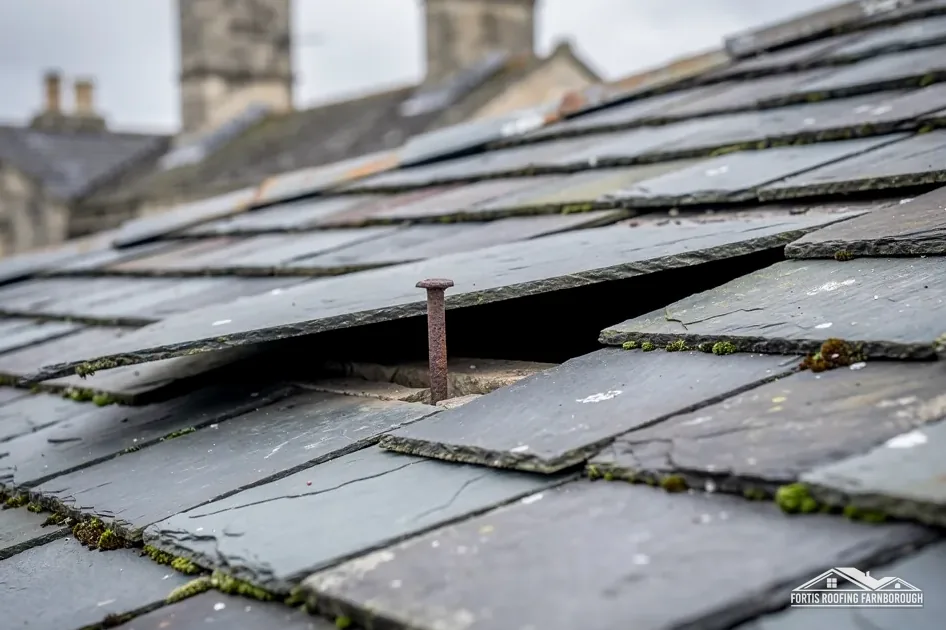
Maintenance matters, because slate asks for little but not nothing. Roof checks after storms, gutters kept clear and moss dealt with gently all help. Fixings can fail, a slate can crack, and moss can build up. Our answer on slate roofing describes the care involved.
Check the base. A slate roof is judged by the battens, underlay, fixings and structure under it, and cutting corners there wastes the slate's long life. Part of the price of a good job is that hidden work.
We survey the roof, photograph the structure and the covering, and talk through the options with their published lives and typical prices. Each route is priced as one written total, with material, fixings and underlay named in the scope. If slate does not suit your roof, the reasons will be set out, and if it does, you will see why.