The short answer
Natural slate generally outlasts tile: HomeBuilding (Sep 2025) lists Welsh slate at 100+ years, clay tile at 60-80 and plain concrete at 40-50. Slate is thin, flat and close-lapped, with a 20 degree pitch floor in Cupa's reading of BS 5534, while tiles vary by type. Weight and the street's look settle many choices.
How long each lasts
HomeBuilding & Renovating (30 September 2025) tabulates typical lives: Welsh slate "100+ years", Spanish natural slate "75-100 years", clay tile "60-80 years", plain and Double Roman concrete "40-50 years", fibre cement "30-40 years".
Marley, a tile maker, puts its roof tiles at around 60 years and stresses that figure is no warranty. Where two sources differ, the fair reading is a range with both named. A roof is also more than its covering: battens, underlay and fixings each have their own life, and a long-lived slate on short-lived fixings still needs attention long before the slate does.
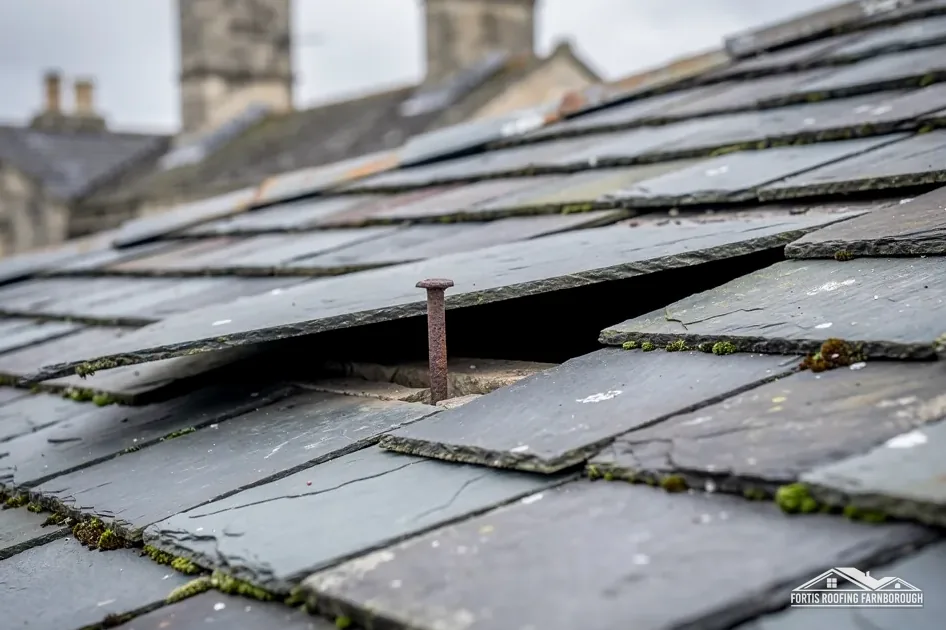
Slate's long life comes from the stone, which does not wear through as a manufactured tile can. The weak points are its fixings, because iron nails rust, and its brittleness. The nails often give out before the slate, which is why re-laying sound slates on new fixings is so common.
Lifespans are typical ranges and never promises. A well-built tile roof in a sheltered setting can beat a poor slate one, and the covering is only one part of the roof's life.
Our guide to natural and fibre-cement slate covers the cheaper imitation.
Pitch and what each needs
Pitch limits split the field. Slate relies on overlap, so it needs a slope for water to shed: 20 degrees at the lowest, per Cupa's reading of BS 5534, with hooks ruled out under 25 degrees.
Tiles vary much more. Marley publishes minimum pitches for its range. Its Canterbury clay tile is 40 degrees, Ashdowne 35, Hawkins 30 and Acme Single Camber 30, and its Lincoln pantile is 15. Among concrete tiles, plain is 35 degrees, Edgemere 17.5, Double Roman 22.5 in the smooth version, Mendip 15 in the smooth version, Mendip 12.5 for its low-pitch type, Ludlow Plus 22.5 and Ashmore 22.5.
So slate sits in the middle. A low roof may take a shallow-pitch concrete tile or pantile and not slate, while a steep roof takes either. A change of covering therefore needs the pitch measured first, and only the maker's sheet for the exact tile or slate settles the limit.
The fixing method follows the pitch. Slate on a lower slope is nailed, and tiles may need clips, nails or both depending on the pitch and exposure.
We measure the pitch at the survey and say which coverings the roof will take. Our answer on the minimum pitch for slate goes through the slate figures.
Weight, structure and approvals
Weight is where a change of covering gets serious. By the Planning Portal's rule, 15 per cent or more extra weight on the roof triggers Building Regulations approval, and an engineer's or surveyor's advice is wanted beforehand. Approved Document A applies the same test to loading, with the line at more than 15%. Light tile to heavy slate, or slate to concrete, may cross that mark.
That means the rafters, purlins and walls are looked at before a change, not after. A roof built for slate can often take most tiles, and one built for lightweight tiles may not carry slate. Our answer on slate roof weight explains the check.
Planning is separate. Class C is the normal route for a house re-roof, so a tile-to-slate change can be permitted development, though flats, listed buildings, conservation areas and Article 4 areas need checking. In four central areas under Article 4, Basingstoke and Deane wants slate and clay kept.
Councils near Farnborough set no re-roofing percentage of their own, so the Planning Portal's pair of limits, 25 per cent of the envelope and 50 per cent of the roof, guides us, and the local council's page is read for your address. Three neighbouring councils word re-covering in their own ways.
Look, cost and the choice
Slate has a thin edge, a fine texture and colours from blue-grey to green. It sits well on older houses, in terraces and in conservation settings, and it weathers without fading to a flat tone. Tiles give more variety: clay in warm reds and browns, concrete in several profiles and colours, with the character of a plain tile or the bolder lines of a Double Roman.
Costs differ. For a three-bedroom semi, HomeBuilding puts plain concrete tiles at "between £10,000 and £15,000", labour, scaffold and insulation included, with Welsh slate on that house reaching "£18,000". MyJobQuote (Oct 2026) says fitting a slate roof averages "around £7,800". Guides assume different things about the house and what is included, so each is named and none blended.
The choice is a balance. Slate costs more at the start and lasts longer, with a thinner profile and a classic look. Tile costs less, comes in a wider range and often suits a lower pitch. A roof already in one material generally keeps it, absent a good reason to change.
The survey measures the pitch, photographs the structure and covering, and sets out the options with lives and weights, then each route comes as one written total. See slate roofing for the wider service.