Britain's Victorian housing has come through a century and a half of weather, and in many houses the roof structure is still the original. Where the covering is slate, the roof may have a great deal of life left, provided its fixings and details are looked after.
Rushmoor's own conservation area documents give the local timeline. North Camp and South Farnborough were laid out from the 1860s, the Farnborough Cottage Company dates from 1863, the main roads were laid out by 1874, and Aldershot became the Home of the British Army in the 1850s. Those dates frame when houses of that era went up here. They say nothing about what any single roof is made of, and only the roof itself can tell you that.
Below: how to check what an older roof is built from, the failures that show up at that age, how lead valleys and chimneys behave, how to choose between repair and re-slating, and what planning means for older houses, for homes around Farnborough and Aldershot.
What a Victorian slate roof is built from
Houses of the period were built with a recognisable roof structure, whatever the covering, and slate has features that give it away.
The structure
Timber rafters carry timber battens, usually spaced to suit the slate, and a ridge board or ridge piece sits at the top. Larger houses may have purlins, collar ties and king posts. The timbers are often sawn softwood of good quality, though many are now dry and sometimes affected by beetle.
Clues that the covering is slate
- Thin, flat, grey or blue-grey slates in overlapping courses, with a fine, dense texture.
- Slates that shrink in size as they climb towards the ridge.
- A relatively steep pitch, since natural slate needs a minimum of 20 degrees under BS 5534.
- Lead valleys, flashings and soakers, and often lead-covered hips or ridges.
Other coverings
An old house may have clay tile, or a replacement of an earlier covering. The way to know is to look at the roof or ask a roofer. Do not rely on the age of the house alone.
Underlay
Very old roofs may have no underlay at all, with the slates laid straight onto the battens, or may have old bitumen felt that has perished. In either case, a new underlay is part of any re-slate.
Why identification matters
The covering decides the fixings, the pitch limits and the consent route. Our guide to how long a slate roof lasts sets out the published lives for each slate.
The usual failures on an old slate roof
Roofs of this age fail in a few familiar ways, and the trouble begins in the supporting parts, with the stone playing little part.
Rusted fixings
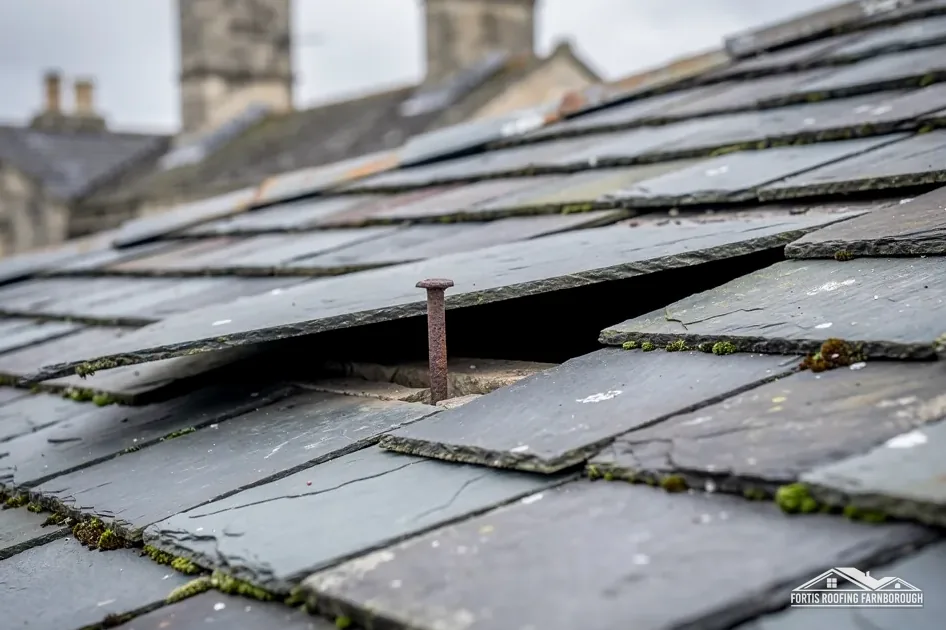
Original nails were often iron or steel, and after a century or more they have corroded through. Slates then slip, one after another, until a pattern appears. Our guide to nail sickness on slate roofs explains why.
Softened timber
Battens that have been damp for decades, especially near the eaves and in the valleys, lose their grip on nails. A split or crumbling batten cannot hold a slate however good the slate is.
Missing or perished underlay
Many Victorian roofs were laid with no underlay at all, with slates bedded straight onto battens and pointed with lime or hair mortar on the underside. Where an old felt does exist, it cracks and falls away. Either way, every slipped slate lets water onto the timber.
Worn lead
Valleys, flashings and soakers may have cracked, lifted or been patched with sealant. Lead flashing can last for over 80 years, MyJobQuote says, but it is not eternal, and movement or poor detailing shortens it.
Tall stacks
The big brick chimney stacks common on houses of this age suffer from failed pointing, loose pots and defective flaunching and flashings. They shed water into the roof around them.
Layers of earlier repair
A long life leaves cement fillets, mismatched slates, mastic on flashings and ridge pieces of several kinds. Some are sound and some hide faults.
Cast-iron gutters
Rusted and cracked iron gutters overflow and soak the eaves. Our guide to cast iron guttering covers their care.
Repair or re-slate: the decision
A Victorian slate roof usually sits at a fork. The slates may be excellent, and the roof may still need more than a patch.
When repair is enough
A handful of slipped slates, battens that test sound and nails that are still thick and clean on sample slates point to repair with tingles or hooks. It keeps the original material and costs little. Our guide to repairing a slate roof explains the methods.
When to re-slate
Rust across the slopes, soft battens or no sound underlay point to a re-slate, which cures the cause instead of treating symptoms. The sound slates are taken off, sorted and put back on new battens and underlay with fixings that will outlast them. The roof then restarts on its existing stone.
The slate itself
HomeBuilding (Sep 2025) gives Welsh slate 100+ years and Spanish natural slate 75 to 100 years, as typical ranges. A roof at or past those figures may have slates that are laminating or brittle, and then a new covering is the fair answer. Sample slates, tapped and lifted, show which you have.
Cost context
The guides say a typical UK average for fitting a slate roof is about £7,800 (MyJobQuote, Oct 2026), and a re-slate that reuses slates depends on how many are sound. Our guide to slate roof cost explains what moves the price.
What you see
Photographs of the nails, battens, lead and slates go into the survey, with a written view and a price for the route.
A note on lime and old mortar
Some Victorian roofs carry lime mortar pargetting under the slates, a plaster-like layer that stopped wind and dust. It often crumbles when disturbed, and a re-slate replaces it with a modern underlay.
Lead, chimneys and the details that fail first
Houses of this period have many junctions, and slate roofs of the time leaned on lead to seal them.
Valleys
Lead lines a valley that takes water from two slopes together. After many decades it can be thin, cracked at its joints or covered in later patches, and repair means re-lining or renewing sections, with the slates either side cut to a clean line.
Flashings and soakers
Where roof meets wall or chimney, lead flashings and soakers keep rain out. They lift from the masonry, crack under movement or lose their sealing mortar, and are then re-dressed or renewed with the joint repointed.
Lead codes
Lead sheet is sold in codes by thickness. Royston Lead's brochure lists Code 4 at 1.80 mm and Code 5 at 2.24 mm for flashings and valley gutters, with Code 3 at 1.32 mm for soakers only. A roofer picks the code for each detail. Our guide to lead flashing repair covers the work.
Chimneys
The stack needs a look at its pointing, pots, flaunching and the flashing at its base, and trouble there should be sorted before the roof is re-covered. In Rushmoor\'s Cargate Article 4 area, altering or removing a chimney visible from public land needs permission.
Ridge and hips
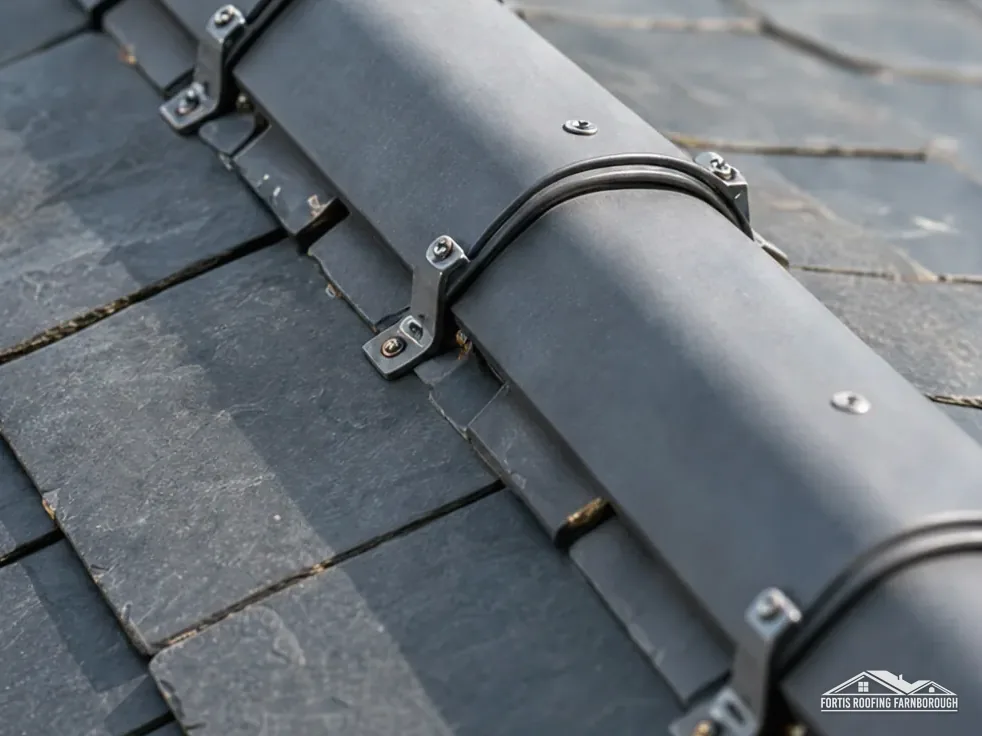
Ridge pieces may be clay, stone or lead-covered, and the mortar beneath them often fails first. Repairs add mechanical fixing, as BS 5534 expects.
Planning, conservation areas and listed houses
Victorian houses are often in conservation areas, and some are listed. Both affect what can be done to the roof.
Conservation areas in Rushmoor
Rushmoor has nine designated conservation areas, among them Cargate, Manor Park and South Farnborough, and the council\'s map shows whether your address lies in one. Re-roofing a house there normally stays within Class C, although an Article 4 direction can restrict related work such as chimneys.
Listed buildings
For a listed house, Class C is still available, and it sits alongside a duty to obtain consent where the work alters the building. A change from slate to another material would very likely count as such a work. Our guide to replacing the roof on a listed building sets out the route.
Matching materials
Where the council or a conservation officer has a view, expect to be asked for natural slate of a matching type, not artificial slate. Reclaimed slate often gives the best match, and our guide to reclaimed roof slates explains it.
Building Regulations
A re-slate probably needs a building control application, and a heavier covering, by 15 per cent or more, brings approval into play whatever else applies. For Rushmoor addresses, the Hart and Rushmoor Building Control Partnership is on 01252 398715.
Flats
A flat or a house converted to flats has no permitted development rights, so check with the council.
Looking after a Victorian slate roof
A roof that has lasted this long is worth keeping, and a little attention keeps it going.
From the garden each season
Look at each slope in good light, with binoculars. Note slipped or missing slates, a wavy roofline, gaps along the ridge and signs of lifting at flashings. Take the photographs from the same spots every time, so that changes show.
Do not walk on it
Old slate cracks under a foot, and the fixings may already be weak. Anything that needs access, such as an aerial, a chimney check or gutter work, should use proper roof ladders and boards.
Clear gutters and downpipes
Overflowing water soaks the eaves and rots timber and slate fixings. Clearing leaves and moss once or twice a year is cheap insurance.
Keep moss in check, gently
Slate carries moss without harm, though thick growth in the laps holds water. If it needs removing, use a gentle method. Marley, a tile maker, does not recommend jet washing at high power for slate or tile.
Deal with small faults early
A single slipped slate repaired now costs little. Left through a winter, it can wet a batten and underlay.
Windows, dormers and extensions
Older houses often have later additions: a dormer, a rear extension with a flat roof, a roof window. Each joins the original roof with its own details, and each is a place where the slate meets another material. They deserve the same close look as the main slopes, and their lead and flashings are as likely to need attention as the chimney.
Keep records
Photographs, surveys and invoices show a buyer or an insurer the roof's history. Our slate roofing service provides photographs with each survey.
One written total follows each survey, with VAT stated.