Anyone planning a new slate roof soon meets two options that look similar from the road. One is natural slate, split from rock. The other is a fibre cement slate, a manufactured sheet made to resemble it. They differ in life, in how they weather, in how they are viewed by planners and in what they cost, and the right choice depends on the house and the budget.
The published lifespans make the contrast clear. HomeBuilding gives Welsh natural slate 100+ years, Spanish natural slate 75 to 100 years and fibre cement tile 30 to 40 years. Each is a typical range rather than a pledge, and bad fixing can cut any of them short, yet the spread shows how long the choice will last.
This guide compares the two on lifespan, weight, appearance and consent, cost and the things to check on an older fibre cement roof, for houses across north-east Hampshire and west Surrey.
What each material is
The names tell you most of what you need. The two are different in kind, not just in price.
Natural slate
Natural slate is a fine-grained metamorphic rock that splits cleanly into thin, flat sheets. It is quarried, split and trimmed to size, and it is a natural product with variation in colour, texture and thickness. It does not rot or rust. It is sold as Welsh, Spanish and other types, and as reclaimed slate recovered from old roofs.
Fibre cement slate
A fibre cement slate is manufactured from cement and reinforcing fibres, pressed into sheets and cut to the shape of a slate. It is made to a standard size and finish, so each one is uniform. Modern ones are made without asbestos, though older products from before the year 2000 may contain it, which is covered later.
How each is fixed
Both are nailed or clipped to battens in overlapping courses, with the pitch, headlap and fixings set by the maker's instructions. BS 5534:2014+A2:2018 sets out how slate and tile are fixed, and it applies to both.
Handling and breakage
Both are brittle. Natural slate is cut and holed by hand, and a roofer working with it gets a feel for how each piece splits. Fibre cement can be cut with powered tools, which makes dust that must be controlled for any older, suspect sheet. Spare slates should be kept after the job, since a matching one is hard to find years later.
Variation
Natural slate varies from piece to piece, and a good roofer sorts and blends them. Fibre cement is regular, which some people like and others find flat. Over time, natural slate weathers evenly, and fibre cement can fade or grow moss differently.
If you are unsure what is on your roof now, a roofer can tell by sight and by touch, and a test is the answer for any suspected asbestos.
Lifespan side by side
Published figures give a rough measure of how long each is expected to last.
| Covering | Typical life |
|---|---|
| Welsh slate | 100+ years |
| Spanish natural slate | 75 to 100 years |
| Reclaimed Welsh slate | 50 to 80 years |
| Fibre cement (Eternit) tile | 30 to 40 years |
What the gap means
A natural slate roof may be expected to last two to three times as long as a fibre cement one. Over a century, that means a fibre cement roof is renewed more than once while a Welsh slate roof is not. The upfront price of the two reflects that, though the whole-life cost is a different sum.
These are typical ranges
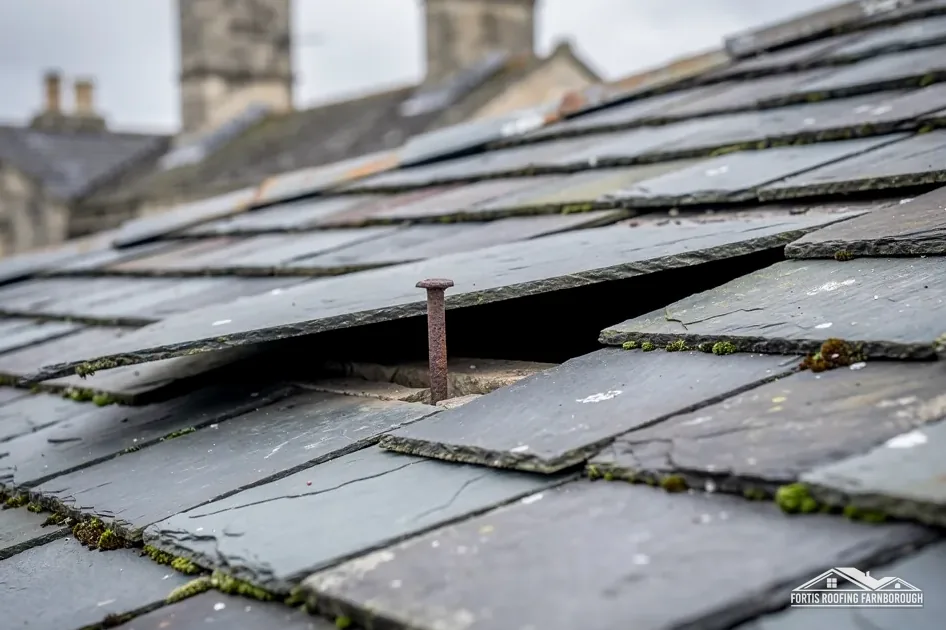
None of the figures is a guarantee or a warranty. A roof's life depends on how it was fixed, how it has been looked after and the local weather. The fixings often fail before the slate does, as our guide to nail sickness on slate roofs explains. A fibre cement roof can fail early if the sheets absorb water and crack in frost.
Reclaimed slate
Reclaimed natural slate sits between, with a shorter expected life because it has already been in service. It brings weathering and colour that new slate lacks, and it is often chosen for matching.
For the long view
An owner with decades ahead in the house gains most from the longer-lasting covering, while a shorter horizon may favour lower upfront cost.
Weight and the 15 per cent rule
A roof covering is a load on the structure, and changing it can change the load. The rules treat that carefully.
Why weight matters
The rafters, purlins and walls were designed for a certain weight of covering. A much heavier one can overload them, and a lighter one can leave them with less restraint against wind lift. Natural slate, clay and concrete tiles, and fibre cement slates all weigh different amounts per square metre, and the maker's data sheet gives the figure for each product.
The regulation
On the Planning Portal's test, a covering that makes the roof 15 per cent or more heavier brings in Building Regulations approval, and the Planning Portal's guidance is to take a structural view first. Approved Document A frames the same idea as a loading increase of more than 15%.
Putting it into practice
If you are replacing concrete tiles with natural slate, or fibre cement with natural slate, ask for the weights and the percentage change. If the change reaches that 15 per cent mark, approval and a structural look follow. If the new covering is lighter, a check on the fixings and wind restraint is still sensible.
Matching an existing roof
If only one slope is being re-covered, the new slate has to sit well beside the old. Natural slate from a different quarry or batch can differ in colour and thickness, and fibre cement from a different maker differs again. Reclaimed slate often gives the closest match to an old roof, since it has the same age and weathering.
Other triggers
The Planning Portal also notes that approval is needed if the performance of the new covering in a fire would be significantly different from the old one. In Farnborough the question goes to the Hart and Rushmoor Building Control Partnership, 01252 398715.
Where the survey finds the structure sound and the weights compatible, the choice can be made on look and cost.
Looks, conservation areas and consent
Natural slate has a depth of colour and a slight unevenness that is hard to reproduce. Planners and conservation officers know the difference, and they often have a view.
Appearance
Natural slate has texture, variation and a character that ages gracefully. Fibre cement is uniform and can look flat, with a surface that does not weather the same way. From the road, the difference may be small on a new roof and larger after a few years.
Conservation areas
In a conservation area, the council may expect materials to match the original. Basingstoke and Deane controls roof changes in four town-centre conservation areas, asks for original slate and clay to be kept, and calls artificial slate unlikely to be acceptable. That is one council's wording for its own areas, and other councils differ. Rushmoor has nine designated conservation areas, and Class C permitted development for a re-roof on a house still applies there, though an Article 4 direction can change it.
Listed buildings
A listed house keeps its Class C right but also needs separate listed building consent whenever its character is affected. Swapping natural slate for an artificial substitute would struggle to meet that test.
Check first
Ask your local planning authority before you order, and keep the answer in writing. Our guide to Victorian slate roofs covers older houses where the choice is most often questioned.
Cost, as published
Natural slate costs more to buy than most alternatives. The published figures show by how much for the slate itself.
| Slate | Supply-only price per m² |
|---|---|
| Spanish natural slate | £72 |
| Reclaimed Welsh slate | £90 |
| Welsh slate | £185 |
That is for the slate alone, without labour, underlay, battens, scaffold or waste. The cost of a complete roof is higher, and MyJobQuote gives around £7,800 as the average for fitting a slate roof (Oct 2026, typical UK range). HomeBuilding says Welsh slate on a 65 m² semi might reach £18,000, against £10,000 to £15,000 for plain concrete tiles (Sep 2025).
Fibre cement
Fibre cement has no supply price per square metre in the guides, so a fair comparison comes from a supplier's quote for your own roof.
Maintenance
A natural slate roof needs little beyond an occasional look for slipped slates and failing fixings. Fibre cement needs the same attention, and it may need cleaning more often if moss takes hold on its surface. Gutters and valleys need clearing on either, and the lead flashings last long if they are well fitted.
Whole-life view
A covering that lasts 100 years and costs twice as much to fit is not necessarily dearer in the long run than one that must be replaced after 30 to 40 years. It depends on how long you will own the house and what the money could do elsewhere.
One total
Our written total follows the survey, with VAT stated and scaffold included. Our guide to slate roof cost sets out what moves the price.
Old fibre cement roofs and asbestos
Fibre cement was made with asbestos fibres until it was banned. If your roof is older, this is the first question to ask.
The pre-2000 rule
Under HSE's guidance, any property constructed or refurbished before the year 2000 should be treated as containing asbestos until shown otherwise. That applies to a fibre cement roof of unknown make and age. You cannot tell by looking.
What to do
Do not break, drill, scrub or pressure clean an old fibre cement roof. A surveyor takes a sample, a laboratory analyses it, and the material is named. If it is asbestos cement, HSE treats careful removal as non-licensed work, provided the material is handled without breaking it up, and substantial breakage makes it notifiable. Asbestos waste travels on a consignment note and never goes into a household skip.
Why it matters for the choice
If you are replacing an old fibre cement roof, the removal route and cost depend on the survey. MyJobQuote gives around £2,750 for asbestos roof removal and around £325 for an asbestos survey (Sep 2026, typical UK ranges). The survey comes before the quote for the new roof.
A new roof
A modern fibre cement or natural slate roof raises none of these concerns, and the choice between them is about look, life and cost.
Our slate roofing work starts by identifying what is there, whatever the roof is made of.