Every slate on a roof has to be fixed to something. Two methods are in common use. The traditional one drives nails through holes in the slate and into the batten behind. The other uses a hook or clip, a small piece of stainless steel that engages the lower edge of the slate and is fixed to the batten, so that nothing passes through the slate except at the fixing points where it is holed for other reasons.
Each suits some roofs and not others. The choice depends on the pitch of the roof, the type and thickness of the slate, the exposure and what has to be repaired later. A fixing that is right on a steep roof may be wrong on a shallow one, and the manufacturer's data sheet and the British Standard both put limits on it.
This guide explains how each method works, what the published limits are, how they compare on look and repair, which suits which roof and what to ask a roofer before the choice is made, for slate roofs around Farnborough.
How nailing works
Nailing is the long-established way to fix slate. Two nails are driven through holes near the head of each slate, which is the end that sits uppermost on the roof. The slate above overlaps the nail heads, which keeps them dry.
The nails
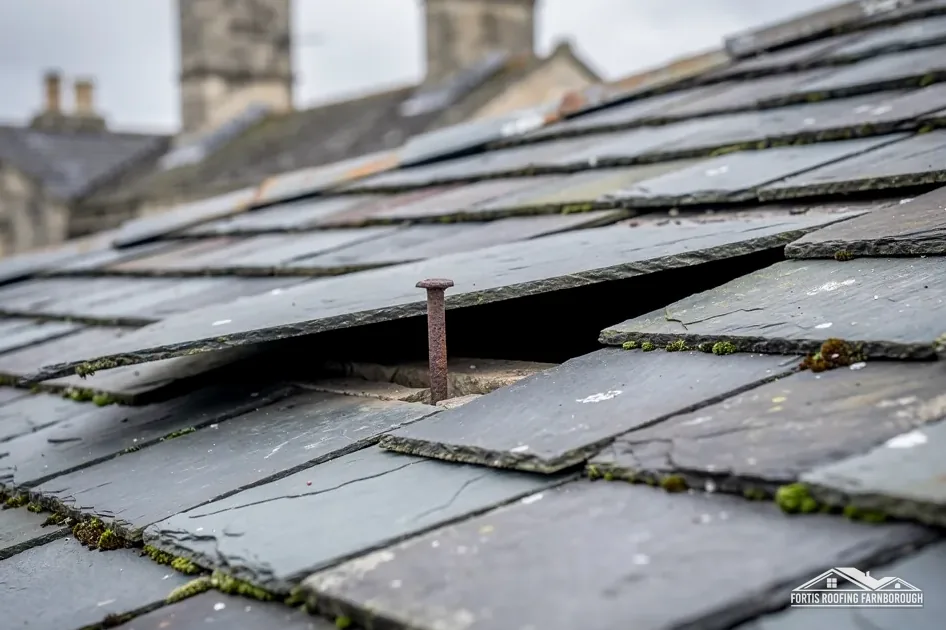
Slate nails are copper or stainless steel, chosen for length and gauge to suit the slate and batten, because those metals do not rust through. Iron and steel nails were widely used in the past, and when they rust, the slates slip. That failure is nail sickness. Our guide to nail sickness on slate roofs explains it.
Why nailing holds
A nailed slate is secured at its head, and it is held down by the weight of the slates above as well as by the nails. On a steep roof, gravity helps hold each slate against the batten. The method is simple and has a long record.
Where it is the choice
Nailing is the standard for shallower roofs, for thick or heavy slates and for exposed places. Cupa, a slate supplier, says hooks are not for pitches under 25º, so slopes of 20º to 25º take nails, and anything below 20º falls under BS 5534's minimum for natural slate.
Limits
A nailed slate has holes through it, and each hole is a point where a slate can crack if nailed too hard or too close to the edge. A nail that misses the batten is useless, and a nail driven too far can split the slate. The work needs a skilled hand.
How hook fixings work
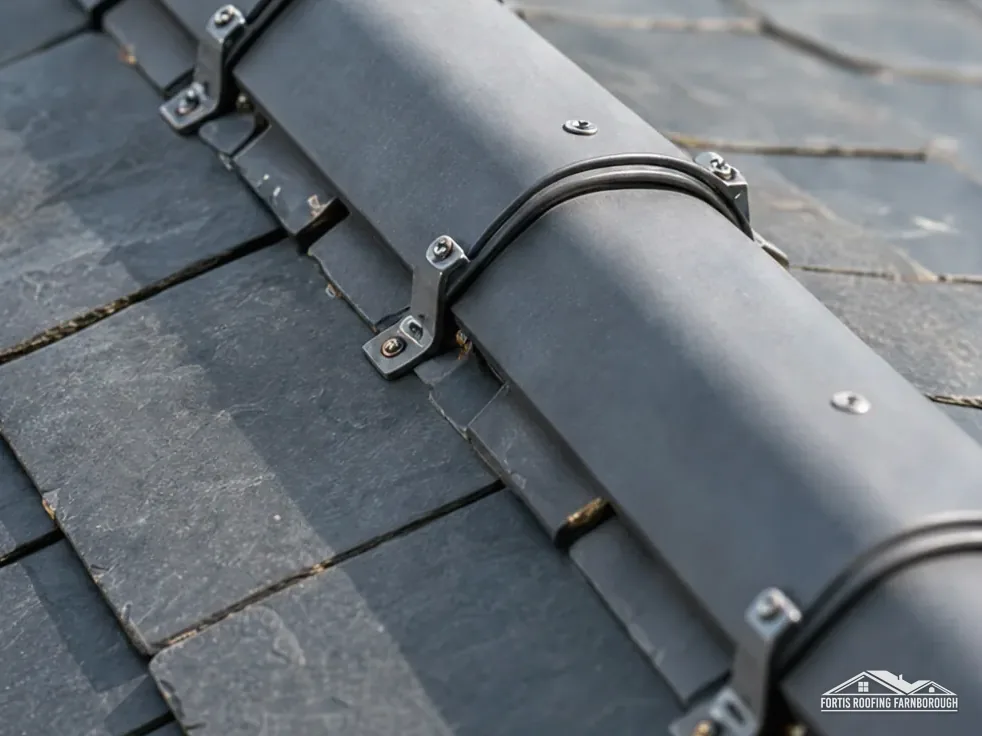
A hook fixing holds the slate by its lower edge, not by nails through its head. The hook is fixed to the batten and curls over the bottom edge of the slate, holding it in place against lifting and sliding.
The parts
The hook is a shaped piece of stainless steel, sometimes called a slate hook or a rafter hook depending on the design. It is fixed to the batten by a nail or screw, and the slate sits in it. Because the metal is stainless, it is not prone to the rust that causes nail sickness.
Why use hooks
- No nail holes are needed in the slate, which avoids the risk of cracking at the hole.
- Stainless steel is resistant to corrosion.
- A hooked slate can often be lifted and replaced without the broken nail problem.
- It can speed up laying on suitable roofs.
The limits
The hook relies on the roof being steep enough that the slate sits against the batten under its own weight. Under 25º, Cupa's advice is to avoid hooks, since a slate held only at its lower edge can lift in wind and rain. Hooks are also visible at the edge of the slate, a detail some owners notice.
Where hooks are found
Hook fixings are common on repairs and on some modern slating, especially where an old roof is being renewed or a lost slate has to be replaced. Our guide to repairing a slate roof shows where they and tingles are used.
The pitch limits that decide the choice
On any given roof, the pitch settles the fixing before preference comes into it. Two figures matter.
| Source | Statement |
|---|---|
| BS 5534 | Indicates a minimum roof pitch of 20º for natural slate |
| Cupa | Hooks not to be used on any pitch under 25º |
Reading the two figures
Below 20º, natural slate is not recommended by the standard at all, so a different covering or a different design is needed. From 20º to 25º, slate can be used, and the fixing is nails. Above 25º, both nails and hooks are possible, and other factors decide the choice.
Why the pitch matters
A shallow roof sheds water more slowly and is more exposed to wind-driven rain, which can be pushed up under the slates. A steeper roof sheds water faster and holds slates down better. Hooks, which depend on gravity as well as the clip, are less secure on a shallow slope.
Measuring the pitch
The pitch is measured on the roof or from drawings, and a roofer records it at survey. A roof that looks steep from the garden may be 22º, so it is measured, not guessed.
Product data
Slate makers publish their own recommendations on pitch, lap and fixing, and the data sheet governs the product. BS 5534:2014+A2:2018 covers slating and tiling, and while Marley points out it is not a legal duty, it describes sound fixing in detail.
Look, repair and wind
Once the pitch allows both, the differences are in how the roof looks, how it is repaired and how it stands up to weather.
Appearance
A nailed roof has its nails hidden under the slates above, so the face is clean. Hooks can show as a small bright tab at the lower edge of a slate, depending on the design and the angle you see it from. On a period house, many owners prefer the look of a nailed roof.
Repair
A nailed slate that has failed is usually replaced with a hook or tingle, since the nail holes in the old slate are not reliable. A hooked slate can be lifted and replaced in place. In a roof where the original nails are failing, hooks, clips and tingles are the main tools of repair. Our guide to nail sickness sets out when repair stops making sense.
Exposure
A roof in an open position, on the edge of an estate or on a hill, sees more wind than one tucked among other houses. Where exposure is high, the roofer may add fixings or choose the method that holds best, and the maker's data sheet sets the minimum for the site. Neither nails nor hooks is a cure for a roof that is under-fixed at its edges.
Wind
Both methods hold slates against wind when correctly used on the right roof. Exposed edges, verges and ridges get extra fixing, and the standard sets out how many. The weak point on any roof is a poorly fixed slate, not the type of fixing.
Cracks and breakage
A hook avoids a nail hole, and a nail can crack a slate if it is driven badly. A hook can scratch or stress the edge if it is poorly formed. Both depend on workmanship.
Cost
Hooks cost more per fixing than nails, though they can save time. The difference is small beside the cost of the slate and the scaffold, and it is not a reason to pick the wrong method for the pitch.
Which suits which roof
A few simple cases show how the choice usually falls.
A steep Victorian roof, 40º or more
Either works. A nailed roof gives the traditional look, and hooks can be used for repairs. The decision follows the condition of the battens and the owner's preference.
A moderate pitch, 25º to 35º
Both are possible. Nailing is the usual choice for a full re-slate, with hooks for repairs and in places where nails are hard to place.
A shallow roof, 20º to 25º
Nails are the answer. Hooks should not be used below 25º. The slate lap is set larger, and fixings at the edges are doubled where the maker requires.
Below 20º
Natural slate is outside the BS 5534 minimum, so the covering or the design has to change. A roofer who proposes slate on a roof this shallow should explain how it meets the standard.
A conservation-area or listed roof
The look matters, and nailing with hidden fixings is usually preferred. The council may have views, and a listed building needs separate consent where its character is affected. Our guide to re-slating a roof covers how the work is done.
A roof being repaired
Hooks, clips and tingles do most single-slate repairs, because they can be fitted without nailing through the slates above.
The survey records the pitch and the condition, and the specification names the fixing for each part of the roof.
Questions to ask and cost context
A short list of questions shows whether a roofer has thought about the fixing and not just the slate.
Questions
- What is the pitch of my roof, and how was it measured?
- Are the slates to be nailed or hooked, and why?
- What material are the nails or hooks, and what are their sizes?
- How many fixings does each slate get, and how many at the edges and ridge?
- Does the specification meet BS 5534 and the maker's instructions?
What a good answer sounds like
A good roofer names the pitch, quotes the limit that applies and says why the chosen fixing suits. A vague answer, or one that ignores pitch, is a warning.
Cost context
The fixing is a small share of a slate roof's cost. A typical UK average for fitting one is around £7,800 according to MyJobQuote (Oct 2026), and HomeBuilding's slate supply prices run at £72, £90 and £185 a square metre for Spanish, reclaimed Welsh and Welsh slate respectively (Sep 2025). Our guide to slate roof cost shows what moves the figure.
One written total
The written price after the survey shows VAT, and states the fixing method, which makes a fair comparison with other quotes possible.
Next step
Our slate roofing service begins with measuring the pitch and checking the battens, since both decide what can be fixed.