Anyone who has looked closely at a good slate roof will have seen that most of the slates are whole, and that the interesting work is at the edges. Where the roof meets a wall, runs into a valley or turns round a hip, whole slates do not fit, so each one is cut to shape. Those cut slates are what keep the water out at the most exposed points of the roof, and they are the part of the job that takes the most skill.
People look up how to cut slate for several reasons. Some have a small repair, such as one slate to replace. Some are building a garden structure. Others have taken on a re-roof themselves. The right advice varies with each, and the risks are not the same.
Here we explain what cutting slate involves, from marking out to holing and dressing the edges, why a slate has to be accurate to do its job, and what makes the work hazardous. The aim is to help you understand what a roofer is doing, and to judge when a task is beyond a safe home project. It is general information, while a survey of the roof in question gives the specifics.
Why slates are cut at all
Slate is laid in overlapping courses, each row lapping the one beneath so that water runs from slate to slate down to the gutter. Across the open field of a roof, whole slates of one size do the job. The edges are different.
Where cutting happens
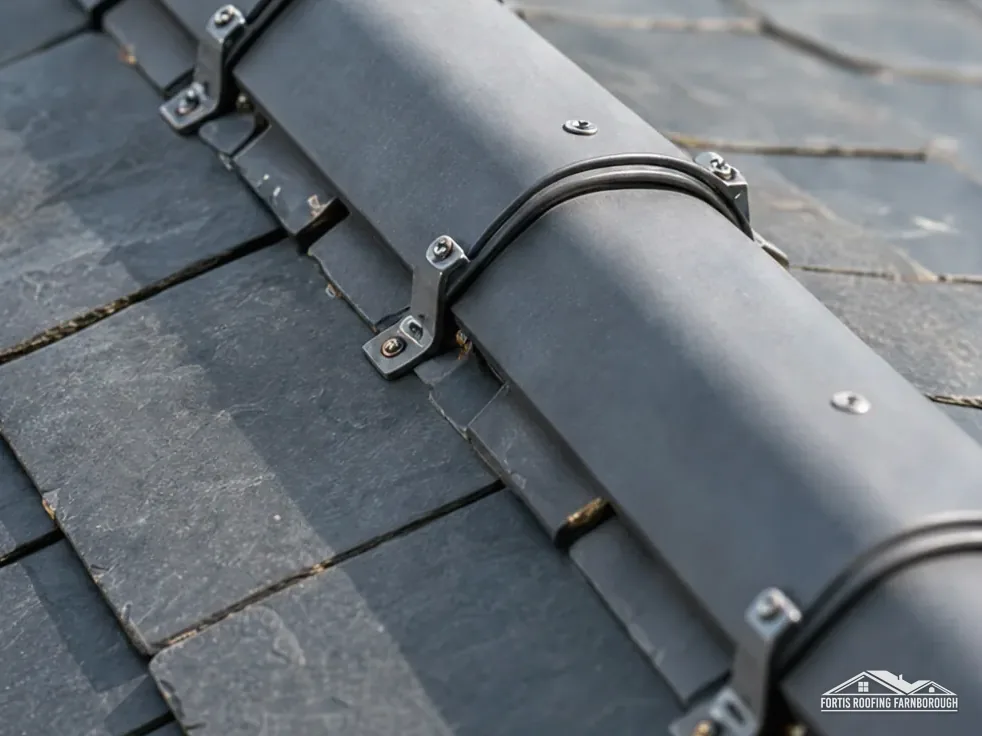
At a verge, where the roof ends over a gable wall, the last slates must stop neatly at the edge. At a hip, two slopes meet on an outward angle, and the slates on each side must be cut to the line of the hip. At a valley, where two slopes meet on an inward angle, the slates are cut to the line of the valley and lap over its lining. At a wall, a chimney or a roof window, slates are trimmed to the flashing. At the ridge, the top course is cut to suit.
Why the cut slate matters
A cut slate carries the same load of water as a whole one, and its edge may sit over a joint in the lining or flashing beneath. If the cut is too tight, the slate will not sit flat. If it is too loose, a gap opens and water gets in. Cut slates are often where a leak starts.
Cutting to a pattern
Slate roofs follow a pattern of lap and gauge, the spacing between rows. Every cut slate has to preserve that pattern. Our answer on slate headlap explains what the lap does.
Marking, trimming and dressing an edge
A cut slate is made in stages, and each stage affects the next. Roofers use slate cutters and hand tools, and the technique matters more than the tool.
Marking out
The cut line is marked on the slate, using the next slate, a template or a measurement taken from the roof. The mark must allow for the lap the slate will have under the course above it and for the gap to the valley or hip line. Poor marking is the first source of error.
Trimming
The slate is split or cut to the line. Slate splits along its natural cleavage plane, so a cut across the grain takes care, and a slate can break unexpectedly. A roofer may cut over a bench or on the roof, with the slate supported on both sides.
Dressing the edge
A fresh cut leaves a sharp, rough edge. Dressing it means taking off the burr and tidying the line so that the slate sits flat and does not catch the one beside it. On visible edges, such as at a verge, a clean, even edge also looks right.
Beyond the edge
An edge cut by hand will not be as sharp as a factory edge. That is acceptable on a roof, where cut slates sit in the lap of the next course and are not on show. A roofer will aim for a close fit, not a perfect one.
Wear
Slate dust is fine and gets into everything. Hand tools wear quickly on slate and need regular sharpening and care, which is one reason a small repair is rarely worth buying the kit for.
Holing, nails and hooks
A slate is held in place by fixings, and each slate has to be made ready to take them. This is holing, and it is a second kind of cutting.
Nail holes
Slates are usually nailed through two holes near the head. The holes are punched or drilled from the underside, so that the break on the top face is a clean countersink. The position of the holes is set by the lap and the pattern, and nails driven in the wrong place miss the batten or weaken the slate.
Slate hooks
Another method is to hold a slate by hooks at its tail. Cupa, a natural slate supplier, rules out hooks on slopes under 25 degrees, so the method is limited by the pitch of the roof. Our guide to slate hooks against nails compares the two.
Holes in cut slates
A cut slate often has to be holed afresh, because its original holes have been trimmed away. Its new holes must be in the right place for the batten it will hang on.
The pitch rule
Cupa reads BS 5534 as giving 20 degrees as the lowest pitch that natural slate should be laid on. No amount of careful cutting rescues a roof that is shallower than that. Measure the pitch first.
Fixings
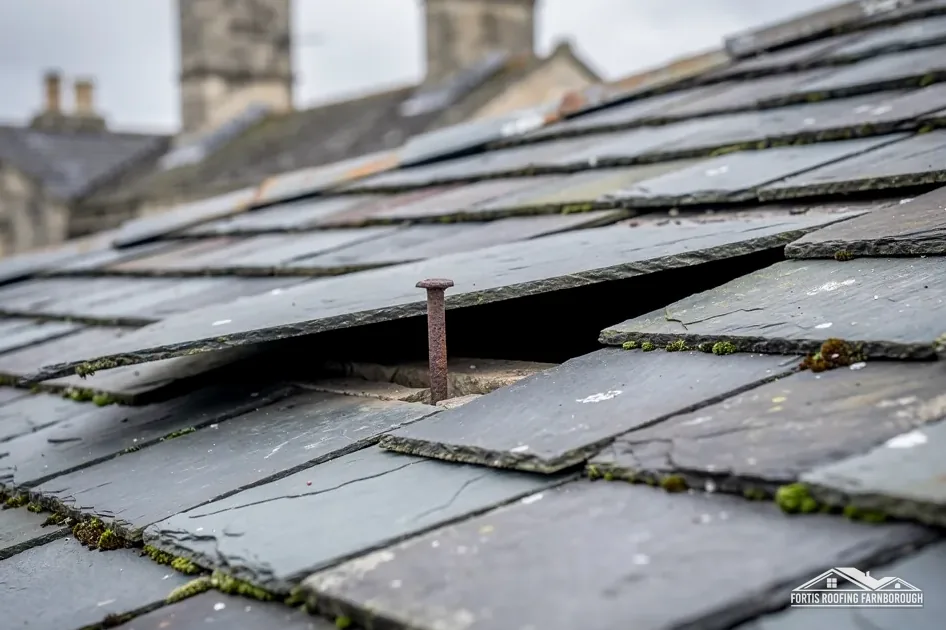
Nails for slate need to resist corrosion, because a rusting nail is the cause of nail sickness, where slates slip. Using the right fixing matters as much as the cut.
Why exactness matters on the roof
It is tempting to think of a roof as forgiving, since water runs downhill. In fact a slate roof relies on accuracy, and small errors have outsized effects.
The lap
The lap is how far one slate reaches over the slate two courses beneath it. A slate cut short reduces the lap at that point, and wind-driven rain can travel up under it. The lap is chosen to suit the pitch and exposure, and cutting should not erode it.
The gap between slates
The side gaps between slates in a course must be covered by the slate in the next course up. A cut slate that is too wide or too narrow breaks that rule and leaves a path for water.
Valleys and hips
At a valley the slates must overhang the lining by a set amount, leaving a channel of the right width. Too narrow a channel chokes with debris, and too wide a channel lets water spill past. At a hip, the cut line must be straight, so the hip covering seats well.
Breakage and cost
Cutting breaks slates. In HomeBuilding's supply-only table the slate itself costs £72 per m² for Spanish natural slate, £90 for reclaimed Welsh and £185 for Welsh slate. A fumbled cut wastes a slate, and on a larger job the waste adds up.
Matching
If a roof is old, new cut slates must match the weathered ones in size and thickness. Our answer on reusing roof slates covers when old slates can go back.
The risks of the work
Cutting slate for a roof is skilled, and it is also hazardous. The risks come from the height, the surface and the material.
Working at height
A roof is a place to fall from. A pitched slate roof is steep and slippery when damp, and edges are unprotected without scaffold. Safe work needs edge protection, roof ladders and, on a high building, a scaffold. A fall from a domestic roof can cause serious injury.
The surface
Slates are brittle. Stepping on a cracked or loose one can send you sliding. Moss makes it worse. Our answer on walking on a tiled roof explains why roofers use ladders and boards.
Dust and cutting
Cutting slate with a disc creates dust that is unpleasant to breathe, and eye protection and a mask are sensible. Handling sharp slate edges can cut hands.
Asbestos
HSE's advice is to presume asbestos in any building built or refurbished before 2000 until a check shows otherwise, and it classes asbestos cement roofing as fragile in every case. A slate-look covering on an older building might be asbestos cement, so stop if you have any doubt. Breaking asbestos cement up substantially is notifiable non-licensed work under HSE's rules, and not for guesswork.
The law
Under the CDM Regulations 2015 a domestic client's duties pass to the contractor, and a contractor working alone still prepares a construction phase plan.
When to call a roofer
Cutting slate is a skill built up over many roofs, and it is easy to underestimate. This is where the line usually falls.
Jobs from the ground
A few jobs never go near the roof: shaping a slate for a garden path, a plant label or a craft project. They can be done with the right tools and eye protection at a workbench. The cutting techniques above apply, and there is no height risk.
One slate on a roof
Replacing a single slate looks simple and often is for a roofer, but it means reaching the slope safely, lifting the slates above and fixing the new one with a proper fixing. Our answer on replacing a single slate explains the method. If the slope cannot be reached from a ladder at the eaves, leave it to someone equipped for the height.
Anything at hips, valleys or abutments
These are where cut slates matter most and where an error is most expensive. They also tend to be on the highest and most awkward parts of the roof.
A re-slate
Re-slating a roof is a trade skill, and a job where a survey, scaffold and a plan matter. The cutting alone, across every hip, valley, verge and abutment, takes a good deal of the time on site, and it is what separates a roof that sheds water for decades from one that leaks within the first winter.
What a survey gives you
We measure the roof and photograph its condition, then explain which parts are in good order and which need work. Citizens Advice recommends at least 3 written quotes. After the survey, one written price follows. Our slate roofing page covers the slate work we carry out.