Most advice on hiring a roofer reads like a checklist of credentials. This post is a script instead. It follows the conversation as it happens, from the first phone call to the point where you are asked to sign, and it puts a question at each step that makes a good roofer easy to spot and a poor one uncomfortable.
The questions are the same whoever you ask, including us. They are aimed at the things that go wrong on real roofs: a vague scope that grows once work starts, a survey that cannot be checked, a scaffold that arrives without a licence, a price with gaps in it, and payments that run ahead of the work.
None of this needs technical knowledge. You are asking for things to be explained and put in writing. A roofer ready to show photographs, name the parts of the roof and say who arranges each task deserves a longer conversation.
Read the sections in order, or jump to the one you need. For the evidence side, a companion post covers what to look for when hiring a roofer.
Questions about the scope of work
Begin with what exactly is going to be done. A scope is a list of jobs, and a job you cannot name is a job that can be added to the price later.
What to ask
- Which slopes or sections are included, and which are left alone?
- Is the job a repair, a partial re-cover or a full re-roof, and what is the reasoning?
- What happens to the battens, the underlay and the ridge, hips and verges?
- Are flashings and valleys part of the job, or only the covering?
- What is not included, and what would add to the price if it turned up?
Why the last question matters
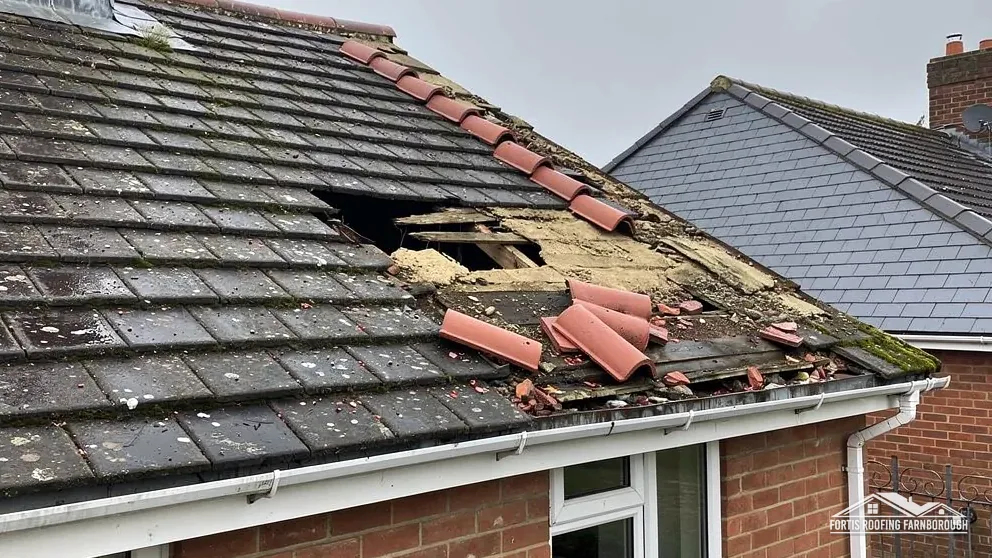
Hidden damage is the usual cause of disputes. A roof opened up can reveal rotten battens or a damaged rafter that nobody could see from the loft. Ask in advance how that would be handled: who tells you, how soon, with what evidence, and whether you decide before anything extra is done.
Listen for plain words
You should hear tiles, battens, underlay, flashing and ridge, not a general promise of "the works". If the answers are vague, ask for the scope to be written down and read it back. A repair that will do the job properly should be offered as a repair. A roofer who reaches for a full replacement before looking at the evidence is selling a bigger job than your roof may need.
If you are unsure what the parts are called, the guide to spotting a dodgy roofer lists the warning signs that sit alongside these questions.
Questions about the survey and what it found
A quote should rest on a survey, and a survey should leave you with something you can look at. The second part of the conversation is about evidence.
What to ask
- Did someone go on the roof, or look from the ground?
- Was the loft inspected from inside?
- Can I see photographs of the actual problems?
- What are the measurements, and how many tiles, metres of lead or square metres of membrane are involved?
- How would you tell me if the repair does not fix the leak?
Photos and measurements are the test
A roofer who has really looked at your roof can show you what they saw. They can point to the cracked flaunching, the missing mortar under the verge, the failed outlet or the lifted lead, and say how it connects to the stain on your ceiling. If the explanation sounds rehearsed and the pictures are generic, be careful.
Ask for the findings in writing
The written findings should name the problem, say where it is and say what fixes it. They give you something to put in front of a second roofer, which is valuable: Citizens Advice's guidance is to collect three or more quotes in writing before choosing. A good roofer will not mind you doing that.
If you are still weighing up what a survey should cost, our post on how much a roof survey costs gives the typical figure and what it buys. Take your time over this stage, because every later question depends on getting it right.
Questions about scaffold, consents and building control
Access and permissions are where small firms and large ones most often differ. Ask who arranges each of these, and ask for the answer before the price is agreed.
Scaffold and the highway
A highway licence is the legal step whenever scaffold occupies the footway or carriageway (Highways Act s169), and the highway authority grants it. For Rushmoor addresses that is Hampshire County Council, which expects the scaffolder to put in the application, with a 10 clear working day gap before the start date. Where scaffold stays inside the property boundary, no licence enters the picture. Other authorities have their own fees and timings, so ask who applies, who pays and how long it takes.
Building Regulations
A re-roof can need Building Regulations approval, depending on the work. The Planning Portal draws two lines, at 25 per cent of the building envelope and 50 per cent of the roof; work under both is not usually notified. A covering at least 15 per cent heavier is different, because approval and a structural check then apply. Ask the roofer whether building control needs to be told and who does it. In Farnborough the service is the Hart and Rushmoor Building Control Partnership, on 01252 398715.
Planning and heritage
Class C permitted development normally covers re-roofing a house. Flats are different, and a listed house needs listed building consent as well. Conservation areas can bring Article 4 directions. Ask whether the roofer has checked your address with the council.
Waste and protection
Ask what happens to the old materials, how the garden and driveway will be protected, and who clears the site each day.
Questions about the written quote
A written quote before work starts is the first protection, and what it says matters as much as having it. Get a single total price on paper, with the scope described in the same document.
What to check it states
- The total price for the whole job, not a rough range.
- Whether VAT is included. The standard rate is 20%.
- Whether scaffolding and waste removal are covered in that total.
- The start date, the expected length of the job and what happens if weather delays it.
- How long the quote stays valid.
One price, not a menu
The best quotes give you a single figure for a clearly described job. Be wary of a price that changes depending on who you speak to, or one that leaves out the very things that tend to cost money, such as scaffold. If you are comparing two quotes, compare the scope first and the total second. A figure that is low only because the scope is small is no saving.
National cost guides are only a sense-check. Which? (November 2025, ex VAT) shows replacing one to six broken or missing standard roof tiles at £75 to £400, and MyJobQuote puts a typical roof repair at around £650 in 2026. Those are typical UK ranges, not what your own roof will cost.
Take the quote away, read it properly and ask for changes in writing.
Payment stages and your cooling-off rights
How you pay should follow the work, and the rules on cancelling follow where you signed.
Agreeing the stages
Ask how payments are structured and what each one is for. Some jobs are paid in one go on completion. Larger ones may be staged, with a payment on a start date for materials and the balance after the work is finished and you are satisfied. What matters is that the stages are in writing and match the progress of the job. A request to pay the full price in advance, in cash, for a job not yet started, is a warning sign.
Cooling-off
Signing at your own kitchen table after a survey makes the contract off-premises. Citizens Advice puts the cooling-off right at services costing £42 or more where the business came to you, and the count starts the following day. The minimum is 14 days, and a trader who never mentioned the right can see the window extended by up to 12 months.
Urgent repairs
There is one exception. Where you specifically invite a trader in for an urgent repair, such as a leak coming through a ceiling, there is no cancellation right under regulation 28(1)(e) of the Consumer Contracts Regulations. Starting work within the 14 days needs your request in writing that you can keep, an email for instance.
Keep every message and receipt. If you have a problem, Citizens Advice runs a consumer helpline on 0808 223 1133.
Questions for the days when the work starts
The last set of questions covers the practical side: how the job will run, who you will deal with and what happens if it goes wrong.
On site
- Who is my contact, and how do I reach them during the job?
- What is the start date, and how will I be told if it moves?
- How will the work be made weathertight each evening?
- Who tells me about hidden damage, and when?
When something is not right
Consumer Rights Act 2015 s49 asks for reasonable care and skill in anything a trader does for you. If the work falls short, you can require the trader to correct it, and that duty cannot be signed away. Raise problems early and in writing, with dated photographs, and keep the originals.
If a trader will not resolve a complaint, the Citizens Advice consumer helpline on 0808 223 1133 can explain the next step. Section 308 of the DMCC Act 2024 also obliges a trader to point you towards any complaint-resolution route they have on offer.
Finally, the close
A good roofer finishes the job, shows you the completed work in photographs and leaves the site tidy. If you would like a visit to talk any of this through, the Fortis Roofing Farnborough homepage shows how to arrange a survey.
Write your questions down before the call, and tick them off as they are answered. It changes the tone of the conversation, and it leaves you with a record of what was agreed.