On an older house the slate roof is usually the feature everyone sees first. When slates begin to slip, nails give way or the roof starts to leak, you have to decide whether to patch, re-slate or, rarely, change the covering. In a conservation area there is an extra question: what are you allowed to do, and what will the council expect to see?
The legal starting point is less restrictive than owners often assume. Re-roofing a house is permitted development under Class C, and that class has no exclusion for conservation areas. Local Article 4 directions can take rights away, though, a listed house needs its own consent, and a flat has no permitted development rights at all. Beyond the law, a conservation team has views on materials, and they shape the decision.
This post sets out the rules for a house in or near Farnborough's conservation areas, explains how nail sickness and reclaimed slate figure in a re-slate, and covers matching, cost and the checks to make before work starts. Treat it as general guidance, and put your own address to Rushmoor Borough Council's planning team.
What Class C allows on a house
Houses get their permitted development rights from the General Permitted Development Order 2015, Schedule 2 Part 1. Class C is the broad one for roof alterations.
Re-roofing a house
Within Class C falls any roof alteration on a house, re-roofing included. A new covering on a house is therefore normally permitted development, with slate for slate the simplest case. The 1990 planning Act, at section 55(2)(a), also excludes work that leaves a building's outside appearance materially unchanged from the meaning of development, so a like-for-like repair often needs no planning decision at all.
The window condition and main limit
Class C stops an alteration standing more than 0.15 metres above the original roof plane, and it sets glazing rules for windows in side slopes. Neither touches a plain re-slate.
No conservation area exclusion
Unlike dormers under Class B, which are barred on article 2(3) land, Class C has no exclusion for conservation areas. So re-slating a house in one is not automatically a planning matter, whatever some websites suggest. The important checks are the three that follow.
Not a rule for flats
A flat is not a dwellinghouse for these purposes, and flats have no permitted development rights. Planning permission may be needed for a flat's roof work in a conservation area. Rushmoor says a flat needs permission unless the work swaps like for like and leaves its appearance exactly as it was.
Why it matters here
Many period buildings in town streets have been divided into flats, so it is worth finding out which category your own roof belongs to before you assume the house rules.
Rushmoor's conservation areas and its directions
Rushmoor Borough Council has nine designated conservation areas. Knowing which one your road sits in is the first check.
| Conservation area | Designation |
|---|---|
| South Farnborough | 1987, revised 2025 |
| Farnborough Street | 2025 |
| Farnborough Hill | 2025 |
| St Michael's Abbey | 1977 |
| Cargate (Aldershot) | 1980, revised 1982, 1989 and 2020 |
| Aldershot Military | 2003, revised 2021 |
| Aldershot West | 1980, revised 1982, 1989 and 2025 |
| Manor Park | 1980, revised 1989 and 2022 |
| Basingstoke Canal | 1977, revised 2022 |
A change in 2025
Until 2025 a single, older Farnborough Hill area existed. It was divided that year into two new ones, with the original de-designated, so older guidance can name an area that has gone.
Article 4 directions
Among the directions Rushmoor has in force, Cargate in Aldershot controls visible work including chimney and flue changes, Wellesley in Aldershot deals with aerials on the street side, and Church Circle, inside the South Farnborough area, deals with front garden parking. The directions do not name re-slating, but ask the council whether one applies to your house.
Check the council
Rushmoor's planning team can confirm which area and which directions cover your address. Ask in writing and file the reply with your documents, so that you can show what you were told if a neighbour or a buyer ever asks.
Trees
Rushmoor's overview notes that trees in a conservation area with a stem of 75 millimetres or more at 1.5 metres are protected, and that six weeks' notice is needed. If a tree overhangs your roof and you are thinking of cutting it back before scaffold goes up, that notice comes first.
Listed homes and churches
If a house is listed, a different regime sits on top of the planning rules, and slate roofs on listed buildings need particular care.
Listed building consent
Listing leaves a house its Class B and Class C permitted development rights. Section 7 of the Planning (Listed Buildings and Conservation Areas) Act 1990 then adds a separate consent for anything that alters its special character. Re-slating in matching slate may be judged a repair, whereas a different slate type, size or fixing could change the character. Our answer on slate roofs on listed buildings covers the route.
Ask first
Because the line between repair and alteration is a matter of judgement, ask the council's conservation officer before ordering materials. Put the question in writing and keep the reply. A short note with a photograph of the roof, the slate you propose and the work you plan gets a better answer than a general enquiry.
The abbey conservation area
One of Rushmoor's nine areas is named after St Michael's Abbey, which Rushmoor says was completed in 1887. If your house lies near it, the area's designation applies to you, whatever approvals the monastery itself follows.
Flats and commercial
Flats and non-domestic buildings sit outside Class C, so their planning position is checked separately.
Why slate roofs fail, and what re-slating means
Before deciding to re-slate, it helps to know what has actually gone wrong. The slates themselves usually outlast the fixings.
Nail sickness
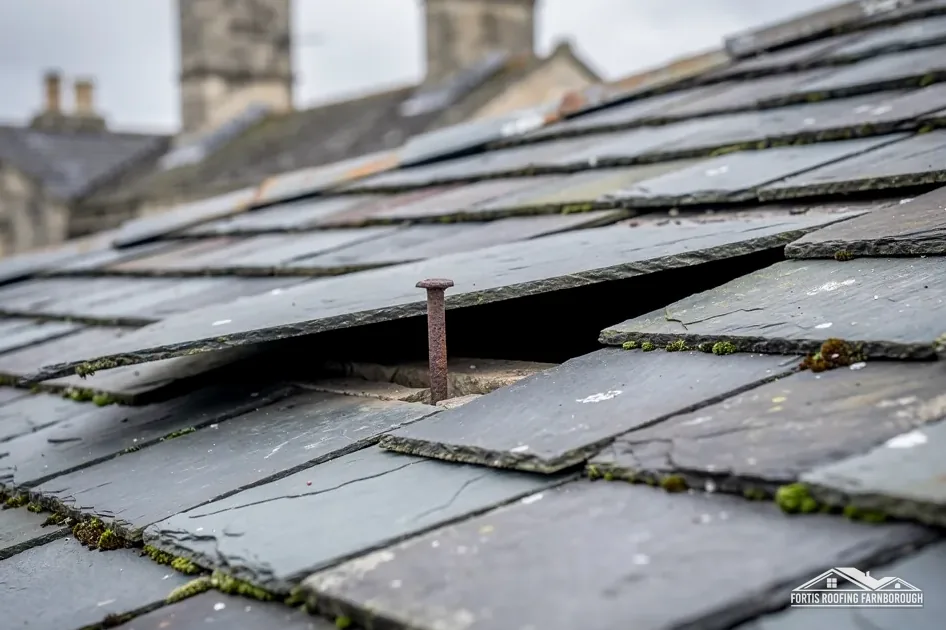
Nails driven through holes near the head hold each slate. When they corrode and snap, slates slide and gaps open across the roof, a fault known as nail sickness. If only a few slates have slipped, repair is possible. When nail failure runs across the whole roof, the sound slates have to come off and be re-fixed, and that is what re-slating means.
The lives of slate
In HomeBuilding's table Welsh slate lasts 100+ years, Spanish natural slate 75 to 100 and reclaimed Welsh slate 50 to 80. The slate can often outlast its nails, so the question is whether the slates are sound, not just whether the roof leaks.
What re-slating involves
Slates are stripped and sorted, with sound ones kept and cracked ones thrown out. Battens and underlay are inspected and renewed where needed. The slates then go back on new fixings, with replacements for any that broke. Our guide to re-slating a roof goes through the process.
Minimum pitch
Via Cupa, BS 5534 sets 20 degrees as the lowest pitch for natural slate, and hooks are not for pitches below 25 degrees. A re-slate must respect the roof's pitch.
Lead and flashings
Valleys, chimney flashings and abutments on a slate roof are often in lead, and they are renewed alongside the slates if they have failed. Old lead that is still sound can sometimes stay, but a re-slate is the time to look at it closely, because scaffold is up and the slates around it are already lifted.
Ridge and verge
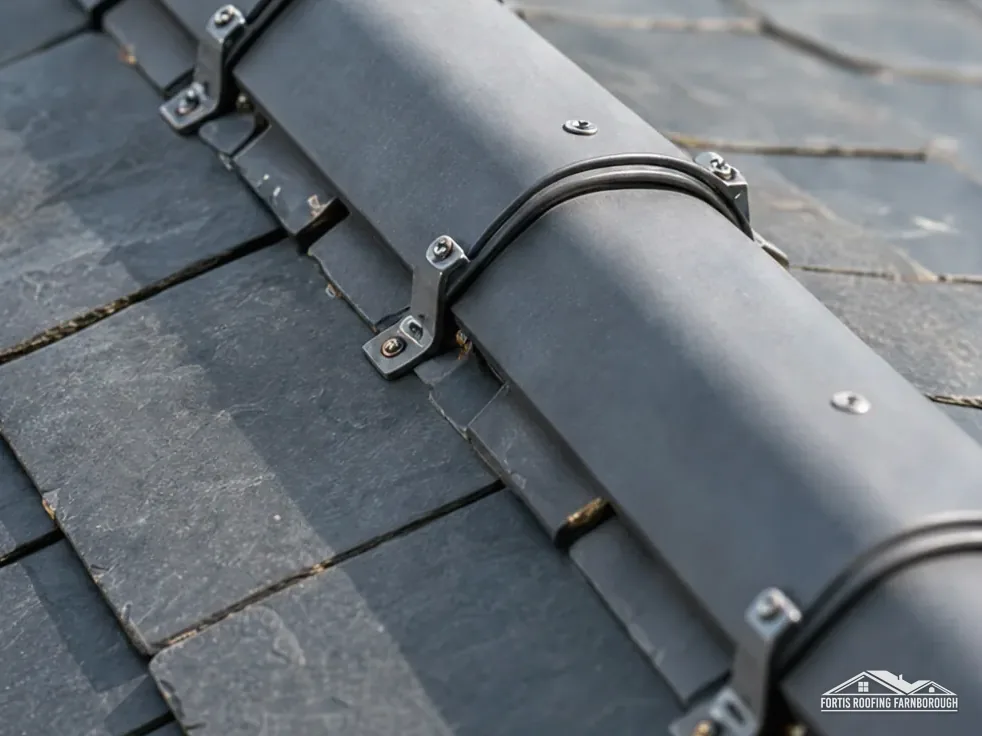
On older roofs the ridge and verge were bedded in mortar. Mortar is still used, but it is not enough by itself to hold ridge and hip tiles, and dry-fix systems tested to BS 8612 hold them mechanically. On a conservation roof, check with the council before changing the ridge detail.
Matching what is on the street
On a street of similar houses, a re-slated roof should look as if it belongs. Matching is a planning concern in a conservation area and a practical one everywhere else.
Size, colour and texture
Slates vary in size, thickness, colour and surface. A new slate that differs from its neighbours looks out of place and, on a pair of semis, shows up as a join down the party wall. Salvaged slates from the roof itself, or reclaimed slates from a similar source, are the best match. Our answer on matching slates explains how it is done.
Natural against substitutes
Other materials look like slate from the ground, but a conservation team may not accept them. Basingstoke and Deane Borough Council asks, for its four town-centre Article 4 areas, that original Welsh slate and clay roofs stay, and it expects to turn down concrete tiles or artificial slates. That is that council's position for its own areas,.
Pattern and detail
Coursing, ridge, verge and eaves all contribute to the look. Where possible they should follow the original.
Hart's guidance
For its own conservation areas, Hart District Council tells owners that repairs to unlisted buildings need no planning permission so long as they reproduce the original method, detail and material. That statement is Hart's and applies to Hart's area.
Photographs
Photograph the roof before work starts. A record of the original is useful for any consent and for the future.
Cost and the sequence of a re-slate
Slate costs more to supply than most coverings, and a re-slate takes skill. The published figures give a sense of scale.
What the guides say
HomeBuilding's supply-only rates run £72 a square metre for Spanish natural slate, £90 for reclaimed Welsh and £185 for Welsh slate. MyJobQuote gives an average of around £7,800 for fitting a slate roof (October 2026). In HomeBuilding's worked example, a three-bedroom semi of 65 square metres in Welsh slate might reach £18,000. Which? gives £7,000 to £21,000, ex VAT, to replace an entire roof (November 2025). Each figure above is a guide's typical UK range, not a price from us.
Re-using what you have
Re-slating with the slates already on the roof costs less in materials and keeps the look of the house. Only sound slates go back, so the survey and the sort matter, and the saving depends on how many survive.
The order of work
Before the first day we survey, photograph and agree the plan. Then scaffold goes up, with a licence if it stands on the pavement. The slates are stripped, the timbers checked and repaired, underlay and battens renewed, and the slates re-laid, with lead work at the hips, valleys and chimneys. Waste is taken away.
Building control
A like-for-like re-slate may need no application, yet the Planning Portal test still applies, and a new covering whose weight is 15 per cent or more over the old covering's brings approval into play. The Hart and Rushmoor Building Control Partnership is on 01252 398715.
Getting a price
Citizens Advice recommends at least 3 written quotes. Our slate roofing page describes the slate jobs we do, and a written price follows each survey.