The short answer
Head-lap is the distance by which each slate overlaps the slate two courses below it. That overlap is what stops rain driven up the slope from reaching the nail holes and the battens. A shallower pitch or a more exposed site needs more of it, and the exact figure comes from the data sheet for the slate and its size.
What head-lap does
Slates are laid in rows called courses, each course covering the joints of the one below. They are not sealed to each other. Water stays out because each slate sits partly on top of two others, so the path from the outer surface to the inside is long and winding.
Head-lap is one measure of that path. It is the distance from the bottom edge of a slate down to the head of the slate in the second course below, measured along the slope. A slate with a long head-lap has more cover behind it, and water has to travel a greater distance before it can reach a nail hole.
Side-lap matters too. The slates in one course are laid so their joints fall over the middle of the slate below, a pattern called a bond. Each joint is therefore covered by a slate underneath, and rain that gets through a vertical gap meets a solid slate behind it.
The slates are held to the battens by nails through holes near the head, or by hooks, and the hidden part of each slate is wider than the part that shows. The visible part, the gauge, is what the roof looks like, and the lap is what the roof does. A roofer sets the batten spacing to fit both.
Our answer on the minimum pitch for slate explains the angle side of the same problem.
Pitch and exposure set the lap
Rain does not only fall straight down. On a shallow slope it creeps up between the layers by capillary action, and gusts push it uphill under the slates. The lower the pitch, the further water can travel up, so a lower pitch needs a longer head-lap to stop it.
Exposure counts as well. An open, high site asks more of a roof than a sheltered street, so each roof is judged on its own position, and the slate maker's tables give the lap for each pitch and exposure band.
A long slope delivers more water to the eaves, and the lowest courses take it.
The slating code, BS 5534:2014+A2:2018, is read by Cupa as setting a 20 degree floor for natural slate, so below that the talk is of a different covering. Above it, the head-lap steps down as the slope rises. A roof that has been re-pitched, extended or recovered in a new material needs its head-lap checked, not assumed.
Data sheets and what a roofer checks
The slate maker's data sheet is the authority, listing for each size the minimum head-lap at each pitch and exposure, with the matching batten gauge. Working from the sheet instead of habit gets the lap right, and the written scope can quote it.
Measuring comes first. We take the pitch in degrees with a level, measure the slate length and width, count the courses and note the batten gauge. On an old roof the existing lap is measured too, because a repair has to keep it.
Gauge and lap are linked by arithmetic. For a slate of a given length, a longer head-lap means a smaller gauge, so more courses and more slates and battens per square metre of roof. That is part of why a low-pitch slate roof costs more to cover: it uses more material for the same area.
Where a roof is being repaired, a replacement slate must lap correctly with its neighbours. A slate that is too short cuts the lap and lets water in, which our answer on matching slates for a repair explains.
Where the sheet asks for more lap than the roof has, the roof is at risk, and you will be told what that means.
Signs of too little lap
Leaks from a lack of lap tend to show in wind-driven rain, not in ordinary showers. Stains appear on the ceiling in a storm and dry out afterward, and the pattern follows the direction of the wind. The loft may show damp on the underside of the slates, wet battens near the nail line or marks on the underlay.
Look for slates that are shorter than the rest, a roof that has been re-battened at the wrong gauge, or a slope where the courses look closer together than they should. A roof re-laid with the lap shortened to save slate will show it in the details.
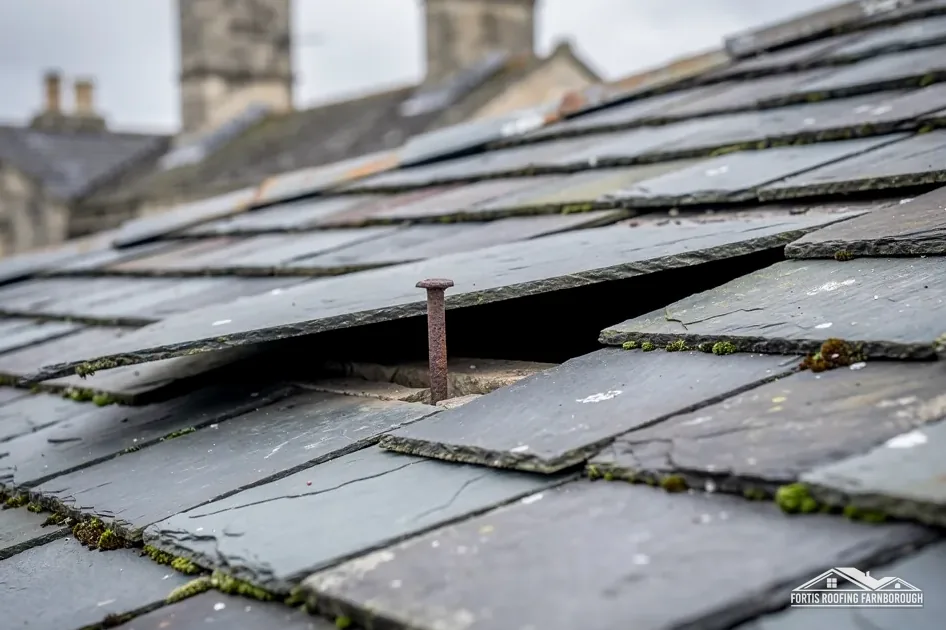
Nail sickness can mimic a lap problem, because a slate that has slipped loses lap. The difference is that a slipped slate sits out of line, while a short-lapped roof is uniform and consistently leaky in the same conditions. Our answer on a leaking slate roof covers the diagnosis.
If a roof is found to have too little lap, the fix is to re-slate with the right gauge. Patching does not cure it, because the whole slope shares the fault.
We measure, check the sheet and report what the roof has and what it needs. See slate roofing for the wider service. The survey ends with a written total.