The short answer
A breathable (LR) underlay lets water vapour pass through it so the roof can dry. Foam sprayed directly onto it covers that route and can leave moisture trapped between foam and membrane. The membrane may also be damaged or glued to the foam. Removal has to be done carefully to save it, and a torn membrane is replaced with one chosen to suit the new ventilation.
What a breathable membrane is meant to do
Beneath tiles or slates, the underlay acts as back-up against rain. There are two kinds. A high-resistance (HR) underlay is non-breathable: it stops vapour and so the roof space needs ventilation at the eaves. A low-resistance (LR) underlay is breathable, and it lets water vapour move through the membrane itself.
That difference changes how a roof is built. Marley's BS 5250 figures set 25mm of eaves ventilation up to 15 degrees of pitch and 10mm above it where HR underlay is used. Over LR underlay and a tight ceiling, Marley accepts 3mm of incidental eaves gap, provided third-party certification backs the product. The membrane is doing part of the ventilation job.
For it to work, vapour has to reach the membrane and pass through it. The roof also needs a space on the other side where the vapour can disperse. Warm moist air from the house rises into the roof, reaches the membrane, passes through, and is carried away by the air moving under the covering.
BS 5250:2021, the current code on moisture in buildings, is under review. HR underlay is never breathable, and the two types should not be confused. Our answer on felt under a slate roof sets out the differences.
What foam does to that arrangement
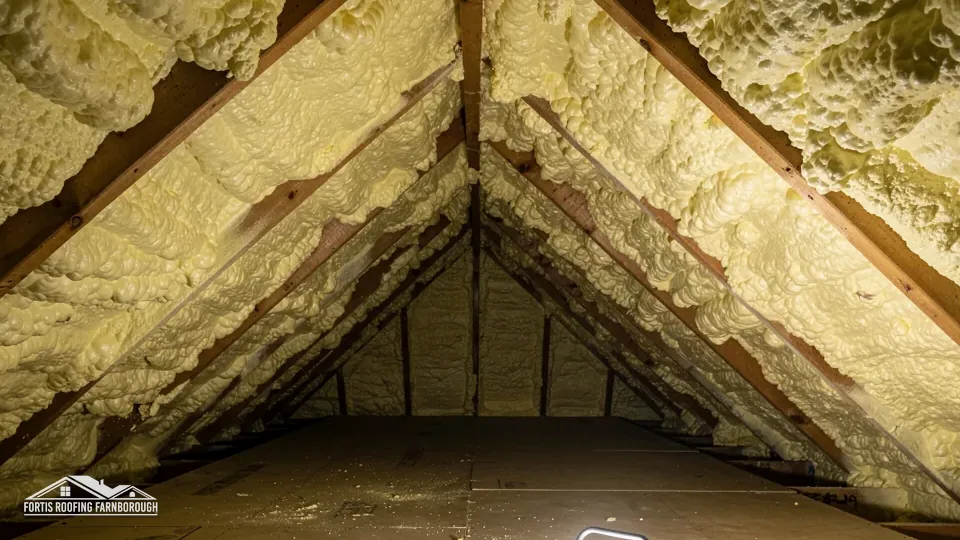
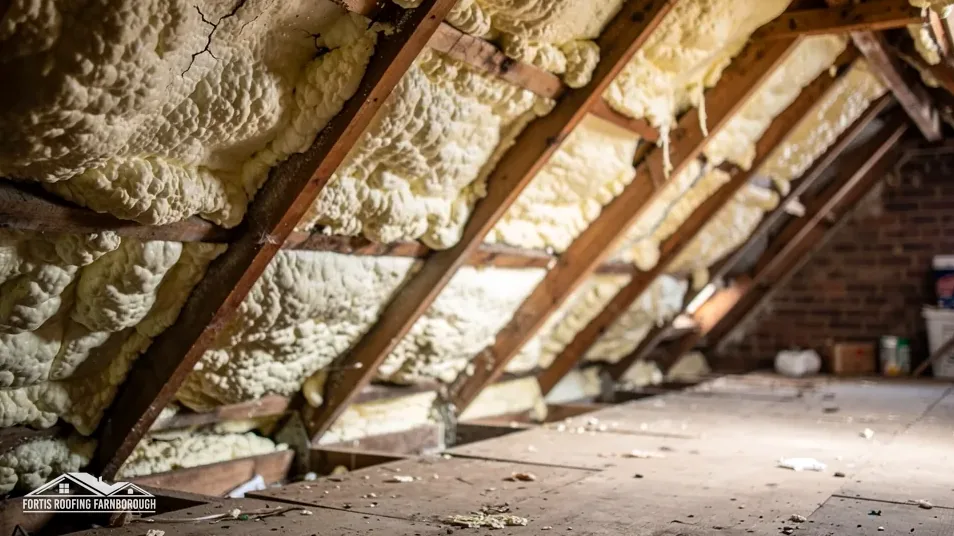
Foam sprayed against the underside of a breathable membrane changes the picture. The foam sits where the vapour has to pass, and depending on its type and thickness it may reduce or stop that movement. Closed-cell foam, in particular, resists vapour. The membrane is then covered on its inner face and cannot do the job it was chosen for.
Moisture that does reach the area is the problem. Warm air passing gaps or imperfect foam can condense on the cold side, between the foam and the membrane, and stay there. Because the foam hides the timbers, nobody sees the damp until it shows indirectly. RICS cautions that insulation put in wrongly can disturb airflow and cause damp, and this is a clear example.
The membrane itself can suffer. Foam may bond to it, so that the two come away together, and a membrane that has been in contact with foam and heat may be marked or weakened. A torn or perished membrane no longer protects the timbers from wind-driven rain that gets under the covering.
Not every case is a problem. A well-designed job on a suitable membrane can perform. The difficulty is that it is hard to tell without looking, and the original designer of the roof did not intend foam against the underlay.
What removal involves
Taking foam off a breathable membrane is delicate. The membrane is a thin sheet, often a few millimetres of fabric, and foam bonded to it can tear it as it comes away. The work is done by hand, slowly, from inside the loft, cutting and peeling the foam in small sections and holding the membrane back where possible.
Sometimes the membrane can be saved. A section that has bonded firmly may not be recoverable, and patches may be taped or replaced. Where the membrane is torn in several places, the sound course is to replace it, which means lifting tiles or slates in that area and relaying them over a new sheet.
We photograph the membrane as it is exposed, and report the condition honestly. Dry, undamaged membrane and sound timber is the best outcome. Staining, damp or tears point to repairs.
Roof repairs then call for access. A re-roof or a strip of a slope may be the sensible response, and our answer on re-roofing after spray foam removal covers it. Part of the work might need scaffold, which depends on the survey.
The waste leaves in sealed bags, and the loft is cleaned ready for the next step.
Replacement membranes and what to ask
A replacement membrane should be chosen with the new insulation and ventilation in mind. If the roof is to be insulated again with mineral wool at ceiling level, a cold roof arrangement works, and the underlay can be HR with eaves ventilation of 25mm or 10mm as pitch requires, or LR with a sealed ceiling and certification. The two combinations are different systems.
The roof's covering matters. Slate, clay and concrete tiles each lay differently, and the membrane must suit the covering and the batten arrangement. A lender or surveyor may also ask what has been used. Our guide to insulation after spray foam removal sets out the replacement options.
Questions to ask any contractor include what type of membrane is being specified, what certification it carries, what eaves ventilation is planned, and how the ceiling will be sealed. The written scope should name the product and its use.
If a lender is involved, check with it early. RICS reported in March 2023 that lender caution began in equity release, and policies vary.
Our survey photographs the membrane and foam, then sets out the options simply, and the written total comes after. See spray foam insulation removal for the service.