Heathland-edge homes
Whitehill stands on the edge of Woolmer Forest, heathland the 1908 county history places on the Lower Greensand.

Roofs along the heathland edge of Woolmer Forest and the National Park
Whitehill stands on the edge of Woolmer Forest heathland beside Bordon, with the South Downs National Park touching its edge. We survey roofs in a town of nearly 15,000 and write each up.
Whitehill stands on the edge of Woolmer Forest, heathland the 1908 county history places on the Lower Greensand.

The town adjoins Bordon, and the 2021 Census counted 14,741 usual residents across the Whitehill civil parish.
The South Downs National Park touches the area, with about 43 per cent of a 1.5 km box inside it.
Map of Whitehill with Bordon, Lindford, Greatham, Headley marked around it.
Map data © OpenStreetMap contributors. Loads only when you ask for it.
Bordon lies close by, with Lindford just beyond it, Greatham to the south-west, Headley further north-east, and Selborne and Liphook more distant on either side.
About 19.2 road miles south of Farnborough · East Hampshire District Council and Hampshire County Council.
Whitehill, heath and park edge
Where the South Downs National Park touches Whitehill and which authority decides, what the 1908 history says about Woolmer Forest, and what the HSE says about asbestos cement garage and outbuilding roofs.

| No. | Chapter | The figure it turns on |
|---|---|---|
| 01 | A town on the National Park's edge | 43 per cent inside the National Park |
| 02 | Woolmer Forest, redsand and the town's roots | Selborne's share: 7 miles by 2½ |
| 03 | Cement garage roofs and asbestos | Built before 2000: assume asbestos |
Chapter 01 of 03
Whitehill: population, park edge and conservation areas
Whitehill sits on the edge of Woolmer Forest heathland and adjoins Bordon. At the 2021 Census the civil parish held 14,741 people. Two councils matter for roof work here. East Hampshire District Council decides planning questions and keeps its own building control team, and Hampshire County Council manages the roads and licenses scaffold that stands on them.
The place point we use for Whitehill falls outside the South Downs National Park, yet the Park reaches into the surrounding 1.5 km box and covers roughly 43 per cent of it. That has a practical consequence. Applications for addresses inside the Park boundary go to the South Downs National Park Authority, and applications for addresses outside go to East Hampshire. Two houses a short walk apart can therefore deal with different offices.
Repairs are rarely affected. A replacement covering that matches the old one is a repair wherever the house stands. The boundary matters once a plan alters the roof: a dormer, a raised ridge or a new material. The planning permission guide explains the rules, and your address is compared with the boundary during the survey, before an alteration is priced.
Three conservation areas, Blackmoor, Headley Mill and River Wey, are the nearest the national dataset shows within about 2.5 km. Whether any of them reaches your street is a question for East Hampshire, and we put it to the council whenever a house might be inside one.
Under Hampshire County Council's process the scaffolding firm files the licence application on its customers' behalf. The council asks for a gap of 10 working days from application to planned start and offers no extensions. Hampshire County Council charges £211.90 for the first two weeks and £72 for each fortnight after. We therefore plan a job to fit one fortnight where the roof allows, and repairs reached from a ladder, or from a tower standing on your own land, need no scaffold licence.
When a house sits well back on its own drive, scaffold may stand wholly on private land, outside the licensing regime for the highway. The plot tells us which applies, and the answer goes into the access plan you receive.
Chapter 02 of 03
| Subject | Record |
|---|---|
| Woolmer Forest | Its Selborne three-fifths: about 7 miles by 2½ (1908) |
| The soil | Unfertile redsand of the Lower Greensand |
| Selborne parish | Three-fifths of the forest then lay in it |
| Whitehill today | 14,741 usual residents, ONS Census 2021 |
| Conservation areas nearby | Blackmoor, Headley Mill and River Wey |
The 1908 volume of the Hampshire county history describes the three-fifths of Woolmer Forest then in Selborne parish as a tract roughly 7 miles long and 2½ miles wide, on the unfertile redsand of the Lower Greensand. Whitehill stands on the edge of that heathland, and today the parish holds nearly 15,000 people.
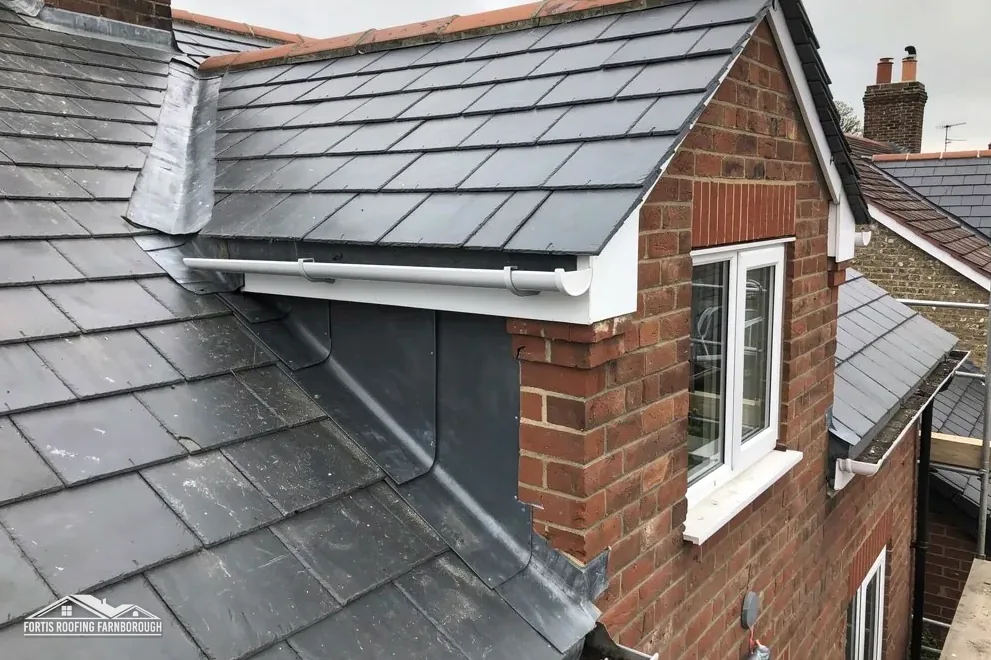
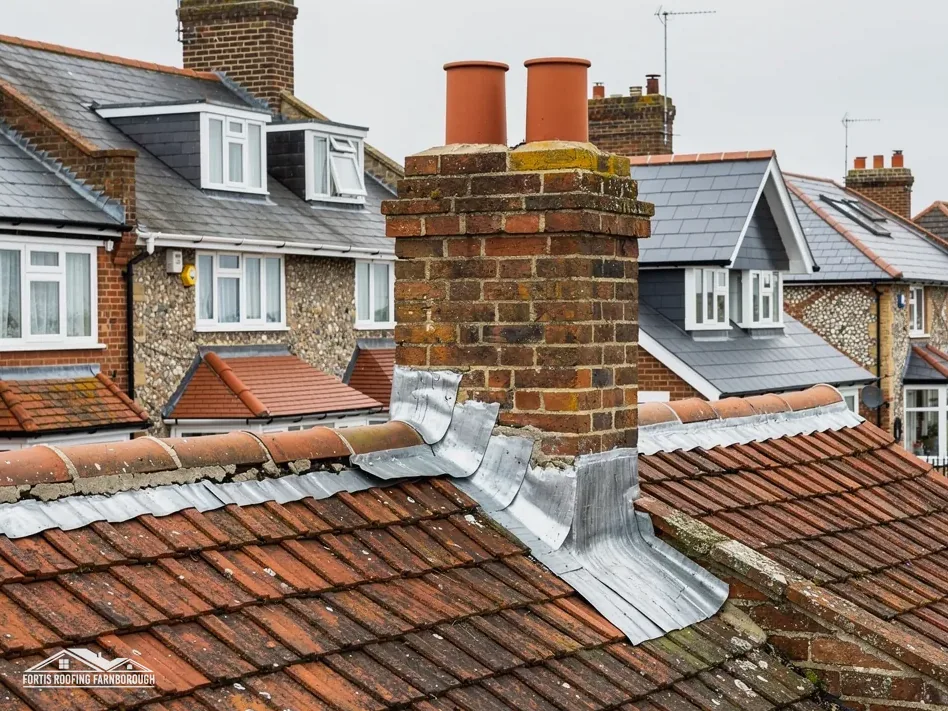
Every Whitehill roof is surveyed as it stands. Each visit notes what covers every slope, how the ridge and verges are holding and whether the flashings round any stack are sound, so the price reflects the actual roof, not a guess based on when the street went up. A town that grew from heathland holds roofs of many ages side by side.
Houses beside heath and woodland live with falling plant matter. Leaves, needles, twigs and seed cases drift into gutters, settle in valleys and pile against the base of chimney stacks. Shade holds moisture, so moss gathers on the shadier slopes. None of this is a fault in the roof, but it accelerates wear, because debris keeps water in contact with the covering long after the rain has stopped.
A survey therefore concentrates on the places where debris collects. We photograph each valley, each outlet and the lowest courses of tile or slate above the gutter, where staining first shows. A blocked valley can often be cleared on the day, which shows whether the lining beneath is still sound.
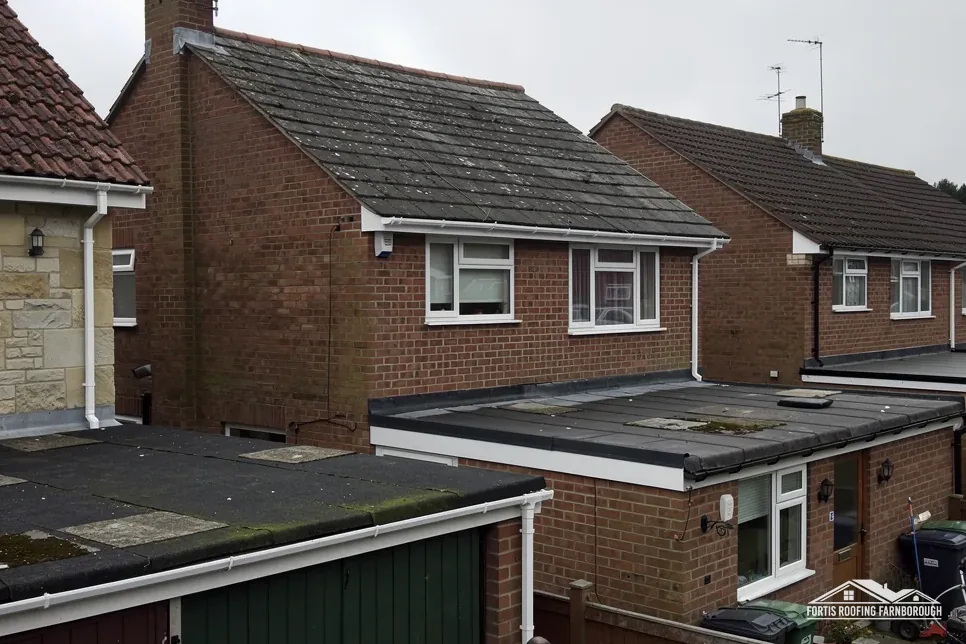
Flat roofs on extensions and garages suffer most, since they have no slope to carry debris away. Water lingering on the surface two days after rain suggests the finished fall is too slight or the deck beneath has settled. BS 6229:2025 asks for a minimum finished fall of 1:80, and IKO recommends designing for 1:40. We level the deck before suggesting anything, and the readings go into your notes.
The roofline matters too. Fascias and soffits, the boards under the eaves, rot where gutters overflow, and a rotten board lets birds and weather into the roof space. Our gutters, soffits and fascias page covers the repairs, and the flat roofing page explains membranes.
Gutter brackets work loose under the weight of debris, and a sagging run holds water instead of shedding it. Each failed bracket is noted, so the one price covers every fix.
Chapter 03 of 03
What the HSE says about asbestos in a roof
Garages, sheds and other outbuildings are sometimes roofed in corrugated sheet, and sheet laid before 2000 may contain asbestos cement. HSE advice for a building from before 2000 is to presume asbestos could be present until a test shows otherwise. This chapter explains what that means for roof work on an outbuilding, not for the house itself. Plenty of garages and lean-to sheds in a town of this age have sheet roofs, so the question deserves a clear answer before any ladder goes up.
Asbestos work falls into three groups. Non-licensed work covers asbestos cement items such as roof sheeting, so long as they are handled and taken off with care and not broken up. Weathered cement that is otherwise sound stays in that group. Once the material will be broken up or badly damaged, the job becomes notifiable non-licensed work, which carries extra duties including a health record kept for 40 years.
Asbestos insulating board is treated differently. It turns up in external soffits and is hard to distinguish from other board by eye, and work on it is licensable unless a risk assessment shows the job will be short. That is why a soffit on an older building is treated with caution until it has been identified.
The HSE treats an asbestos cement roof as fragile in every case. Nobody should walk across one, and nobody on our team does. We inspect from the eaves, from a tower or from a safe platform and describe what can be seen from there, with photographs taken at a distance and a note of any broken or lifting sheets.
Asbestos waste goes into two wraps with a label, and it travels with a consignment note through a registered carrier. It never goes into an ordinary skip. Waste from asbestos is carved out of the usual household hazardous waste allowance, so it needs its own route from the start.
If a survey raises a suspicion, work on that part stops and you are told. Sampling and removal go to a contractor suited to the task, and you decide the next step once you have seen what we found, with time to take advice if you want it. Our pitched roofing page covers the replacement coverings that follow.
It could be, if it was laid before 2000. HSE guidance is to presume asbestos in a building from before that date, and it calls asbestos cement roofs always fragile. Nobody should walk on one. We look from a safe position and explain your options before anything is touched or moved.
It depends on the boundary. An address inside the South Downs National Park goes to the National Park Authority, and an address outside goes to East Hampshire. About 43 per cent of the area round Whitehill lies inside the Park, so we check your address against the line and tell you which office to expect before you apply for anything.
Hampshire County Council has the scaffolding firm apply for the customer, leaving a 10 working day gap before the start and allowing no extensions. The firm and dates are agreed with you in writing at the survey, while work done from a ladder, or from a tower inside your boundary, involves no highway licence, which keeps small jobs simple.
It can speed up wear. Leaves and needles fill gutters and valleys, and shade encourages moss, so water stays on the covering longer. We photograph valleys and outlets, tell you whether clearing is enough and state plainly if the covering beneath has been harmed, with the photographs beside the price, so nothing is a guess.
Get your free roof quote
Send your Whitehill address and the fault, and someone will come, photograph the roof and check which authority applies.
10-year workmanship guarantee, in writing.