

Red tiles on All Saints
In 1908 the church roofs were covered with red tiles, over walls of sandstone and ironstone rubble.

Roofs around a heath, a sandstone church and Headley Mill
Headley is built around a heath, with a sandstone and ironstone church that was red-tiled in 1908 and a long history of water-mills. We survey each roof slope.
In 1908 the church roofs were covered with red tiles, over walls of sandstone and ironstone rubble.

Suters has been listed Grade II* since 15 August 1985, one of ten listed buildings nearby.
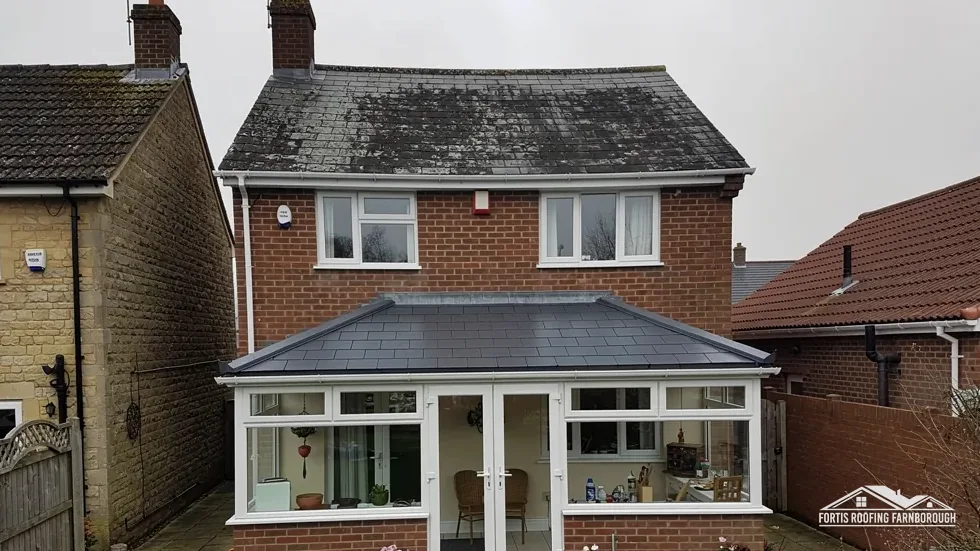
The 1908 county history places the schools on the heath itself, with the church to the west.
Map of Headley with Lindford, Bordon, Bramshott, Whitehill marked around it.
Map data © OpenStreetMap contributors. Loads only when you ask for it.
Lindford is the next village west, with Bordon beyond it; Grayshott lies east, Churt north-east and Bramshott south-east, and Farnborough is a long way north.
About 17.9 road miles south of Farnborough · East Hampshire District Council and Hampshire County Council.
Headley, heath village record
What to keep and what to expect if storm damage hits a Headley roof, what the 1908 county history and East Hampshire's leaflet record about the church, spire and mills, and which listings and conservation areas matter.

| No. | Chapter | The figure it turns on |
|---|---|---|
| 01 | Storm damage and what to keep, in Headley | 8 weeks before the Ombudsman can act |
| 02 | A heath, a burnt spire and six mills | 6 water-mills recorded in the parish |
| 03 | Two conservation areas and a Grade II* house | 10 listed buildings within 500 m |
Chapter 01 of 03
| Step | Published position |
|---|---|
| Tell your insurer first | Then make the property safe and keep photographs and receipts |
| What counts as a storm | Violent winds, usually with rain, hail or snow; rain, hail or snow alone can be a storm |
| How the Ombudsman judges it | It considers the Beaufort scale and whether storm conditions were the main cause |
| Roof already in poor condition | A complaint is unlikely to succeed if the roof was already bad and you knew |
| If your insurer does not answer | After 8 weeks without a final response you can complain to the Financial Ombudsman Service |
Headley stands on the B3002 north of Grayshott, 17.9 miles by road south from Farnborough, counted from the A325 Farnborough Road. Planning in Headley is East Hampshire District Council's, along with a building control team of its own, and the roads and the scaffold licences on them are Hampshire County Council's. After a storm in any village of old tiled roofs, the question is what to do, and in what order.
Financial Ombudsman Service guidance treats a storm as strong wind, normally with rain, hail or snow, while allowing that heavy rain, hail or snow can amount to a storm without much wind. It looks at the Beaufort scale. If an insurer turns a claim down, the Ombudsman asks three things: was there a storm, does the damage fit one, and was the storm the main cause. A complaint is a poor bet where the roof had long been in poor repair and the owner was aware of it, or where the storm merely exposed an old fault.
So order matters. Phone your insurer before anything else. Make the property safe, which for us means a temporary repair and dated photographs. Keep every receipt and picture; a structural engineers' body describes photographs as vital for a claim. Read the policy itself, because its own storm wording governs, and a wind speed quoted elsewhere may not match it.
A leaking roof is made safe first, what we find is photographed, and the write-up carries dates. The claim stays between you and your insurer, and we hand you evidence rather than a promise about the outcome. Where an insurer gives no final response within eight weeks, the Financial Ombudsman Service can be approached on 0800 023 4567, and a complaint after a final response must come within six months.
Our emergency and general roof repairs page describes a make-safe and the repair that follows it, and our pitched roofing page covers the lasting repair. The written report records the roof's state, which helps whoever later assesses the claim. Storm damage can hide where the ground cannot show it: lifted ridge tiles, displaced hips, flashings pulled back from a stack. The visit looks at each of those places, close up, and numbers the photographs against a plan, with the date on each one.
Chapter 02 of 03
Headley's record in four published facts
The 1908 county history describes Headley as built around a heath: the schools stood on the heath itself, with All Saints' church to the west and the Holly Bush Inn, mentioned by Cobbett, nearby. It says the church has walls of local sandstone and ironstone rubble with sandstone dressings, that in 1908 its roofs were covered with red tiles, and that the chancel and nave were rebuilt in 1859. At the 2021 Census the parish had 5,577 usual residents. East Hampshire's leaflet says the Headley conservation area was designated in 1977 and extended in 1993.
East Hampshire's conservation-area leaflet says the church tower was built around 1380 and was topped by a spire until fire destroyed it in 1836. A spire stands above everything else on a roofline, and the leaflet adds that the tower is built of much harder local sandstone rubble than the church, with a castellated top and octagonal pinnacles. A tower is a reminder that anything standing proud of a roof, a chimney or a tower, needs its own flashings and its own look.
The county history recorded six water-mills in Headley parish, and the leaflet names them as Lower Standford, Upper Standford, Barford Middle, Barford Lower, Headley Park and Headley, noting Headley Mill as the only one then still working. Where trees overhang a roof, moss can grow on shaded slopes and leaves collect in gutters and valleys. Where moss or leaves have collected, the survey marks the spot and decides whether cleaning would suffice or the covering below has failed. A gutter should also fall toward its outlet, with Brett Martin's guide being 1 mm for every 600 mm of gutter, so falls, joints and brackets are checked along each run.

The faults on a red-tiled roof are cracked tiles, slipped tiles and a tired ridge, and the county history's colour of 1908 says nothing about the tile or its age today, so a tile is read by size, thickness, lap and course. The flashings and flaunching at a stack are covered on our chimney repairs page, and renewing a whole roof is set out on our roof replacement page.
Chapter 03 of 03
| Designation | In Headley | For roof work |
|---|---|---|
| Conservation areas | Headley; Headley Arford | Changes to the look checked with East Hampshire |
| Grade II listed church in use | Church of All Saints (NHLE 1094029) | Church of England faculty, not listed building consent |
| Grade II* listed house | Suters (NHLE 1093985) | Listed building consent for works affecting its character |
| Grade II listed | Headley Grange (NHLE 1339007) | Listed building consent for works affecting its character |
| Grade II listed | Appletree Cottage (NHLE 1339008) | Listed building consent for works affecting its character |
East Hampshire's conservation-area list names two Headley areas, Headley and Headley Arford, and the council's online map answers the question for one house. Putting back what was there is outside planning control under section 55 of the Town and Country Planning Act 1990, and a fresh covering, a changed ridge line or a rebuilt chimney would alter the look, so East Hampshire's planners hear about it first. We also ask East Hampshire whether an Article 4 direction applies to the address.
All Saints has been Grade II listed since 31 July 1963, and because the Church of England worships there, repairs to its roof are a faculty matter and not East Hampshire's. Suters holds a Grade II* listing from 15 August 1985, with Headley Grange and Appletree Cottage listed Grade II, so works affecting the character of those three houses need consent. The leaflet describes Suters as a 15th-century Wealden house, one of very few in Hampshire, with a tile-hung first floor. Historic England's list counts 10 listed buildings within about 500 m of the village point.
Before a listed house's character is altered the owner must hold consent, and we see that consent before a start date goes in the diary. On any Headley house inside a conservation area or beside a listed building, the first visit photographs the covering, ridge, verges and stacks, the repair follows the original, and the record goes into a file you keep. Where a roof can be seen from several directions and not only from the road, hips, verges and the back of the ridge matter as much as the front slope, and all faces are photographed and repaired to the same standard.
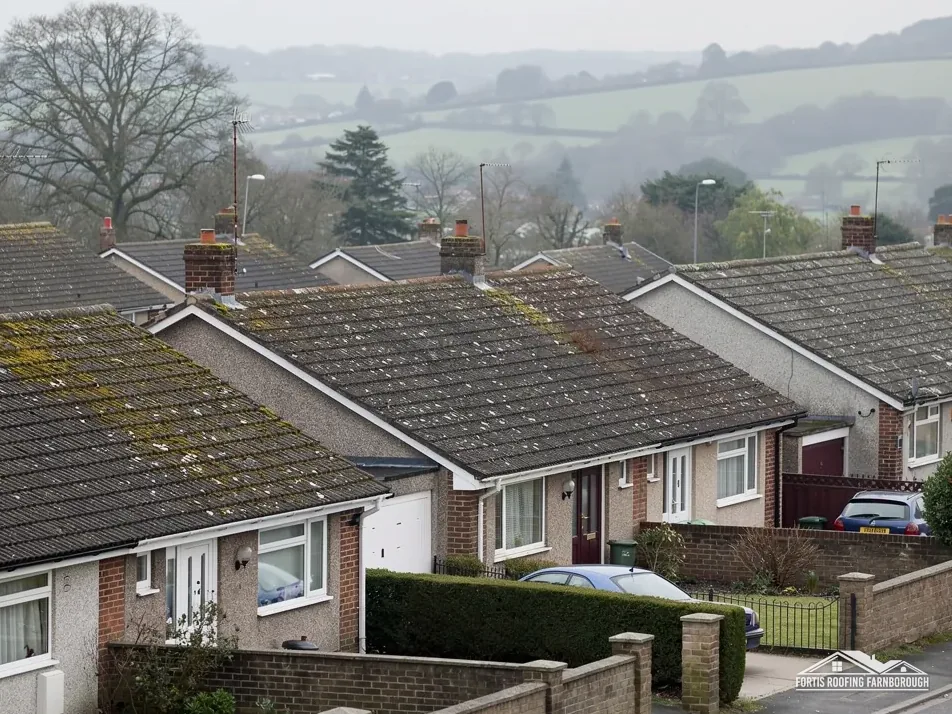
That file is also what a buyer's surveyor or an insurer will ask for, and the photographs are numbered against a plan so that each one can be found again, which links back to the first chapter: the better the record of a roof's condition, the easier it is to show what a storm changed. Where a house is let, the owner arranges the roof and the tenant reports faults, so the report is addressed to both, with each slope named, and the instruction can be passed on without a second visit.
Your insurer decides first, working from your policy's own storm wording. The Financial Ombudsman Service looks at wind, rain, hail and snow together with the Beaufort scale, and hears complaints once the insurer has given a final response, or after eight weeks without one. A dated survey report shows what the roof looked like.
East Hampshire's list names two, Headley and Headley Arford, and the council's map settles which side of a boundary your house falls. Section 55 of the Town and Country Planning Act 1990 does not count restoring the original as development. A different covering or ridge would alter the look, so the council's planners are asked first.
No, as the church, though Grade II listed, is still used for worship by the Church of England, and that places its roof under the faculty system. The houses are different: Suters, Headley Grange and Appletree Cottage need listed building consent from East Hampshire before any change to their character.
Yes, as evidence. A leaking roof is made safe first, what we find is photographed and dated, and you receive a report to send to your insurer. The claim is a matter between you and the insurer, and its outcome turns on your policy and the insurer's decision.
Get your free roof quote
Send your Headley address and a line on what happened to the roof, and a survey visit follows.
10-year workmanship guarantee, in writing.





