Headley Mill and its house
Headley Mill and its adjoining house are both Grade II listed, which means roof work starts with a consent question.

Roofs by the River Wey, a Grade II mill and farmhouses
In 1908 the county history listed Lindford and its Royal Exchange inn among the hamlets of Headley. We survey the roofs of this river village slope by slope.
Headley Mill and its adjoining house are both Grade II listed, which means roof work starts with a consent question.

Hatch House Farmhouse was first listed Grade II on 15 August 1985.
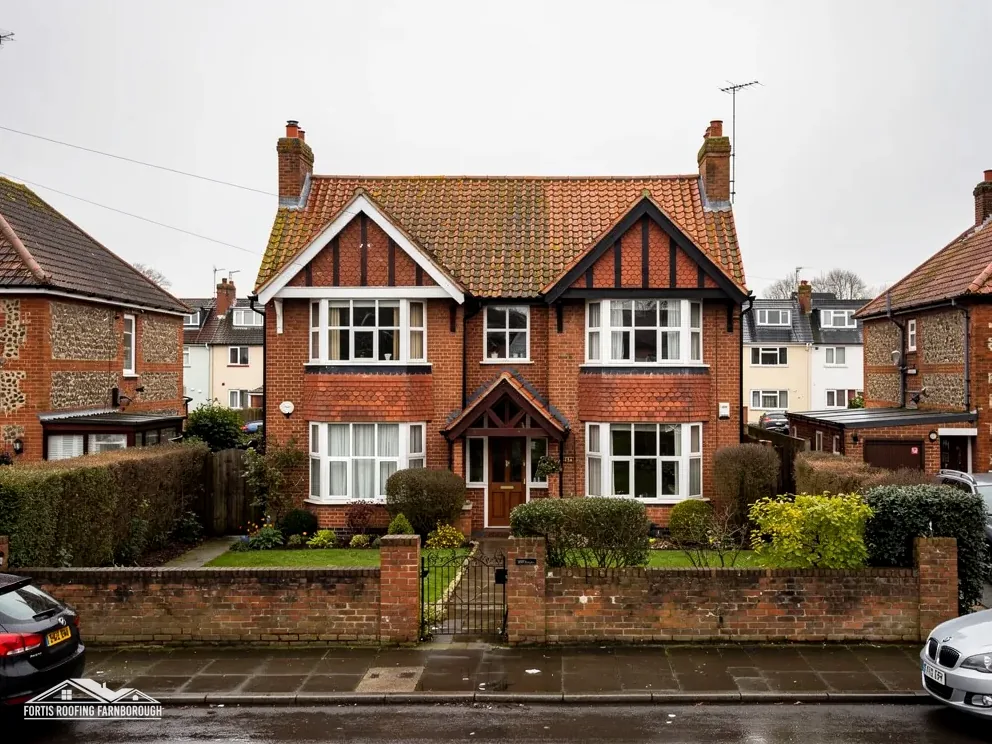
Watermeadow Farmhouse, listed Grade II, sits beside the Wey that the 1908 history describes.
Map of Lindford with Headley, Bordon, Whitehill, Bramshott marked around it.
Map data © OpenStreetMap contributors. Loads only when you ask for it.
Headley is the next village east, with Bordon to the south-west, Whitehill beyond it, Churt to the north-east and Bramshott to the south-east, and Farnborough lies north.
About 17.4 road miles south of Farnborough · East Hampshire District Council and Hampshire County Council.
Lindford, river village record
How East Hampshire, its fallback for building control and Hampshire's scaffold standards apply to a Lindford roof, what the 1908 county history records about the Wey, and how a mill conservation area and Grade II farmhouses shape repairs.

| No. | Chapter | The figure it turns on |
|---|---|---|
| 01 | A reversion route and Hampshire's scaffold standards | BS EN 12810 and 12811 scaffold standards |
| 02 | A hamlet of Headley parish on the Wey | 2,739 residents in Lindford parish |
| 03 | The Headley Mill conservation area and three listings | 0.75 km to the Headley Mill conservation area |
Chapter 01 of 03
| Question | Office or rule for Lindford addresses |
|---|---|
| Planning | East Hampshire District Council |
| Building control, council route | East Hampshire District Council's own team |
| Building control, private route | A registered building control approver |
| Scaffold licence on the highway | Hampshire County Council; the scaffold firm applies |
| Scaffold standard named by Hampshire | BS EN 12810 and 12811, or TG20:13 |
Lindford sits on the River Wey on the east side of Bordon, 17.4 road miles south of Farnborough on the A325 Farnborough Road measurement. Local government in Hampshire has two tiers, with East Hampshire District Council on planning and its own building control, and Hampshire County Council on the roads. Neither is set to change, because the government has dropped its plan to replace Hampshire's councils.
A roof job reaches building control when it passes the Planning Portal's limits, which are 25 per cent of the building envelope and 50 per cent of the roof, or when the new covering is 15 per cent or more heavier. East Hampshire sets no percentage of its own. A householder can choose a registered building control approver instead of the council's team, registered under the regime that came into force on 6 April 2024. East Hampshire's building control page adds that the council can take a file back through what it calls a reversion application when a private approver cannot continue.
That last point is worth knowing before a private route is chosen. If the approver stops, the council can take the file back, so the job is not left without a signatory. We tell you at the survey which route we suggest and why, and the choice is yours. Where the question is weight, as it is when a heavier covering is proposed on an old frame, the Planning Portal says a structural engineer's or surveyor's opinion should come first, and we write the two weights into the plan so that opinion has something to work from.
On Hampshire County Council's page, filing the licence is the scaffolder's job, and the page names the standards the scaffold must meet: BS EN 12810 and 12811, or TG20:13. Its notice period, counted from application to start date, is ten clear working days, and no extension is granted. For a Lindford house on a public road, the plan therefore fixes the licence period before a date is set.
Not every scaffold needs that licence. Scaffold standing in a rear garden is private-land work and sits outside the highway licence. Where the scaffold does stand on the road, our pitched roofing page describes the repairs it makes safe to reach, and the survey notes which slope can be worked from the back.
Chapter 02 of 03
Lindford in four published facts
The 1908 volume of the Victoria County History of Hampshire lists Lindford, with its inn the Royal Exchange, among the hamlets of Headley parish. It also quotes a description of the southern Wey flowing past Bramshott paper-mill to Lindford, where it receives the streams from Woolmer Forest. The 2021 Census counted 2,739 usual residents in Lindford civil parish, so the hamlet has grown a long way from that description.
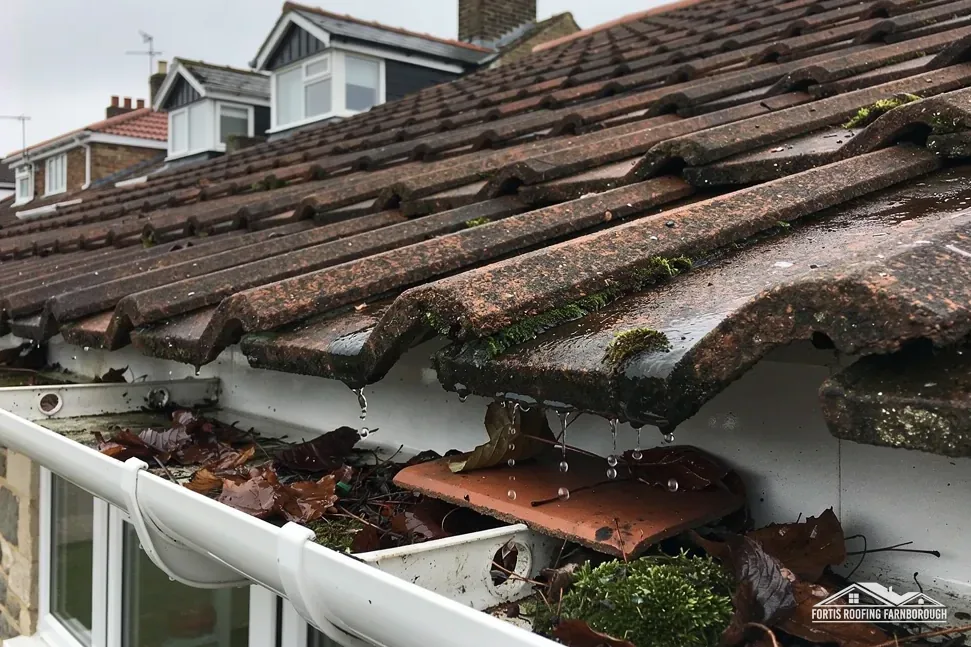
A village on a river and its streams can have damp air and plenty of trees, and both show on a roof. Moss grows on the north-facing and shaded slopes, leaves collect in valleys and gutters, and a blocked gutter holds water against the fascia board. We record where moss has taken hold, whether the tiles beneath are sound and where leaf litter has gathered. Clearing a moss-covered roof is a separate piece of work from repairing it, and our roof cleaning and moss removal page covers it. Gutters on a house near trees fill quickly, and a gutter must fall toward its outlet: Brett Martin gives 1 mm of fall for every 600 mm of gutter as a guide. We check falls, joints and brackets along the whole run, and our gutters, soffits and fascias page covers the repairs.
Marley does not recommend jet washing of roof tiles, so on a tiled roof we clear moss by hand and with soft cleaning, which protect the surface; and the survey says whether the tiles have lost their coating or are simply dirty, so that cleaning is proposed only where it helps.
Headley Mill, with its adjoining house, and Hatch House Farmhouse and Watermeadow Farmhouse, are all listed Grade II. The 1908 history places Headley Mill to the west of Headley village, on the River Wey, and records that it was used for corn. Where an older building has long runs of tiling, valleys where wings meet, or dormers and chimneys with their own flashings, each part is surveyed and photographed on its own.

If the covering is worn across a whole slope, our roof replacement page follows a re-cover in stages, and the survey photographs decide if it is the right step.
Chapter 03 of 03
| Designation | Near Lindford | For roof work |
|---|---|---|
| Conservation area | Headley Mill; River Wey | Changes to the look checked with East Hampshire |
| Grade II listed | Headley Mill and Adjoining House (NHLE 1093994) | Listed building consent for works affecting its character |
| Grade II listed | Hatch House Farmhouse (NHLE 1179617) | Listed building consent for works affecting its character |
| Grade II listed | Watermeadow Farmhouse (NHLE 1094502) | Listed building consent for works affecting its character |
| Article 4 direction | Check with East Hampshire | Ask East Hampshire whether one applies to your address |
The national planning dataset places the Headley Mill conservation area within about 0.75 km of the centre of Lindford, and the same query also touches the River Wey. East Hampshire's online conservation-area map tells you whether a given house lies inside the boundary, and we consult it before pricing any job that would change how a roof appears from the road.
Where a house is inside, section 55 of the Town and Country Planning Act 1990 treats a repair that keeps the original appearance as no development at all. A new covering, a changed ridge or a rebuilt chimney does change it, and for those East Hampshire's planners are asked first, with the reply written down for you. We also ask East Hampshire whether an Article 4 direction applies to the address, and that answer goes into the plan as well.
Headley Mill and Adjoining House is listed Grade II, as are Hatch House Farmhouse, first listed on 15 August 1985, and Watermeadow Farmhouse. Historic England's list counts 3 listed buildings within about 500 m of the village point. Anyone altering the character of one of them needs listed building consent beforehand, and a roofer who starts without it puts the owner at risk of enforcement.
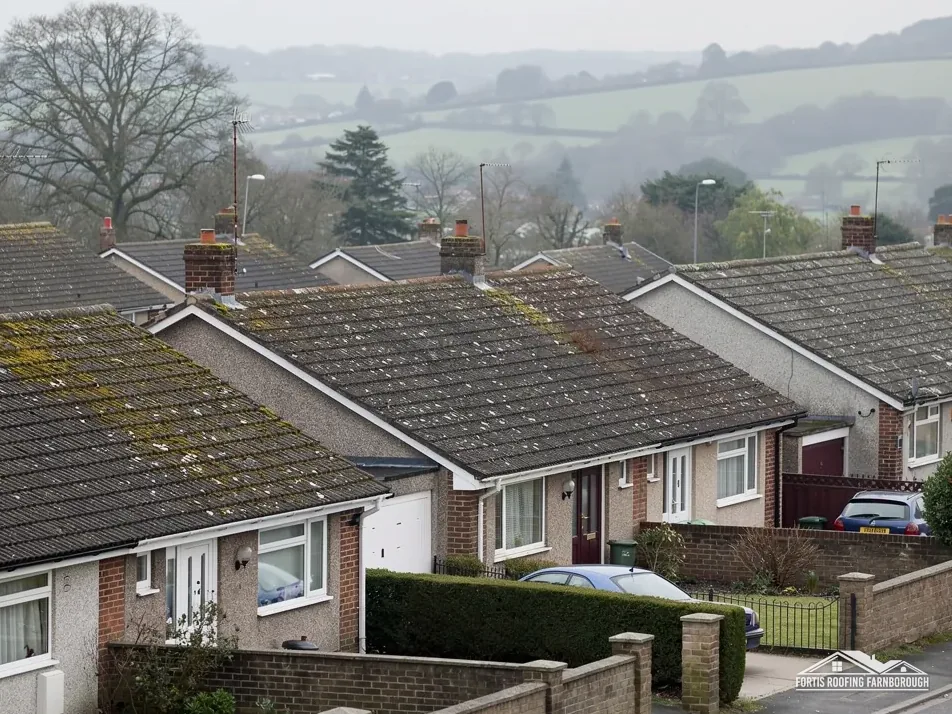
The file we keep for a roof in a conservation area or beside a mill is the same as everywhere else: dated photographs of each slope, its ridge, its verges and its stacks taken before anyone starts, a repair that matches, and a record to show the council, a buyer or a neighbour. It also makes a sound basis for a maintenance plan, which suits an older building, since it shows which parts of an old roof are sound and which are due for attention. Because the three listed buildings are farm or mill buildings, extensions and outbuildings attached to them may be treated as part of the listing, so East Hampshire is asked which parts are covered before anyone touches a lean-to or a rear wing, and the answer is written into the plan so the scope is clear to everyone who works on the roof. That question is quick to ask early and costly to answer late.
Moss on a shaded Wey-valley slope is worth clearing if the tiles beneath are sound, because it holds water and blocks gutters. Marley does not recommend jet washing, which is why clearance here is by hand and soft cleaning. If the tiles are failing, the survey says so first, and cleaning would only hide a repair that is needed.
The planning dataset places the Headley Mill conservation area within about 0.75 km of the village centre. East Hampshire's online map settles whether your own house is inside it. Planning control under section 55 of the Town and Country Planning Act 1990 does not reach a repair that matches the original. A different covering would alter the look, so the planners at East Hampshire are told first.
The scaffolder, not you. Under Hampshire County Council's rules the firm applies for its customer, its notice runs to ten clear working days, and the first 2 weeks cost £211.90, so the licence period is planned before anything is booked. Private roads are outside the licence, and scaffold in a back garden stands on private land, which is another matter.
Yes. You may use a registered building control approver rather than East Hampshire's team, registered under the 2024 regime. East Hampshire's page notes that the council can take the file if an approver can no longer act. We tell you at the survey which route we would suggest.
Get your free roof quote
Send your Lindford address and what the roof shows, and a survey visit is arranged.
10-year workmanship guarantee, in writing.