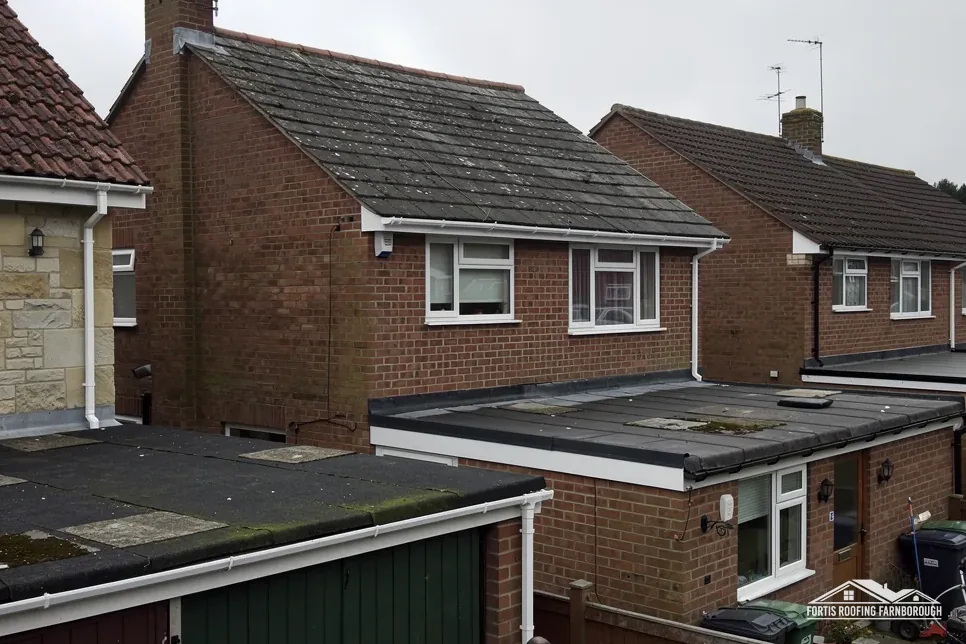
A town from a camp
In 1908 the county history recorded a permanent military camp at Bordon, in the west of Headley parish.

Roofs on the heath edge where a camp was made in 1908
By 1908 a permanent military camp had been made at Bordon, on sandy heathland at the edge of Woolmer Forest. We survey homes and units here slope by slope.
In 1908 the county history recorded a permanent military camp at Bordon, in the west of Headley parish.
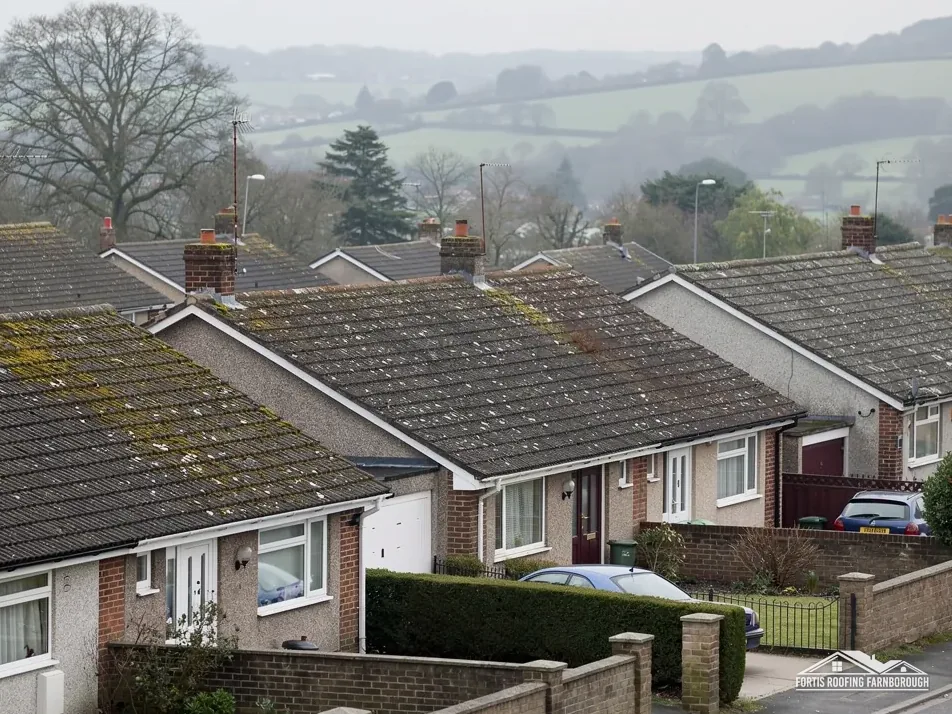
Chase Farmhouse has been Grade II listed since 14 April 2003, one of two listed buildings near the town.
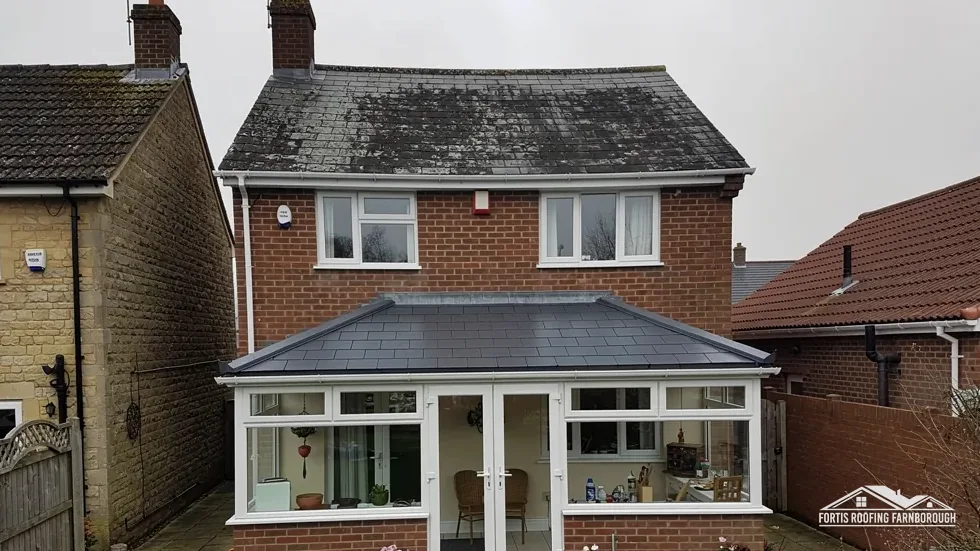
Woodlea Primary School is listed Grade II, one of two listed buildings within 900 m of the town point.
Map of Bordon with Whitehill, Lindford, Headley, Bramshott marked around it.
Map data © OpenStreetMap contributors. Loads only when you ask for it.
Whitehill lies just south-west, Lindford north-east, Headley east and Bramshott south-east, with Liphook further south-east; Farnborough lies far to the north.
About 18.2 road miles south of Farnborough · East Hampshire District Council and Hampshire County Council.
Bordon, camp town and lead
Which lead code suits which job at a Bordon roof edge, what the 1908 county history records about the camp and Woolmer Forest, and what a few listed buildings and nearby conservation areas mean for repairs.

| No. | Chapter | The figure it turns on |
|---|---|---|
| 01 | Lead at the roof edges: codes and colours | 80 years or more for lead flashing |
| 02 | A camp, a forest and 8,000 acres | 9,349 residents in Bordon |
| 03 | Two listings and conservation areas nearby | 2 listed buildings within 900 m |
Chapter 01 of 03
| Code | Thickness and colour | Used for |
|---|---|---|
| Code 3 | 1.32 mm, green | Soakers only |
| Code 4 | 1.80 mm, blue | Soakers, flashings, pitched valley gutters, dormers |
| Code 5 | 2.24 mm, red | Flashings, pitched valley gutters, parapet and box gutters, dormers |
| Code 6 | 2.65 mm, black | Flashings, valley gutters, parapet and box gutters, dormers |
| Codes 7 and 8 | 3.15 mm white; 3.55 mm orange | Valley gutters, parapet and box gutters, dormers |
Bordon is a town on sandy heathland at the edge of Woolmer Forest, 18.2 road miles south of Farnborough as measured from the A325 Farnborough Road. Planning in Bordon is for East Hampshire District Council, which has a building control team of its own; the roads, and scaffold licences on them, are for Hampshire County Council. The part of a roof that most often needs a closer look than the covering is the lead.
Lead sheet waterproofs the awkward places. A soaker is a small lead sheet that turns up a wall under the tiles, a flashing is lead dressed over the joint between a roof and a wall or chimney, a valley gutter carries water between two slopes, and a parapet or box gutter runs behind a wall. Dormers carry lead on their cheeks and roofs. Lead is graded by code, and each code is a thickness: Code 4 is 1.80 mm and blue, Code 5 is 2.24 mm and red, Code 6 is 2.65 mm and black.
The Royston Lead brochure we follow gives Code 3 to soakers alone. Code 4 serves soakers, flashings, pitched valley gutters and dormers. Codes 5 and 6 add parapet and box gutters, and Codes 7 and 8 are listed for the larger gutter and dormer work. Approved Document C refers to BS 6915 for lead, and lead on a roof is not covered by the flat-roof standard BS 6229, which concerns membranes only.
MyJobQuote puts lead flashing at over 80 years of life, a lower bound rather than a guarantee, and HomeBuilding gives 60-100 years for lead on a flat roof. Lead can fail at its fixings, where it has crept down a slope, or where it has cracked at a bend. We photograph each flashing and valley along its whole length, check the code against the job, and say which are sound.
Our lead roofing and lead work page covers the work in full, and our chimney repairs page explains the lead around a stack, which is the most common place for a flashing to be renewed.
Chapter 02 of 03
Bordon's story in four published facts
The 1908 county history recorded that a permanent military camp had been made at Bordon, in the west of Headley parish. It also says Broxhead Common, in the north-west of the old Headley parish, originally formed part of Woolmer Forest, and that in 1908 some 8,000 acres in Headley and neighbouring parishes were still held by the Crown as royal forest. The 2021 Census counted 9,349 usual residents in the Bordon built-up area.
Where a town grew from a camp, former military buildings, houses, schools and newer units can stand side by side, and no covering is assumed for any of them. A building extended over the years can carry more than one kind of roof on a single footprint, pitched over the main block and flat over the later additions. Each roof is surveyed on what it is: the covering, the ridge, the verges, the flashings, the gutters, and whatever lead sits at the joints. A former-camp building may have been altered many times, with extensions, new openings and replaced coverings, so the survey looks for the seams between the old work and the new, and photographs each one. Water finds those seams before it finds anything else, and a lead flashing across such a seam is often the first thing to fail.
Large former-camp buildings and modern units can have low-pitched or flat roofs, with falls, outlets and upstands to check. IKO says to design a flat roof for a fall of 1:40, and BS 6229:2025 keeps a finished minimum of 1:80, so where a flat roof ponds, the survey measures whether its fall meets that minimum.
Flat-roof falls
Where trees stand close to a roof, they can mean leaves in gutters, moss on shaded slopes and branches over the ridge. We record moss and leaf litter where they lie, and say whether a clean would be enough or the covering underneath has failed. Marley does not recommend jet washing, so clearance is by hand and soft cleaning. A gutter also has to fall toward its outlet, and Brett Martin gives 1 mm of fall for every 600 mm of gutter as a guide, so on a house with trees nearby the survey checks the falls, the brackets and the joints along each run, and notes where leaves have blocked an outlet.
Chapter 03 of 03
| Designation | Near Bordon | For roof work |
|---|---|---|
| Conservation areas within about 2.5 km | Blackmoor; Headley; Headley Mill; River Wey | Check the council map for your address |
| Grade II listed | Chase Farmhouse (NHLE 1096088) | Listed building consent for works affecting its character |
| Grade II listed | Woodlea Primary School (NHLE 1482090) | Listed building consent for works affecting its character |
| Article 4 areas mapped nationally | Woolmer Industrial Estate; High View Business Centre | Ask East Hampshire what each covers |
The national planning dataset names four conservation areas within about 2.5 km of Bordon: Blackmoor, Headley, Headley Mill and the River Wey. None lies inside the 1.5 km box around the town centre. East Hampshire's own map is where a Bordon address is checked. Where a house is inside one, restoring the original is not development under section 55 of the Town and Country Planning Act 1990, but a different covering, ridge or chimney would change the look, and East Hampshire's planners are asked first. Whether an Article 4 direction applies is a separate enquiry, and the reply is written into the survey notes next to the photographs it concerns.
Chase Farmhouse has carried a Grade II listing since 14 April 2003, and Woodlea Primary School is Grade II as well. A listing as recent as 2003 is a reminder that the national list changes, so it is searched afresh for every address rather than remembered, and a school building raises its own question of who owns and manages the roof. Historic England's list counts 2 listed buildings within about 900 m of the town point. For a listed building, listed building consent must be in hand before work that alters its character.

The planning dataset maps Article 4 areas over the Woolmer Industrial Estate and the High View Business Centre. East Hampshire is asked what they cover for any premises on those estates before a roof job that would alter the building's look is priced. East Hampshire's own list also includes an employment-to-residential direction, made on 31 January 2018 and officially confirmed on 14 June 2018 for land outside the South Downs National Park, which concerns change of use rather than roofs. For a unit, the lease matters as well as the planning position: the landlord may be responsible for the roof structure and the tenant for the interior, and the report is addressed to both so that the instruction can go to whoever pays.
For a house or unit that none of this touches, the work is the plain kind, with a first visit, a set of photographs, a written plan and one total price, and a file of dated pictures that a buyer, landlord or surveyor can read.
MyJobQuote puts lead flashing at over 80 years of life, a lower bound and not a guarantee. Lead can fail at its fixings, where it has crept down a slope or cracked at a bend. We photograph each flashing along its length, say which are sound, and renew only the worn lengths.
The Royston Lead brochure lists Code 4 and Codes 5 and 6 for pitched valley gutters, and Codes 7 and 8 for the more demanding gutters. Approved Document C names BS 6915 for lead. The right code depends on the span and exposure, and we write the code into the plan.
A finished fall of at least 1:80 is the minimum under BS 6229:2025, and IKO says to design a flat roof for a fall of 1:40. Where a roof ponds, we check whether its fall meets that minimum. We measure falls at the survey and mark standing water on a plan, so the cause is on record.
The planning dataset names Blackmoor, Headley, Headley Mill and the River Wey conservation areas within about 2.5 km of Bordon, and none inside the 1.5 km box. East Hampshire's map settles it for your address. Restoring the original is not development, but a different covering goes to the council, and you hear its reply first.
Get your free roof quote
Send your Bordon address and any signs of damp near a chimney or valley, and we will arrange a survey.
10-year workmanship guarantee, in writing.