Terraces and villas, 1890s
East Hampshire's appraisal says the centre is largely Victorian and Edwardian terraces and villas on long, narrow plots.
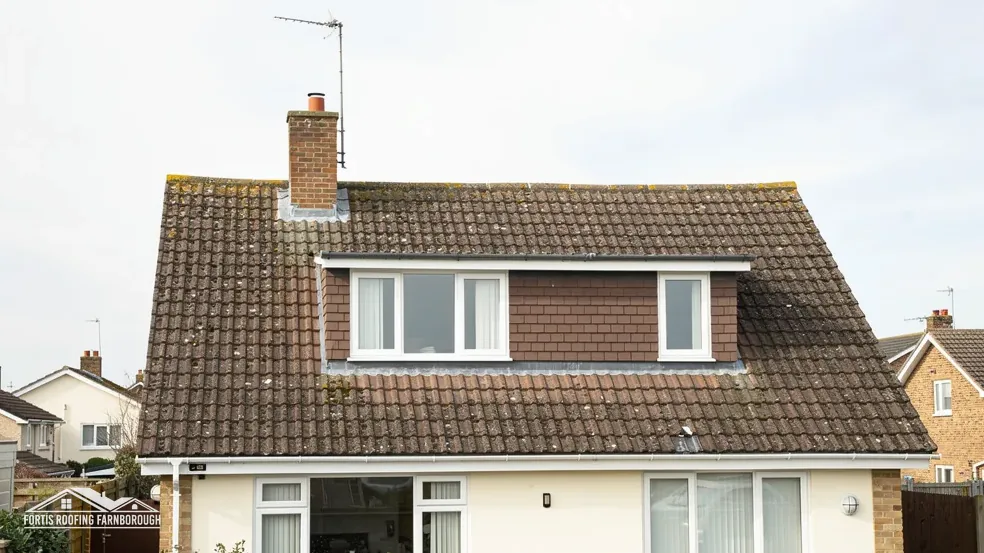
Roofs on Grayshott's 1890s terraces and villas, in clay tile and slate
Grayshott grew in the 1890s as terraces and villas on long, narrow plots. We survey its steep clay-tiled roofs and shallower slate ones slope by slope, then price in writing.
East Hampshire's appraisal says the centre is largely Victorian and Edwardian terraces and villas on long, narrow plots.
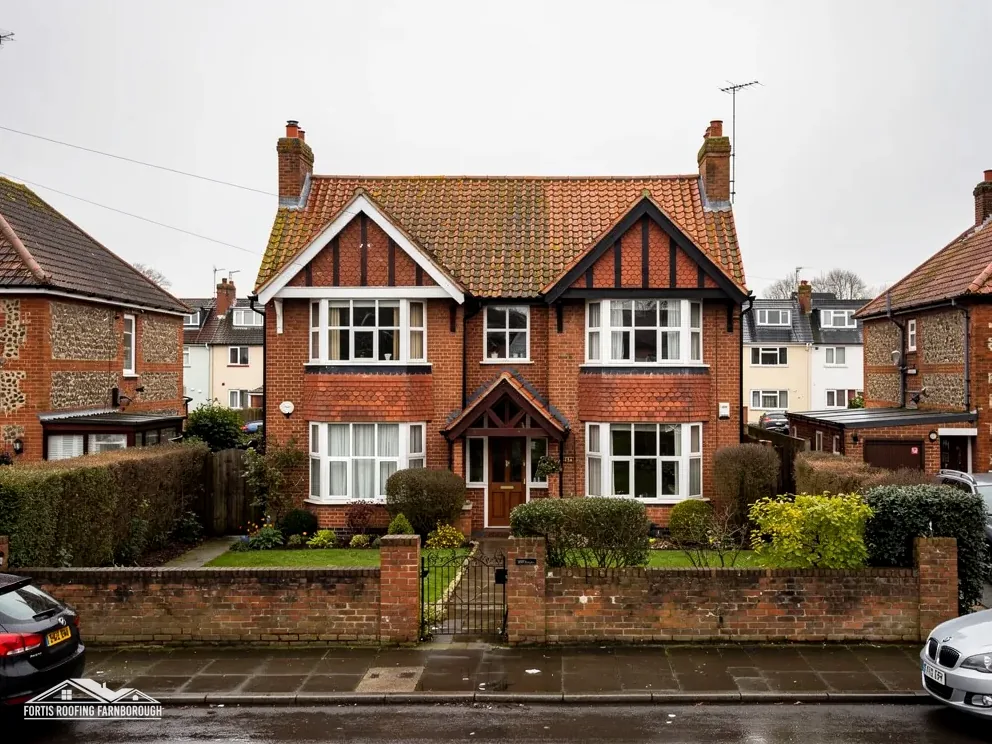
The appraisal records tile-hanging on upper floors and plain clay tiles on steeper roofs, with brick dressings.
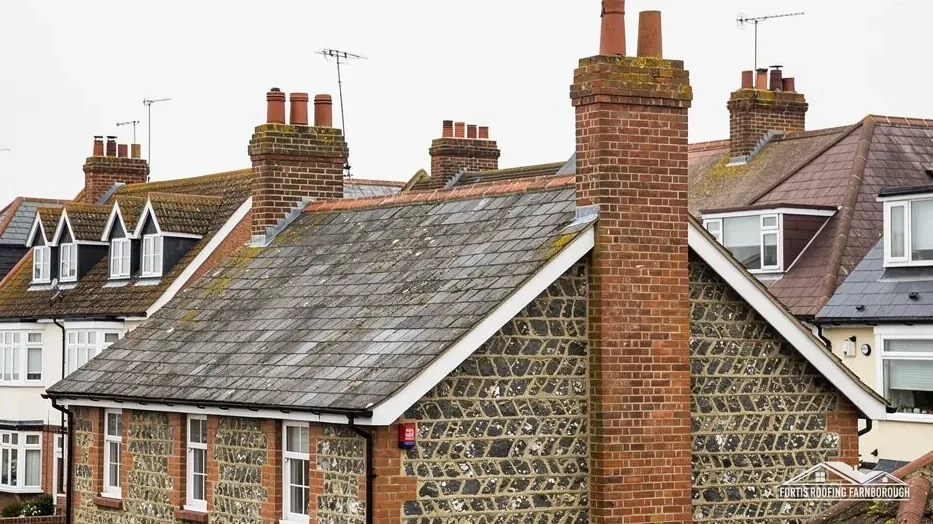
The same appraisal puts natural slate on the shallower roofs, with local sandstone and brick walls beneath.
Map of Grayshott with Hindhead, Churt, Haslemere, Bramshott marked around it.
Map data © OpenStreetMap contributors. Loads only when you ask for it.
Hindhead lies close to the east, Churt to the north-west, Haslemere to the south-east, Bramshott to the south-west, Headley to the west and Liphook to the south-west.
About 18.4 road miles south of Farnborough · East Hampshire District Council and Hampshire County Council.
Grayshott, border village roofs
How East Hampshire and Hampshire County Council share the rules for a Grayshott roof, what the conservation area appraisal says about its tiles and slate, and where the Surrey Hills National Landscape touches the village.

| No. | Chapter | The figure it turns on |
|---|---|---|
| 01 | East Hampshire, Hampshire County Council and ten working days | Ten clear working days' notice |
| 02 | Terraces, villas and a sandstone church | Developed in the 1890s |
| 03 | Plain tile or slate: how long each lasts | Clay 60-80 years, slate 75-100 |
Chapter 01 of 03
Who deals with a Grayshott roof, in four facts
Grayshott is on the Hampshire and Surrey border, 18.4 road miles south of Farnborough by the A325 route we measure from. East Hampshire District Council handles planning for the parish and has its own building control team. Hampshire County Council is the highway authority, which makes it the body that licenses scaffold on a Grayshott road. The 2021 Census counted 2,773 usual residents in the parish, and the village sits just west of Hindhead on the county boundary.
Hampshire County Council puts the scaffold licence application on the scaffolding firm, so the form is theirs to fill in, not yours. The council asks for at least ten clear working days from application to the intended start, and its page says it does not offer extensions. Hampshire County Council charges £211.90 for the first two weeks and £72 for each further two-week period, so a job planned to finish inside the first fortnight avoids the second charge. We build the programme around that, and tell you the dates before you commit to anything.
Those 10 working days drive the programme more than anything else. A roof that leaks on a Monday can be made safe from a ladder or tower within our access, but a full repair that needs scaffold on a road waits for the licence. We tell you at survey which kind of job yours is, so the dates are honest from the start. A scaffold that stands wholly inside your own boundary does not obstruct the highway, so it is not part of this process.
Our scaffold licence answer explains the Hampshire process in more detail.
East Hampshire's building control pages note that a registered building control approver can be used as a private alternative, and that the council can take a job back if the approver cannot continue. East Hampshire publishes no percentage rule for re-roofing, so the Planning Portal's national test applies: building control is not normally needed while the work touches under 25 per cent of the building envelope and under 50 per cent of the roof. A patch of tiles sits well below that, and a whole-roof re-slate sits above it.
The survey puts a number on it. We measure each slope, photograph the area affected, and show which side of the line your job falls, so the question of approval is answered before the price is. On a terrace, the same measurements help you and your neighbour compare notes if both roofs are looking tired.
Chapter 02 of 03
| Building or feature | Record |
|---|---|
| The centre | Largely Victorian and Edwardian terraces and villas on long, narrow plots |
| Walls | Local sandstone with brick dressings, and red and orange brick |
| Upper floors | Clay tile-hanging |
| Roofs | Plain clay tiles on steeper roofs, natural slate on shallower ones |
| St Luke's church | Begun 1898, tower finished 1920, Wealden sandstone, broach spire |
The Victoria County History of Hampshire, in 1908, called Grayshott fast becoming populous. Thirty years earlier the place had one primitive grocer's shop, and by 1908 it had a whole street of shops with a post and telegraph office. East Hampshire's conservation area appraisal says the village grew during the 1890s, with a centre of Victorian and Edwardian terraces and villas in long, narrow plots. The Fox and Pelican pub dates from 1899. A village centre that grew mostly in one decade, with infilling from the 1960s onwards, has many roofs of a similar age, so we use neighbouring roofs only as a guide to age, never as proof of condition.
The appraisal also names the materials. Walls are local sandstone with brick dressings and red or orange brick, with clay tile-hanging on the upper floors. Roofs are plain clay tiles on steeper pitches and natural slate on shallower ones. St Luke's church, begun in 1898 with its tower finished in 1920, is built of coursed Wealden sandstone, with a large broach spire.
Plain clay tiles on a steep roof are small, and there are a lot of them. The tiles are hung on timber battens and held by nibs and nails, and a few slip as the nails fail. Slate on a shallower pitch has less margin: the lower the slope, the more weight is placed on the lap between slates and the fixings behind them. BS 5534 indicates a minimum pitch of 20 degrees for natural slate, which is why we measure the pitch before we agree what can be repaired.
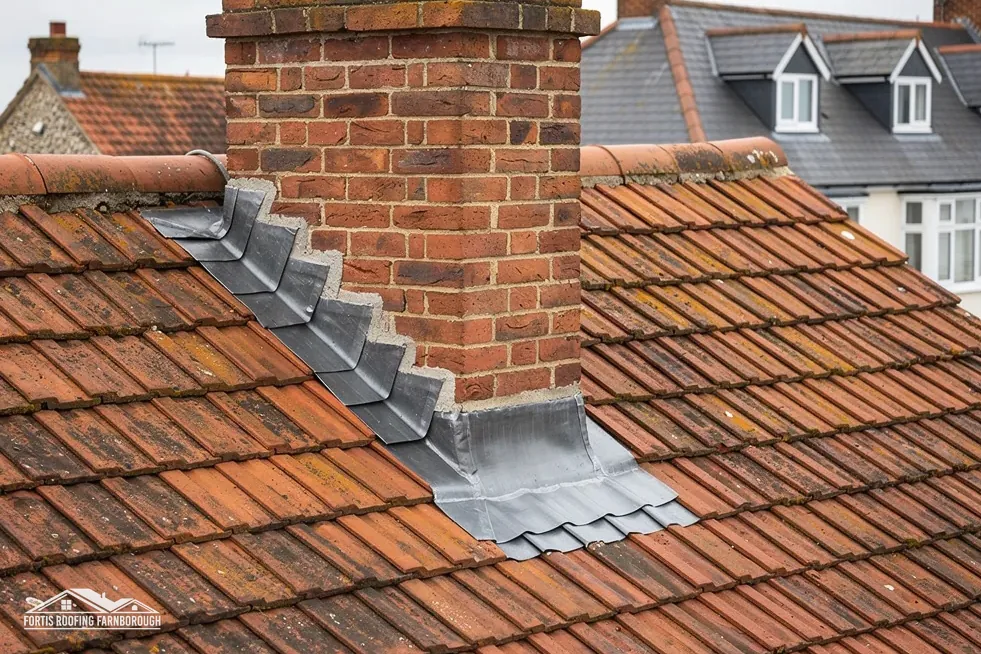
Tile-hanging deserves a mention too. It is vertical, not a roof, but it reaches the roof along the eaves and the dormer cheeks, and we check those junctions because those are the first points to let water in. A lead soaker, the folded piece that lets the tiles overlap a joint, may have gone at a hung gable long before the roof proper wears out.

On a terrace the roofs of neighbouring houses meet at party walls, and a repair on one side often shows the state of the other. We photograph the party wall line and describe whatever we can see of the next slope from our own. Our pitched roofing page explains how tile and slate repairs are carried out.
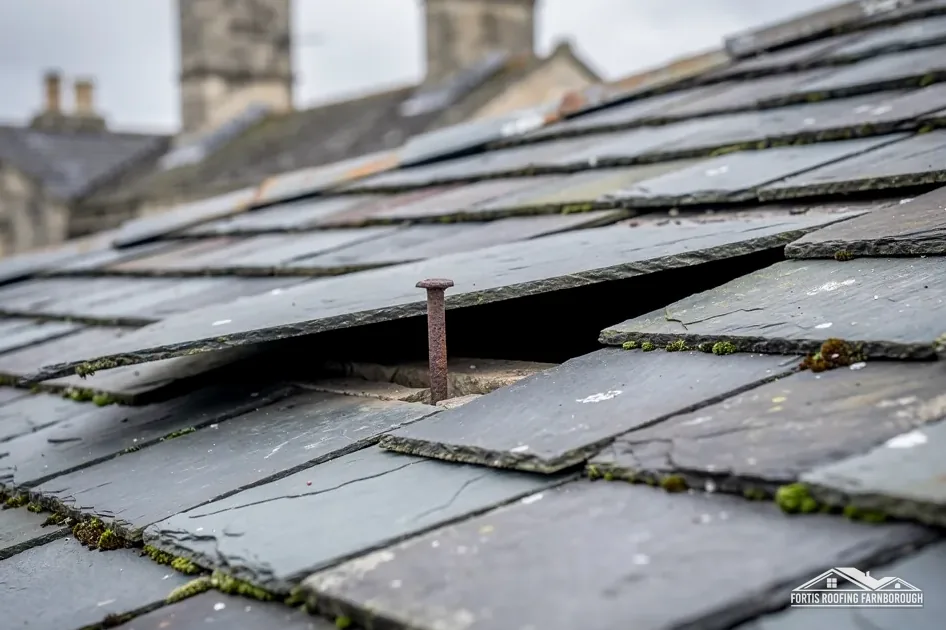
On a shallow pitch the lap between slates matters most, and the fixings behind them do the holding. Nails rust, and a slate slips although the stone is sound. We lift a sample, photograph the underside and measure the pitch, then explain whether refixing the slipped slates is enough or the slope calls for more.
Refitting matching tiles or slates in the same way preserves the appearance; a different material, a raised ridge or a rebuilt chimney changes it. The Grayshott area was designated on 9 April 1991. Before any change is priced we put the question to the district planning team, and their reply stays with your survey photographs so it is on record. A conservation area allows repairs; it asks that they match.
On Hampshire County Council's rules the scaffolding firm makes the application for its customers. A minimum of ten clear working days must pass first, and extensions are not offered, so we agree the scaffolder and dates with you at survey and write them down. Hampshire County Council charges £211.90 for the first two weeks of the licence, and £72 for each fortnight after that.
It can be. About 44 per cent of the area around Grayshott lies inside it, and the designation can affect what an alteration to the roof needs. We check your address against the boundary with East Hampshire before suggesting any alteration that changes the shape of the roof, and tell you the result in writing.
Get your free roof quote
Give us your Grayshott road and what you spotted, and we will book a visit to measure each slope.
10-year workmanship guarantee, in writing.