Church Street's old cottages
Historic records show 16th- and 17th-century cottages along Church Street, beside the 16th-century Market Hall.
Roofs from Church Street cottages to the station-road streets
Burnham's Church Street holds a 16th-century Market Hall and cottages of the 16th and 17th centuries. We survey roofs here slope by slope, old and new.
Historic records show 16th- and 17th-century cottages along Church Street, beside the 16th-century Market Hall.

The Garibaldi Inn is a 17th-century brick and timber house, near the school and more 17th-century cottages.
By 1925 streets of small artisans' dwellings had been built in the outlying parts and on the station road.
Map of Burnham with Taplow, Farnham Royal, Dorney, Farnham Common marked around it.
Map data © OpenStreetMap contributors. Loads only when you ask for it.
Taplow lies to the west, Farnham Royal to the east, Dorney to the south and Farnham Common to the north-east, with Cookham to the north-west.
About 23.1 road miles north of Farnborough · Buckinghamshire Council (unitary).
Burnham, council and record
Which council signs off roof work in Burnham, what the Victoria County History and Historic England record about its buildings, and how listing and the conservation area shape a repair, each with its source.

| No. | Chapter | The figure it turns on |
|---|---|---|
| 01 | One unitary council for Burnham roof work | Buckinghamshire Council, one unitary |
| 02 | From the Thames bank to the Beeches | 12,519 residents in Burnham parish |
| 03 | St Peter's, the conservation area and listed houses | St Peter's, Grade II*, by faculty |
Chapter 01 of 03
| Role | Body for Burnham addresses |
|---|---|
| Planning authority | Buckinghamshire Council (unitary) |
| Building control | Buckinghamshire Council, its own building control team |
| Private building control | A registered building control approver, in force since 6 April 2024 |
| Scaffold licence on the highway | Highway authority, Highways Act 1980 s169 |
| Re-roofing test | Planning Portal: under 25 per cent of the envelope and under 50 per cent of the roof |
Burnham sits in Buckinghamshire, where Buckinghamshire Council is a unitary council: one authority doing the work that a district and a county would split between them elsewhere. A Burnham roof job therefore meets one planning team and one building control team, both at Buckinghamshire Council. Farnborough is 23.1 road miles away, so each survey is booked for a set time and the whole roof is photographed and measured in a single visit. You are shown the pictures and the measurements, then told in plain words what the roof needs and what it does not.
The Planning Portal gives the test most owners need. Building control is not normally required when less than 25 per cent of the total building envelope is affected, and less than 50 per cent of the roof. The envelope counts the walls, floor, roof, glazing and doors as one total, so the sum is made against the whole house and not just the slope that faces the street. Re-fixing a handful of tiles or re-bedding a ridge falls inside it. Stripping a whole pitch and re-covering it falls outside, and the job then needs a different plan.
Weight is the second test. A covering that adds 15 per cent or more to the roof's load needs approval, and the Planning Portal suggests asking a structural engineer or surveyor beforehand. A covering that would behave differently in a fire is the third. On the survey we record what is on the roof now. Before any date is booked we tell you whether Buckinghamshire Council's building control team, or a registered building control approver, needs to see the job.
Highways law is the other gate. Section 169 of the Highways Act 1980 requires a licence for scaffolding that obstructs the highway, and the highway authority issues it. Poles standing on your own drive or lawn need no licence. Where poles would stand on the footway, the licence is left to be arranged with the scaffolder, whom you may ask who is applying. On a village street we note at the survey where the poles would stand, since that decides whether the pavement stays usable for your neighbours while the work goes on.
Chapter 02 of 03
What the records give for Burnham
The Victoria County History's 1925 account of Burnham, on British History Online, describes a long, narrow parish that runs up from the Thames to the higher wooded land of the Beeches, on gravel soil over loam. The 2021 Census counted 12,519 usual residents in the civil parish. A survey here can take in a very wide range of buildings, from cottages older than the railway to houses built since.
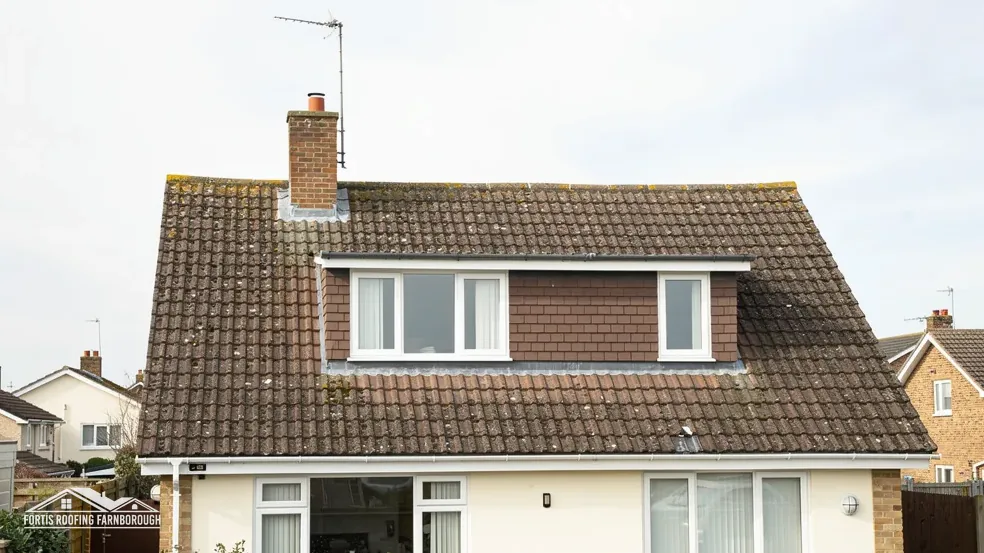
In Church Street the 1925 account records the Market Hall, a 16th-century building with an overhanging gabled upper storey over a large oak gateway, and 16th- and 17th-century cottages along the street. On the High Street it describes the Garibaldi Inn as a 17th-century brick and timber house, near the school and some 17th-century cottages. Historic England lists 113-121 High Street and 14 and 16 High Street at Grade II. A roof on buildings of that age has been repaired many times, so we read the slope as a record: which tiles look original, which are later replacements, and where battens and rafters have been patched.
On a timber-framed cottage the roof structure can be part of the frame, and a repair has to respect it, which is why it is photographed before anything is lifted. We photograph the eaves, the verges and the chimney junctions at the start of the visit, then explain what a repair can fix and what it cannot. For clay tile, HomeBuilding's published life is 60-80 years, a range rather than a forecast, so age alone never settles a re-roof. Our chimney repairs page covers the stacks that rise through those older roofs.
People and listings
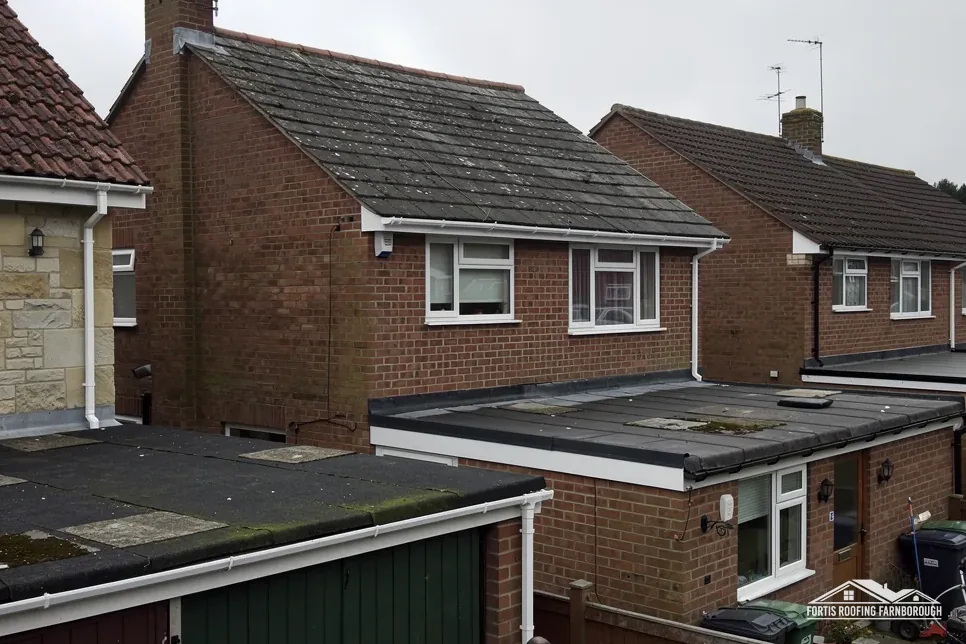
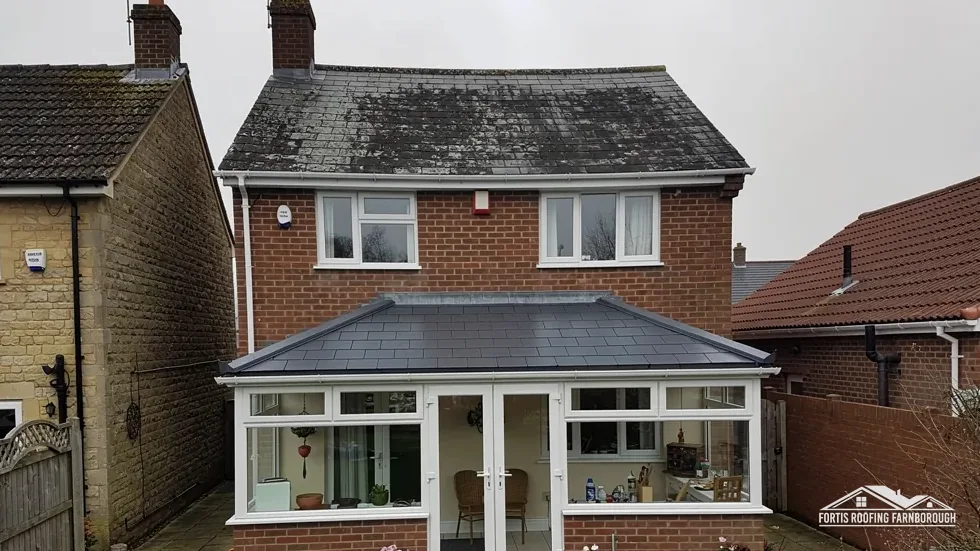
The same account records that in recent years one or two streets of small artisans' dwellings had been built in the outlying parts of the village and on the road to the station. Burnham was spreading outward by 1925, with small homes beside the older High Street buildings. On houses like these the jobs are familiar ones: slipped tiles, tired ridges, failed flashings and gutters that have lost their fall. We photograph each fault and measure it, so you see what is wrong before you see a price.
Chapter 03 of 03
| Designation | In Burnham | For roof work |
|---|---|---|
| Conservation area | Burnham | Changes to the look checked with Buckinghamshire Council |
| Grade II* listed church in use | Church of St Peter (NHLE 1124528) | Church of England faculty, not listed building consent |
| Grade II listed | 1 and 2, Britwell Gardens (NHLE 1124524) | Listed building consent for works affecting its character |
| Grade II listed | 113-121 High Street (NHLE 1124509) | Listed building consent for works affecting its character |
Burnham has a conservation area of its own, and Buckinghamshire Council lists its conservation areas on its heritage pages, with a conservation area document and a boundary map for Burnham that you can open before any change is planned. Designation does not forbid roof repairs. It means an alteration that shows from the street, such as a different covering, a new ridge line or a chimney taken down, goes to the council's planning team before it goes into a quote. Whether an Article 4 direction applies at your address is something to confirm with Buckinghamshire Council, because it cannot be read from the street. Our planning permission for roof work guide explains how to put the question.
St Peter's Church has a Grade II* listing, dated 23 September 1955. Because it is an Anglican church still used for worship, the ecclesiastical exemption applies and work to its roof is approved through the faculty system rather than by the council. Any roofer on the church works to that denominational route, and none of it changes the position of the houses around it, which follow the council's usual consent routes.

Historic England lists 1 and 2, Britwell Gardens at Grade II, and dates that listing to 27 August 1980, with several High Street buildings at the same grade. Works that would alter a listed house's character need listed building consent, which sits alongside any Building Regulations route. We do not start on a listed roof until the consent route is clear. The survey photographs and measurements give the council's conservation officer the roof exactly as it stands today.
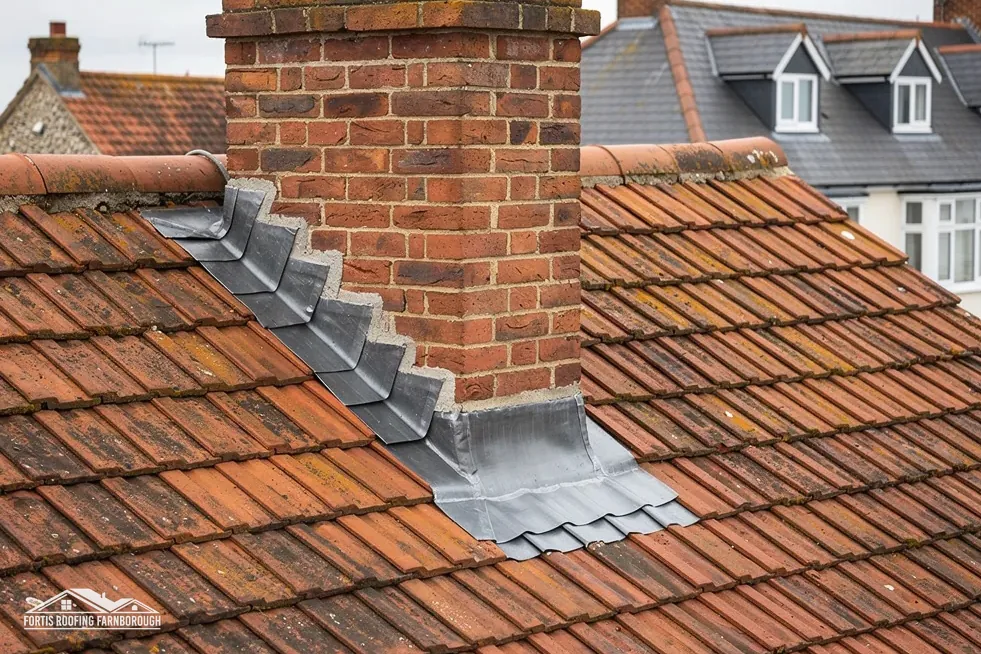
On older roofs the lead matters as much as the tile. Valleys, soakers and chimney flashings on period buildings are renewed in the right lead code, which our lead roofing and lead work page explains. When a ridge is re-bedded, we record whether it is bedded in mortar or dry-fixed, since BS 5534 no longer trusts mortar alone to hold ridge and hip tiles and BS 8612 tests the dry-fixed alternatives. In a conservation area the aim is a repair that can be shown to match what was there, and the record we keep is what shows it. If a listed or church roof needs a consent route first, we explain it at the survey and hold the work until that route is settled.
That is the aim on an old cottage: matching tiles, battens and details to what is already there. On a listed building the work still needs listed building consent if it affects the character. We photograph the slope, name what looks original, and ask Buckinghamshire Council's planning team before pricing anything that changes the look.
Putting back what was there is one question. Altering what passers-by see is another. Ask Buckinghamshire Council's planning team whether your change needs permission, and whether an Article 4 direction applies at your address. Our survey records the roof as it stands, so you can show the council exactly what is there now.
No. St Peter's is listed Grade II* but is an Anglican church still in use, so the faculty system governs its works, not a listed building consent application to Buckinghamshire Council. A listed house nearby follows the consent route instead, for any works that would alter its character, and we raise that before any work is booked.
Section 169 of the Highways Act 1980 makes scaffolding that obstructs the highway a licensed matter, and the highway authority grants the licence. The scaffolder arranges it with us, and you are welcome to ask who applies before signing anything. Scaffold on your own land needs no licence at all, so a rear-slope repair can often begin sooner.
Get your free roof quote
Give us your Burnham street and the problem. We will survey and photograph the roof, then send one written price.
10-year workmanship guarantee, in writing.