Named for tile and hill
The council's appraisal says Tilehurst comes from tigel, a tile, and hurst, a wooded hill.

Roofs in a district named for its tiles and wooded hill
Tilehurst takes its name from a tile and a wooded hill, and brick and tile making shaped its past. Our surveys check what each roof carries now.
The council's appraisal says Tilehurst comes from tigel, a tile, and hurst, a wooded hill.

A red and grey brick tower of 1737 stands beside a flint church of 1856 with a tiled roof.

In the Routh Lane area, 221 New Lane Hill is 17th-century and thatched; many properties date from about the 1960s.
Map of Tilehurst with Calcot, Purley on Thames, Theale, Pangbourne marked around it.
Map data © OpenStreetMap contributors. Loads only when you ask for it.
Calcot lies south-west of Tilehurst, Purley on Thames north, Theale further south-west, Pangbourne north-west, Caversham east and Reading's centre east.
About 25.6 road miles north-west of Farnborough · Reading Borough Council (unitary).
Tilehurst, tile and Routh Lane
Which council covers a Tilehurst address, since part lies in West Berkshire, what Reading's 2010 appraisal says about tile-making, St Michael's and the 1960s houses, and what Routh Lane's conservation area asks.

| No. | Chapter | The figure it turns on |
|---|---|---|
| 01 | Reading or West Berkshire: which council is yours? | Part of Tilehurst lies in West Berkshire |
| 02 | A name from tile, and two church periods | Brick and tile making historically pre-eminent |
| 03 | Routh Lane's conservation area and the war memorial | Routh Lane designated 21 August 1987 |
Chapter 01 of 03
A Tilehurst roof job in four published details
Tilehurst is a large district on the western edge of Reading, and its boundary with West Berkshire runs through it: part of the area is in Tilehurst civil parish, which is in West Berkshire, while the rest belongs to Reading Borough Council. Both councils are unitary, so each handles planning for its own addresses, with no county council above either. The first job on any Tilehurst enquiry is to find out which one covers the house.
A Reading address is planned by Reading Borough Council, which also keeps its own building control service. An address in the West Berkshire part falls to West Berkshire Council, whose building control is Building Control Solutions, known as BCS, a partnership with Wokingham Borough Council. Under either, a registered building control approver of your choosing offers a private route. Give us your postcode when you ring and we will confirm the council, because the answer sets every later step: who plans, who inspects and who issues the highway licence.
Our survey report states the council, the postcode it was matched to and the guidance we followed, so nothing is left to assumption.
Whichever council applies, the Planning Portal's yardstick does not change. Hold a re-roof under 25 per cent of the building envelope and under 50 per cent of the roof, and Building Regulations stay out of it in the ordinary case; a covering heavier by 15 per cent or more brings them in. Tilehurst's houses range from a 17th-century thatched cottage to homes built about the 1960s, so roof sizes differ widely, and measuring each slope is the only way to know where yours stands.
Standing a scaffold on a road or footway brings in the highway authority, whose licence is governed by section 169 of the Highways Act 1980, and the authority is again whichever council covers your address. We establish the applicant, the fee and the lead time with that council, and we put the dates in the written plan.
Tilehurst sits on high ground above the Thames valley, so a house may stand on a slope. We look at the ground where a scaffold would stand, because a sloping drive or garden affects the base and the boards as well as the licence, and we note any steps or retaining walls that a delivery has to get past.
Chapter 02 of 03
| Subject | What the appraisal records |
|---|---|
| Name | From tigel, a tile, and hurst, a wooded hill |
| Trades | Brick and tile making have historically been pre-eminent in Tilehurst life |
| St Michael's tower | Brick, 1737, in red and grey brick in English bond |
| Rest of the church | 1856, by George Edmund Street, flint on a stone plinth with a tiled roof |
| Housing | 221 New Lane Hill is 17th-century and thatched; many properties date only from about the 1960s |
| Administration | Tilehurst did not become part of Reading until 1911 |
Reading Borough Council's Routh Lane appraisal opens Tilehurst's story with a name. It says Tilehurst comes from tigel, an old word for tile, and hurst, a wooded hill, and that brick and tile making have historically been pre-eminent in Tilehurst life. The appraisal covers the Routh Lane area by the church, yet its remark on the trade is a useful reminder for anyone with a tiled roof in the district: tile was made here historically, and replacements can be matched to old tiles with some care.
St Michael's Church has a brick tower of 1737, in red and grey brick in English bond. The rest dates from 1856, to designs by George Edmund Street, built of flint on a stone plinth with a tiled roof. A church of two periods shows how a building can be added to over time and how roofs differ between the parts. Houses behave the same way, with an original roof, an extension of a later decade and perhaps a porch of a third. Where an old roof and a newer extension meet, the junction needs its own flashing, and we record each one with the pictures kept together in the report.
A district with a tile-making past might be expected to have tiled roofs everywhere, but the appraisal makes no such claim, and the survey assumes nothing about any roof. To know what covers a given Tilehurst house we lift a few pieces and look. Our pitched roofing page describes how loose, slipped or broken tiles are replaced, and what is done at ridges and valleys.
Two church dates
In the Routh Lane area by the church, 221 New Lane Hill is a 17th-century thatched cottage, while many properties date only from about the 1960s. That is a wide spread of ages and coverings in a small area, and it means a Tilehurst survey starts without assumptions. Homes of the 1960s can have flat roofs on garages, porches and extensions, and our flat roofing page covers membranes, outlets and falls.
Tilehurst did not become part of Reading administratively until 1911, so its older buildings predate that merger. We survey what is there, not what the date suggests.
Chapter 03 of 03
Tilehurst's designations in four published figures
Reading's records give 21 August 1987 as the date the Routh Lane conservation area was designated, and it lies within about 0.75 km of the centre of Tilehurst. Reading Borough Council holds the boundary map, and a call to its planners will say whether a given house falls inside. Before a dormer goes on, or the roof's look changes in any other way, raise it with the council. If your house is on the West Berkshire side, the conservation question goes to that council instead, and its map and rules may differ.
Whether an Article 4 direction reaches a Tilehurst roof is a question for the council that covers your address, so ask before any change that shows from the street. Our planning permission for roof work guide explains the national rules.
The national list shows a single listed building within 500 m of the centre, Tilehurst War Memorial, listed Grade II on 10 February 2017. A listed building needs consent for work altering its character, and a memorial is no exception. Reading's 2010 appraisal records St Michael's Church as listed Grade II, along with Iris Court, Goodwyns and 221 New Lane Hill inside the conservation area. For the church, those responsible will know the consent route, because the faculty system, not the council, governs a working Church of England church.
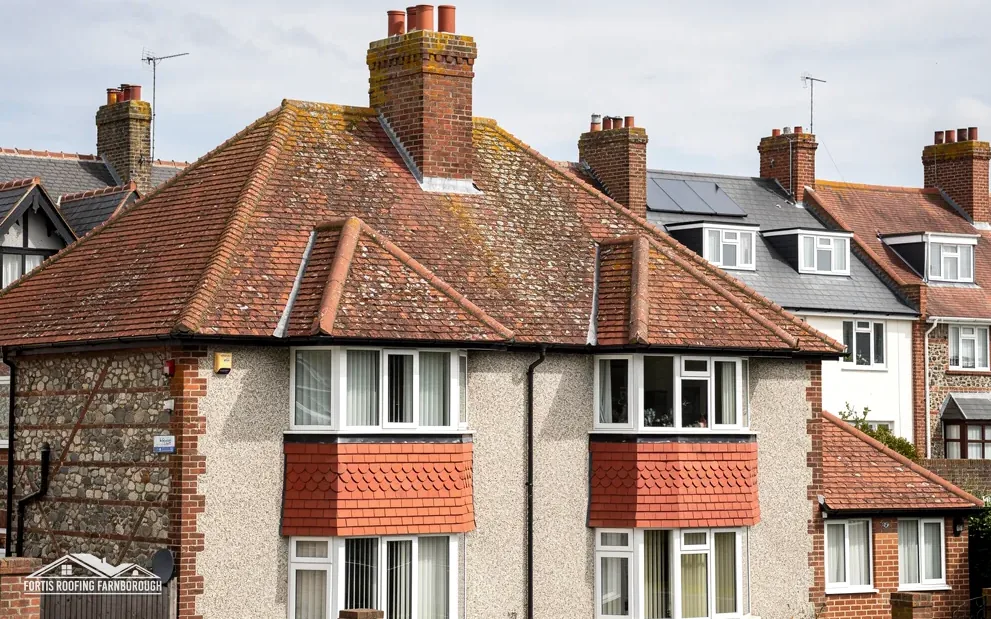
For a Tilehurst house that the list leaves out, restoring what the roof carries now is the straightforward job, because section 55 of the Town and Country Planning Act 1990 sets aside works that leave the way a building looks from outside materially as it was. Our dated pictures show the roof before work, which helps when a council, a buyer or a neighbour wonders later what was changed.
Chimneys are the detail that stands out from the street. If a stack leans or has lost pointing, tell us before you tell anyone else, and we will record it before anything is altered. A stack that serves two houses is also a party wall matter, and a party wall surveyor, not building control, sorts out who does what between neighbours.
That depends on the covering, which we identify at the survey. Reading's appraisal records both tiled and thatched buildings in Tilehurst, and thatch is a separate trade from tiling. If your roof is tiled, the repair of slipped or cracked tiles, ridges and valleys is our work, and the report names what each slope carries.
Designation came on 21 August 1987, and the area reaches within about 0.75 km of the district's centre, so certain houses are inside and many are not. Reading Borough Council's planners hold the map. Dormers and other visible roof changes go to Reading's planners as a question before we quote.
West Berkshire's service is Building Control Solutions, known as BCS, which it runs in partnership with Wokingham Borough Council, while Reading addresses use Reading Borough Council's own service. Under either council a registered approver in private practice can take the application instead. Whether any application arises is a matter of the Planning Portal's limits, which our survey works out for your roof.
Only the memorial is listed, at Grade II, and work touching its character needs listed building consent. That does not by itself restrict work on neighbouring houses. Whether a nearby house is listed, or sits inside the Routh Lane conservation area, is a separate question for the council's map and the national list.
Get your free roof quote
Send us your Tilehurst postcode with a note on the roof's trouble, and a visit will be booked.
10-year workmanship guarantee, in writing.