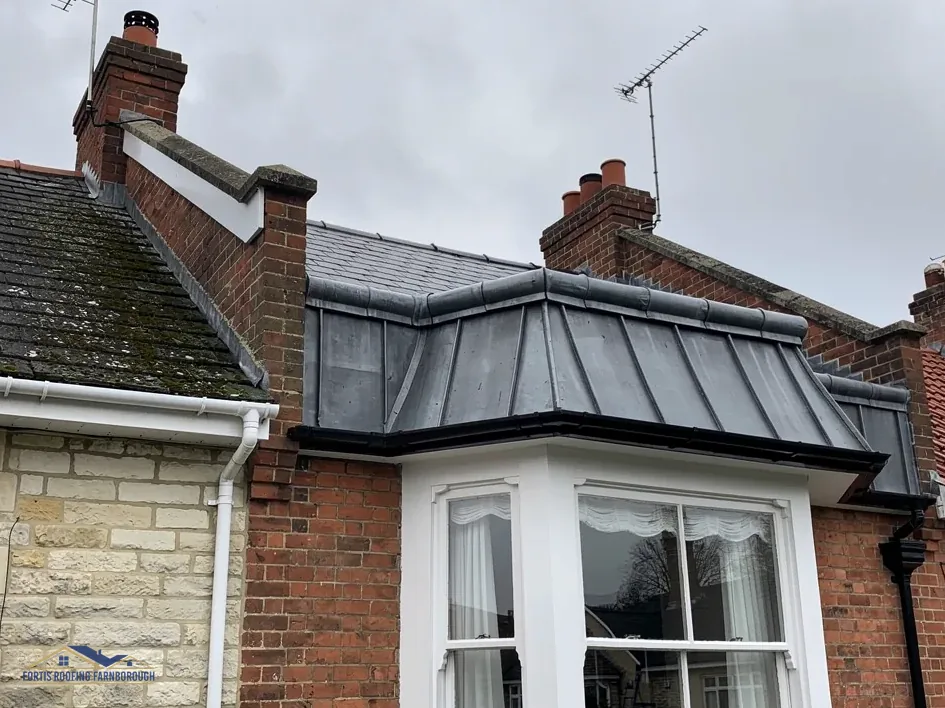
Calcot House's lead heads
The date 1755 on its lead rainwater heads marks when this red brick house in a wooded park was built.
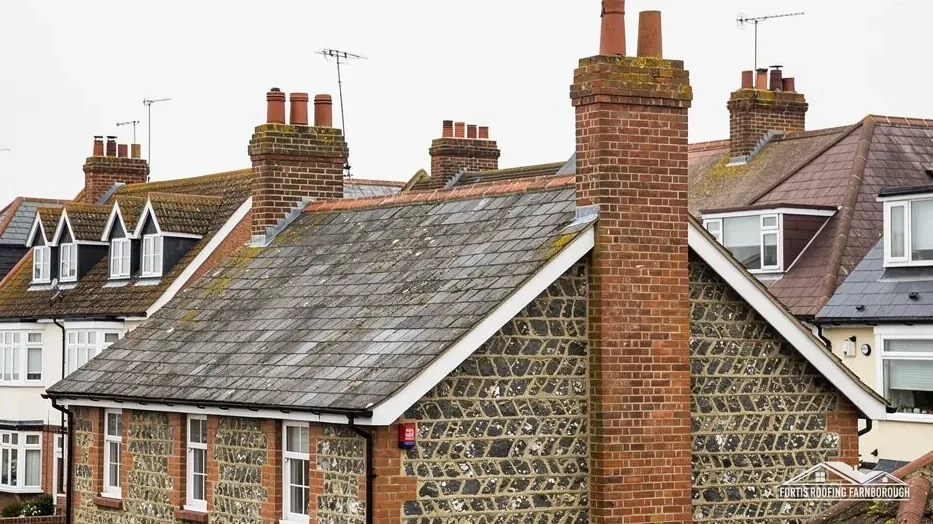
Lead rainwater heads, red brick and the Bath road suburb
Calcot House carries lead rainwater heads dated 1755, and the suburb grew along the Bath road west of Reading. We survey each roof closely, from ridge to gutter.
The date 1755 on its lead rainwater heads marks when this red brick house in a wooded park was built.

By 1923 the walls of Calcot House had been raised to enclose the top storey under a new roof.
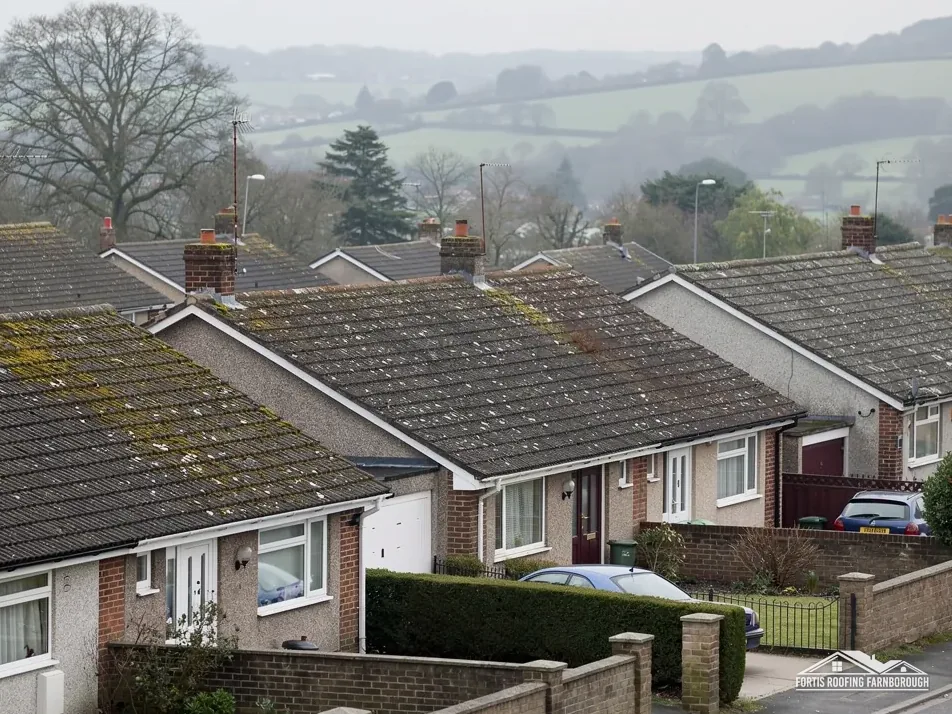
Beansheaf Farmhouse and its granary to the south-west are each listed at Grade II.
Map of Calcot with Theale, Tilehurst, Purley on Thames, Burghfield Common marked around it.
Map data © OpenStreetMap contributors. Loads only when you ask for it.
Theale lies to the west, Tilehurst to the north-east, Reading to the east, Purley on Thames to the north and Burghfield Common to the south.
About 24.1 road miles north-west of Farnborough · West Berkshire Council (unitary).
Calcot, lead and the hamlet
How West Berkshire's building control and the lead codes bear on a Calcot job, how long lead lasts, what the county history records of Calcot House and the hamlet, and which listings sit nearby.

| No. | Chapter | The figure it turns on |
|---|---|---|
| 01 | West Berkshire, BCS and how lead is chosen | Lead flashing can last over 80 years |
| 02 | A 1755 park house and a hamlet that moved | Calcot House dated 1755 by its lead heads |
| 03 | Beansheaf Farmhouse and the conservation areas nearby | Beansheaf Farmhouse is Grade II |
Chapter 01 of 03
| Matter | Position at Calcot |
|---|---|
| Planning authority | West Berkshire Council (unitary) |
| Building control | Building Control Solutions, West Berkshire with Wokingham |
| Lead flashing life | Can last for over 80 years, a lower bound, MyJobQuote |
| Lead on a flat roof | 60 to 100 years, HomeBuilding |
| Soakers only | Code 3, 1.32 mm, Royston Lead |
Calcot is a Bath road suburb at the western edge of Reading. Building Control Solutions, a joint service of West Berkshire and its Wokingham counterpart, handles its inspections, and because West Berkshire is a unitary council, planning sits in the same place. The drive from Farnborough is 24.1 road miles, so a visit is arranged for a set time and the roof is surveyed, measured and photographed end to end.
Lead is the metal most often seen on an old roof, and the question owners ask is how long it will go on. MyJobQuote's guide gives over 80 years for lead flashing. That is a floor and not a ceiling, so it says what lead can do and not what any given strip will. HomeBuilding gives lead on a flat roof 60-100 years. In both cases the figure describes a typical range and is not a promise, and the condition of the sheet decides, not its age alone.
What wears lead out is movement. Sheet that is fixed too rigidly cracks as it heats and cools, joints open, and a strip pulled out of a wall lets water behind it. So a survey looks at how each piece is laid, how long it runs, and whether it has room to move, before it says whether lead can be repaired or must be renewed.
Lead sheet is sold by code. In Royston Lead's cast-lead brochure Code 3 (1.32 mm) is reserved for soakers. Code 4 (1.80 mm) covers soakers, flashings, pitched valleys and dormers, and Codes 5 and 6 (2.24 and 2.65 mm) are for flashings, valleys, parapet or box gutters and dormers, while Codes 7 and 8 suit the larger gutters. A soaker is a small piece bent to run under a tile and up a wall. Our lead roofing and lead work page explains the choice, and the scaffold needed to reach a chimney is part of that plan.
Cost guides give a sense of scale. MyJobQuote puts full chimney leadwork between £350 and £920, depending on the scaffold, and most full roof valley replacements at around £540. Those are typical UK figures, and the one total we give after a survey depends on the lead code, the length, and how awkward the access is.
Chapter 02 of 03
Calcot in dates from the county history
The Victoria County History's 1923 account of Tilehurst describes Calcot House as a red brick house in a wooded park. It says the date 1755 on its lead rainwater heads marks its building, and that by 1923 its walls had been raised to enclose the top storey under a new roof. A rainwater head is the lead box that collects water from a gutter and passes it to a downpipe, and a date cast into one is a reminder of how long lead lasts when it is looked after.
Raising walls to put a top storey under a new roof is a change many houses go through. It leaves joins: between old brick and new, between an old roof line and a new one, and around any chimney that now rises through a different structure. Those joins are where a survey looks first, because flashings there were made by hand, to the shape of the day.
If a house has had such a change, a re-roof or repair can touch the weight on its walls. Where a new covering weighs 15 per cent or more than the old, approval is needed, according to the Planning Portal, which also advises consulting a structural engineer or surveyor. We weigh up the covering already on the roof and tell you whether a change would cross that threshold.
Rainwater heads need the same attention as the roof. A head that has filled with leaves or silt sends water over the top of a gutter and down the wall, and the damage shows far from the cause. We clear and photograph each head, trace the downpipe below it, and check the fall of the gutter feeding it. Our gutters, soffits and fascias page covers the roofline.
Two dates in Calcot's record
In 1894 part of Calcot hamlet was taken from Tilehurst parish into the new parish of Theale, which then held the greater part of the hamlet. The shift matters little to a roof, but it explains why records of Calcot appear under more than one name. For any job here we confirm the council and building control body that apply to the address.
Chapter 03 of 03
| Designation | Near Calcot | For roof work |
|---|---|---|
| Nearest conservation areas | Holy Trinity Theale, Horncastle, Routh Lane, within about 2.5 km | Confirm your address with the council |
| National Landscape | North Wessex Downs, partly: 4 per cent of the 1.5 km area | Ask the planning team about dormers |
| Grade II listed | Beansheaf Farmhouse (NHLE 1214865) | Listed building consent |
| Grade II listed | Granary south-west of the farmhouse (NHLE 1214867) | Listed building consent |
The nearest conservation areas in the national dataset lie within about 2.5 km of Calcot: Holy Trinity, Theale, Horncastle and Routh Lane, with Sheffield Bridge and the Lamb also named. They are not on most Calcot streets, but a distance on a map does not settle an address, so we check West Berkshire's own map before any price is written. Our planning permission for roof work guide covers what to ask the council, and our pitched roofing page covers the repairs we survey for.
Historic England lists Beansheaf Farmhouse at Grade II, dating the listing to 23 December 1983, and the granary about 10 metres to its south-west at the same grade. Two listed buildings lie within 500 m of the Calcot centre point. Alterations that affect a listed building's character need the council's listed building consent, which is separate from Building Regulations, and roof work waits for the consent.
On a farm, the main house, a granary and the buildings behind each have a covering of their own. We number every roof on the holding, house to lean-to, and rank them by urgency, so you can see which need work now, which can wait and which are sound. Daylight matters in a farm group, because dark loft spaces hide daylight leaks, so we look from inside around midday, when light through a slipped tile or an open lap is easiest to see.

Matching is judged from the street, in daylight, as neighbours will see it: tile colour, ridge detail and verge finish are compared with the existing roof before any are ordered, and the comparison is photographed so you can see it too, before work starts.
The North Wessex Downs National Landscape, the designation that replaced the AONB label, touches the ground around Calcot. The centre point lies outside it, and 4 per cent of the area within 1.5 km falls inside. A house on that edge can face different planning rules, so a loft dormer or extension deserves a word with the council before it is designed.
Whatever the designation, the starting point is the same. We photograph covering, ridge, verges and lead before a price is written, and keep the set in the survey file, so a repair, a consent officer or a later owner can compare the finished roof with the one we found.
MyJobQuote gives over 80 years for lead flashing, a floor, and HomeBuilding gives lead on a flat roof 60-100 years. Both are typical ranges, not promises. Condition decides: we check how the lead is fixed, whether joints have opened and whether strips have lifted from the wall, and report each finding with a photograph.
It can. If a new covering would add 15 per cent or more to the roof's load, Building Regulations approval is needed, the Planning Portal says, and a prior structural opinion is wise. We weigh the existing covering and tell you at the survey whether a change would cross that line.
Only for the listed buildings themselves. Beansheaf Farmhouse and its granary are Grade II, so alterations to their character need listed building consent from West Berkshire. A neighbouring house without a listing falls under the usual planning and building control routes, and the survey checks which of those applies to yours, in writing.
BCS, the service West Berkshire runs with Wokingham, or a registered building control approver. A handful of replaced tiles sits inside the Planning Portal's limits. Whether your job goes further is settled at the survey, and we explain in writing what each route would mean for the timetable and the cost.
Get your free roof quote
Tell us your Calcot road and the problem; we will visit, survey and quote one price.
10-year workmanship guarantee, in writing.