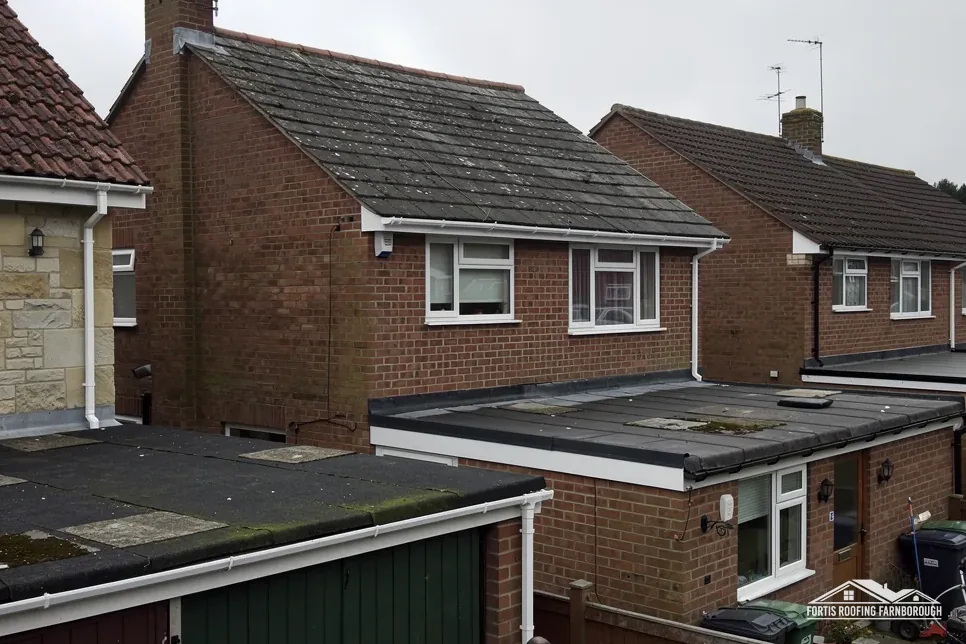
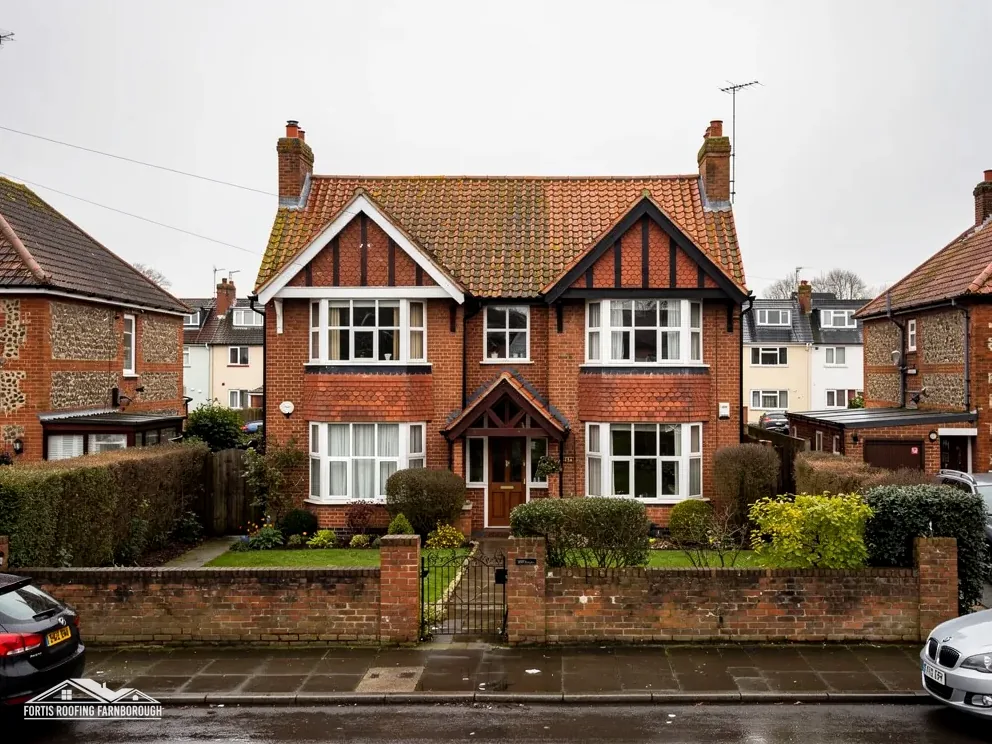
Plain red clay tile
The Tadley appraisal lists plain red clay tile among the traditional roof coverings, over orange or red brick walls.

Plain red clay tile, long-straw thatch and heath-edge brick
Tadley's appraisal records long-straw thatch and plain red clay tile over timber frames and orange or red brick, on a heath edge where bricks were made.
The Tadley appraisal lists plain red clay tile among the traditional roof coverings, over orange or red brick walls.

The same appraisal lists long-straw thatch among the traditional coverings, over timber-frame walls.
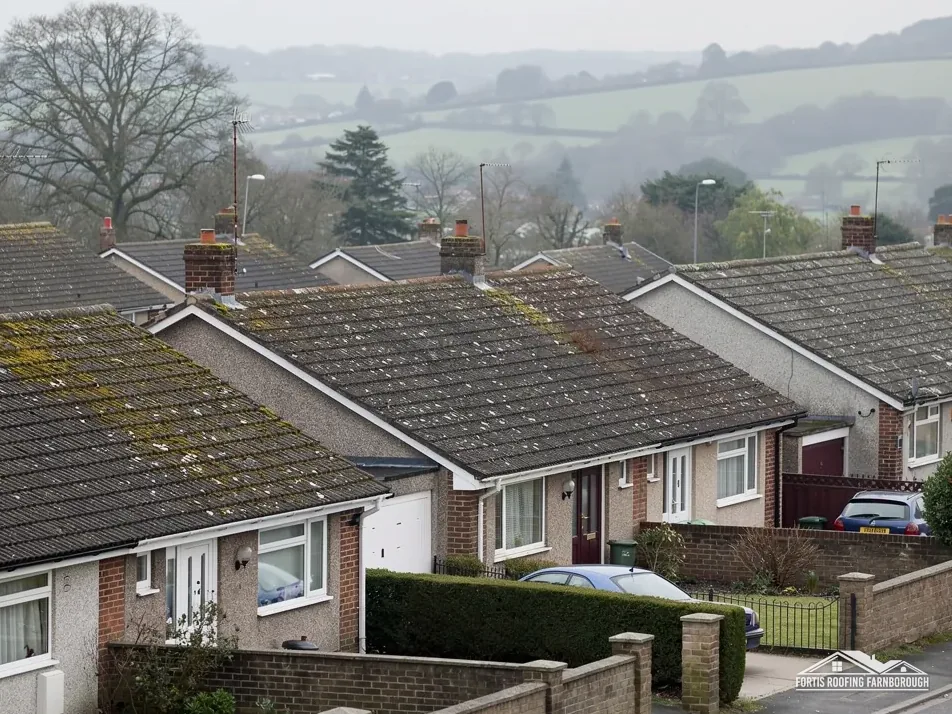
The north of Tadley was heathland and common, and bricks were also made on Tadley Common.
Map of Tadley with Pamber Heath, Silchester, Aldermaston, Woolhampton marked around it.
Map data © OpenStreetMap contributors. Loads only when you ask for it.
Aldermaston lies to the north, Mortimer to the north-east, Woolhampton to the north-west, Pamber Heath and Silchester to the east and Bramley to the south-east, all within about five miles.
About 24.4 road miles west of Farnborough · Basingstoke and Deane Borough Council and Hampshire County Council.
Tadley, clay tile and thatch
What pitch plain clay tiles need, how the appraisal describes Tadley's thatch, tile and brick and where its bricks were made, and what two conservation areas mean for a repair in a large border village.
| No. | Chapter | The figure it turns on |
|---|---|---|
| 01 | The borough and the pitch of a clay tile | Plain clay tiles have a lowest pitch |
| 02 | Heath, common land and the brick made on it | Bricks were made on Tadley Common |
| 03 | Two conservation areas and the national list | Tadley and Church Road conservation areas |
Chapter 01 of 03
| Matter | Position at Tadley |
|---|---|
| Planning authority | Basingstoke and Deane Borough Council |
| Building control | Basingstoke and Deane, its own team |
| Marley Canterbury clay tile, lowest pitch | 40 degrees |
| Marley Ashdowne clay tile, lowest pitch | 35 degrees |
| Marley Hawkins clay tile, lowest pitch | 30 degrees |
Tadley is a large village on the Hampshire-Berkshire border north-west of Basingstoke, on sand, gravel and clay. It answers to Basingstoke and Deane Borough Council for planning and for inspections, and to Hampshire County Council for its roads. Farnborough is 24.4 road miles off, so every visit is fixed in advance, and the roof is surveyed from ridge to gutter, with measurements and pictures, before anyone discusses work.
The Tadley appraisal lists plain red clay tile among the traditional roof coverings. Every clay tile has a lowest pitch below which it should not be laid, since water leaves a shallow slope too slowly to be sure of keeping out wind-driven rain. Marley's table gives 40 degrees for its Canterbury clay tile, 35 for Ashdowne, 30 for Hawkins and for Acme Single Camber, and 15 for the Lincoln pantile. A plain concrete tile also needs 35, so plain clay and plain concrete are held to a similar steepness.
The numbers have practical force at a survey. A level goes on the rafters, the pitch is written down, and it is set against the product's data sheet before anyone says whether a repair will hold or a re-roof is wise. A roof made shallower by an extension, or a lean-to added at a low angle, can fall below its tile's minimum even though the tiles are sound. The data sheet has the last word on any particular product.
The appraisal also lists long-straw thatch among the traditional coverings. For the straw itself you want a thatcher, whose trade it is. A change of covering brings the Planning Portal's fire test: any covering with a markedly different fire performance from the existing one needs approval, and a swap from thatch to tile is such a change. That route starts at the borough's building control team, not at a tile merchant.
On its roads Hampshire County Council expects the scaffolding firm to apply for the licence, with 10 clear working days of notice. We build both into the programme, so the date you are given has already allowed for the paperwork, and we write both down for you.
Chapter 02 of 03
Tadley in published figures
The Victoria County History of 1911 describes Tadley as a main village along the road between Basingstoke and Reading, with the hamlets of Heath End, where the modern church of St Mary stands, New Town and Mount Pleasant to the north, near Tadley Common. The north of the parish was heathland and common land, and bricks were also made on Tadley Common. The 2021 Census counted 11,718 usual residents, so Tadley is one of the larger villages on our patch.
The appraisal lists timber frame with brick infill and orange or red brick among the traditional materials, with long straw thatch and plain red clay tile on the roofs, and it notes that bricks were made on Tadley Common. None of that says what any one house carries, so the survey starts from the roof itself. We take one tile off, photograph both faces and the back, and measure it, noting the nibs, the lugs on the back by which it hangs on the batten.
HomeBuilding gives clay tile 60-80 years as a typical life, and Marley reports a BRE minimum of 60 years, for clay only. Both are ranges and neither is a promise, and a roof's own history decides where it falls. A clay roof that has been re-battened and re-fixed once can run on for decades, whereas one whose fixings have corroded needs lifting however good its tiles look. We test a sample of fixings by hand on every pitch, and tell you how many were sound, so the figure behind our advice is a count and not an impression.
A parish of nearly twelve thousand people holds houses of many dates, from the timber-framed cottages the appraisal describes to much later homes, and the roofs differ with them. We therefore ask the age of the house first and then look for the faults that age suggests. Our pitched roofing page lays out the repair choices, and our gutters, soffits and fascias page covers the roofline, where a failed joint can soak a brick wall for years.
Village and conservation
Where a later house has concrete or fibre-cement tiles, HomeBuilding gives fibre-cement tile 30-40 years and plain concrete 40-50 years, published ranges and never promises. Whatever the age, anything that rises through the roof is checked closely. Stacks, soil pipes, roof windows and vents all depend on sound flashings, and each is photographed from above and from inside the loft, so a leak is traced to its entry point and mended there.
Chapter 03 of 03
| Designation | At Tadley | For roof work |
|---|---|---|
| Conservation area | Tadley | Changes to the look checked with the borough |
| Conservation area | Church Road, Tadley, within about 0.75 km of the centre | Changes to the look checked with the borough |
| Borough Article 4 areas | Four Basingstoke town areas, none at Tadley | Confirm your own address |
| Listed status | Check the National Heritage List by address | Listed building consent if listed |
The borough's appraisals page lists two conservation areas at Tadley: Tadley, designated in 1981, and Tadley, Church Road, designated in 1982. The national dataset places the Church Road area within about 0.75 km of the village centre, and its query also touches Tadley. The borough's plan decides if your house falls inside either, and any proposal to alter the look of a roof is for its planning officers before it is for us to price. Our planning permission for roof work guide sets out what to ask.
Roof-change directions apply to only four conservation areas in Basingstoke town, and Tadley is not among them. There, the borough's text wants the original Welsh slate and clay roofs kept as they are. That is guidance for those places and no rule at Tadley, so a Tadley question goes to the planners alongside the appraisal's own list of traditional materials.
Published guides disagree about the price of replacing a whole roof. HomeBuilding gives £10,000 to £15,000 for a three-bedroom semi of 65 m² in plain concrete tiles, including labour, scaffolding and insulation, and says Welsh slate on the same house might reach £18,000. A Which? survey gives £7,000-£21,000 for the entire roof of an average three-bed home, before VAT. They are national figures for different assumptions, so they say little about a Tadley house until the survey has measured it, and the one total we give rests on that measurement alone.

The Tadley appraisal names Grade II listed buildings in the conservation area, among them Cons Cottage and Crooked Cottage, timber-framed with thatched roofs, so we read the National Heritage List against your address before setting a price. Where a house is listed, changing its character needs the borough's listed building consent, and no roof work begins until it is granted.
Whatever the status, the record comes first. Photographs of tile or thatch, ridge, hips, verges, eaves and the lead round chimneys are taken before a price is set and stay on file, so a later owner can see exactly what was there. Our chimney repairs page covers the stacks on cottages.
Often well, because the appraisal records plain red clay tile as a traditional covering here, and reclaimed tile is worth trying first. One tile is taken off, photographed and measured, and reclaimed stock is tried before new. A close match is the aim, and you see the sample and agree it before anything is ordered, so the result is no surprise.
In practice, yes. Under the Planning Portal's fire test, a covering with a markedly different fire performance from the existing one needs approval, and thatch to tile is that kind of change. Weight is checked as well. The route starts with the borough's building control, while a thatcher advises on the straw itself, which we leave to them.
The borough lists two, Tadley and Church Road, and the national dataset places the Church Road area within about 0.75 km of the centre. Only the borough's plan shows if your house is within either. Put the question to its planners, with our survey pictures attached, so they see the roof as found and can answer in one reply.
Its roof-change directions cover four conservation areas in Basingstoke town, and Tadley is not one of them. Your address is for the borough to check. Where a direction does apply, roof changes need planning permission, so ask the planners before designing anything that alters the street view, and keep their reply.
Get your free roof quote
Message us your Tadley road and the symptom; we call, survey, then give one price.
10-year workmanship guarantee, in writing.