Cottages under steep clay tile
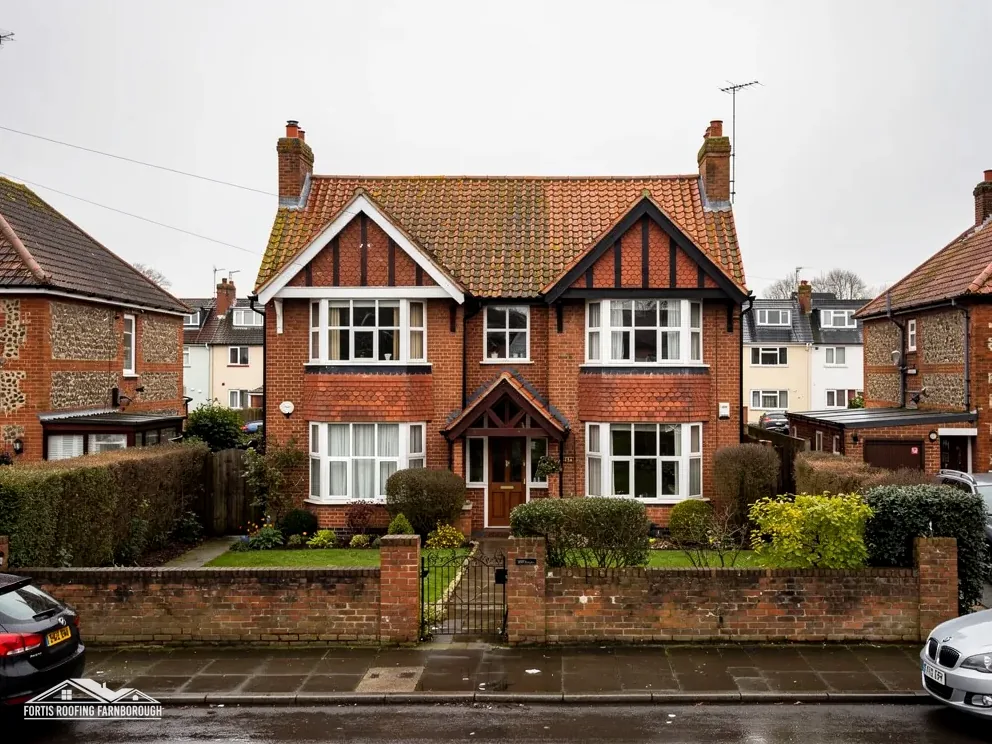
Many historic cottages are two storeys beneath steeply pitched clay tile roofs, the council's character study says.
Roofs on steep clay tile cottages around the Maharajah's Well
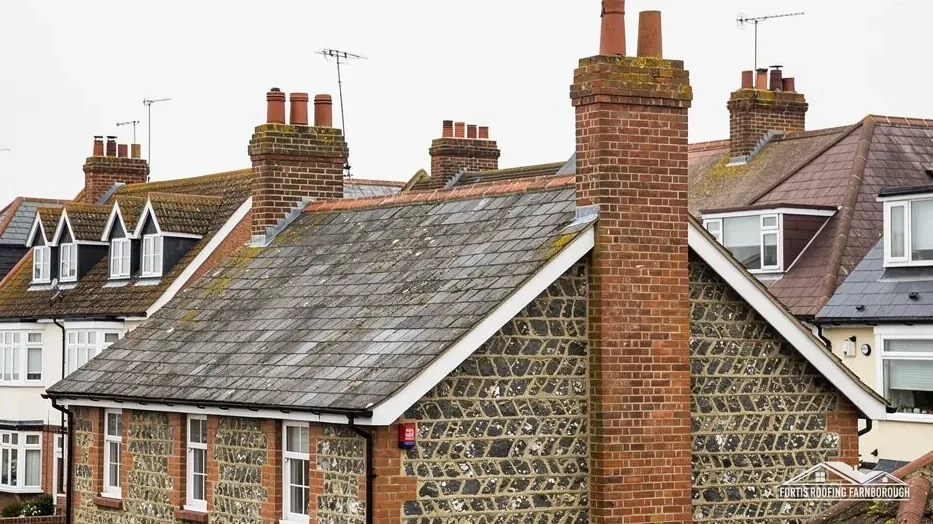
Stoke Row's council character study describes steeply pitched clay tile roofs over small cottages, and a well dug in 1864. We survey every slope first.
Many historic cottages are two storeys beneath steeply pitched clay tile roofs, the council's character study says.

From the late 18th century local clay pits fed a brick and tile industry, with kilns in the woods.
The well, 112 metres deep, was dug in 1864 as a gift from the Maharajah of Benares.
Map of Stoke Row with Nuffield, Nettlebed, Rotherfield Peppard, Woodcote marked around it.
Map data © OpenStreetMap contributors. Loads only when you ask for it.
Stoke Row is a village in wooded Chiltern hills, probably begun as a woodland clearance, and Farnborough lies 28.2 road miles away, to the south-east.
About 28.2 road miles north-west of Farnborough · South Oxfordshire District Council and Oxfordshire County Council.
Stoke Row, tile and asbestos
What older outbuildings and soffits in Stoke Row can hide, what the council's character study says about its clay tile cottages and kilns, and how the conservation area and Chilterns designation shape a repair.

| No. | Chapter | The figure it turns on |
|---|---|---|
| 01 | Older outbuildings, soffits and asbestos | Assume asbestos before 2000 |
| 02 | Clay pits, kilns and a well 112 metres deep | A well dug in 1864 |
| 03 | A 1993 conservation area inside the Chilterns | Chilterns covers all of the 1.5 km area |
Chapter 01 of 03
| Question | The published answer |
|---|---|
| Planning authority | South Oxfordshire District Council |
| Cement roof sheeting, carefully removed whole | Non-licensed work (HSE) |
| Cement that is substantially broken up | Notifiable non-licensed work (HSE) |
| Insulating board in external soffits, not short work | Licensable work (HSE) |
| A building built or refurbished before 2000 | Assume asbestos may be present (HSE) |
South Oxfordshire District Council plans for Stoke Row, and a re-roof here follows the usual order: survey, written price and, where the job is large enough, an application to building control or to a registered approver. Before any of that, older properties raise a question that the clay tile cottages themselves do not. Is there asbestos anywhere on, or under, the roof?
The Health and Safety Executive speaks plainly. If a building was put up or refurbished before 2000, assume it holds asbestos in some place. On a roof the likely places are garage and outbuilding sheeting made of asbestos cement, and the soffits under the eaves, which can be asbestos insulating board. HSE adds that you cannot reliably separate insulating board from look-alike boards by eye, so every soffit of that age is handled with the same care.
The rules differ by material. Cement sheeting that comes off whole, handled with care and not broken, falls into non-licensed work, weathered sheets included provided they are not badly damaged. Where the cement will be substantially broken up, the work becomes notifiable non-licensed work. Work on insulating board that will take longer than a short job is licensable, and where work is notifiable non-licensed, HSE wants registers of it held for 40 years. HSE adds a safety point: such roofs are always fragile, and nobody should step onto one.
We look at outbuilding roofs and soffits on the survey and flag anything that could be asbestos before a price is set. If it might be, the material is tested and removed by a suitable contractor, and the waste travels on a consignment note, double-wrapped and labelled, never in an open skip. The household waste exemption does not cover asbestos waste, and carriers need the right registration.
Few homeowners expect to hear any of this on a roof survey, and many Stoke Row cottages will have none of it, but the check costs little and the consequence of missing it is serious.
If you already hold an asbestos survey report for the property, give it to us at the start. It tells us where not to disturb anything, and it can save a second round of testing.
Chapter 02 of 03
Stoke Row's well, parish and conservation area, in figures
South Oxfordshire's character study of the Stoke Row conservation area describes a Chilterns village in wooded hills, probably begun as a woodland clearance, with Victorian and modern housing running west from the green. Until 1864 the village had no natural water source. That year the Maharajah's Well, 112 metres deep, was dug as a gift from the Maharajah of Benares.
From the late 18th century local clay pits fed a brick and tile industry, with kilns in the woods south and west of the village, and several village buildings are of local brick. The study says many historic cottages are two storeys beneath steeply pitched clay tile roofs, and that most buildings in the conservation area are small cottages of the late 18th and early 19th centuries. Its own summary of materials reads clay tile roofs over timber framing, knapped flint and red brick, with some slate.
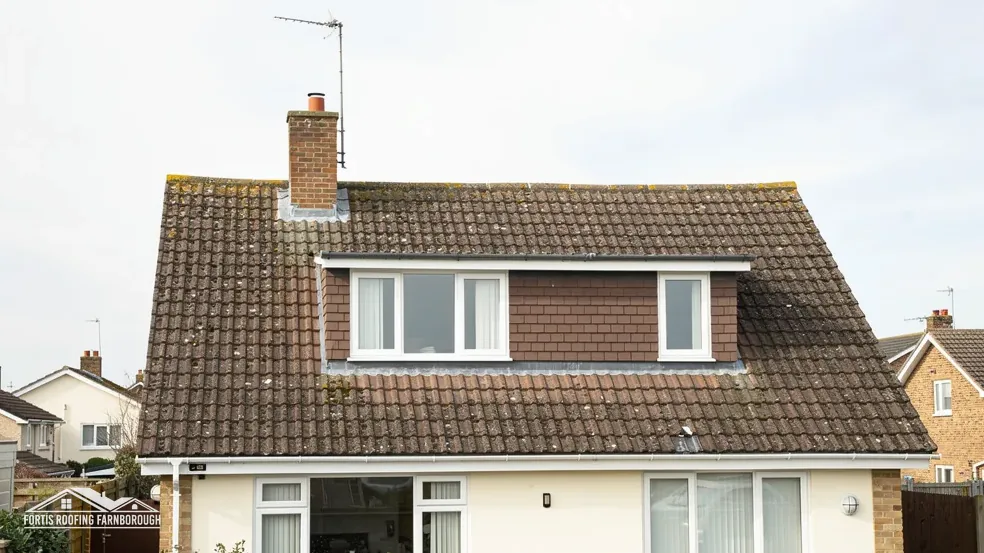
A steeply pitched roof has a high angle and sheds water quickly. It also means longer rafters, more tiles for each square metre of floor and a taller ridge, and any scaffold has to reach further. Our survey measures the pitch and records each tile's size and fixing, so a repair is priced from the roof that exists and not from a standard allowance.
Concrete tiles are the study's particular concern. It encourages owners of prominent and historic properties to swap them for traditional clay, and it calls them an unsympathetic modern material. Where a Stoke Row house has concrete tiles, a return to clay has a planning side and a weight side. Weight matters to building control. Under that test, a covering whose weight rises by 15 per cent or more brings approval, with a structural check beforehand, and so the existing covering is weighed before any swap is advised.
The Maharajah's Well
With 681 usual residents at the 2021 Census, Stoke Row is a place where owners often know their cottage's history well. We listen, record what we are told and check it against what we find on the slope.
Where kilns and clay pits supplied the tiles, matching an old tile may be easier than in places with no such history, though we never promise a match until a sample has been compared on the roof.
Chapter 03 of 03
| Record | In Stoke Row | For roof work |
|---|---|---|
| Conservation area | Stoke Row, designated October 1993 | Matching repairs; ask the council about changes |
| National Landscape | Chilterns, all of the 1.5 km area | Ask South Oxfordshire before any dormer |
| Grade II listed church in use | Church of St John the Evangelist (NHLE 1369052) | Church of England faculty system |
| Grade II listed | Bodgers (NHLE 1194674); Cherry Tree Public House (NHLE 1059327) | Listed building consent for work affecting character |
| Grade II listed | Church Farmhouse (NHLE 1059330) | The same consent route |
The Stoke Row conservation area was designated in October 1993. A repair that matches the existing clay tile, ridge and verge details keeps the look the designation protects, which is why a like-for-like job here is usually simple. A change of covering material is a question for the council's planners first, and so is anything else that shows from the lane. Any Article 4 direction is a matter of the council's record, and we ask about it before a price is set.
All of the 1.5 kilometre area around Stoke Row, 100 per cent in the national dataset, falls inside the Chilterns National Landscape, which was an AONB until recently. A dormer in this landscape is something South Oxfordshire's planners see first, before anyone draws it. Our planning permission and roof work guide explains how repairs and conversions are treated.
Ten listed buildings stand within 500 metres of the village centre. Bodgers, the Cherry Tree Public House and Church Farmhouse each have Grade II listings, and work altering their character requires listed building consent. St John the Evangelist, the village church, is on the list at Grade II from 28 November 1985. Worship continues in the Anglican tradition, which sends its roof to the faculty system.

Each Stoke Row roof gets the same treatment: dated pictures of ridge, hips, verges and stacks are filed before and after the work, and you are given a copy with the written price. Our pitched roofing page explains how steep tiled slopes are repaired, and roof cleaning and moss removal covers the woodland shade that roofs here often sit in.
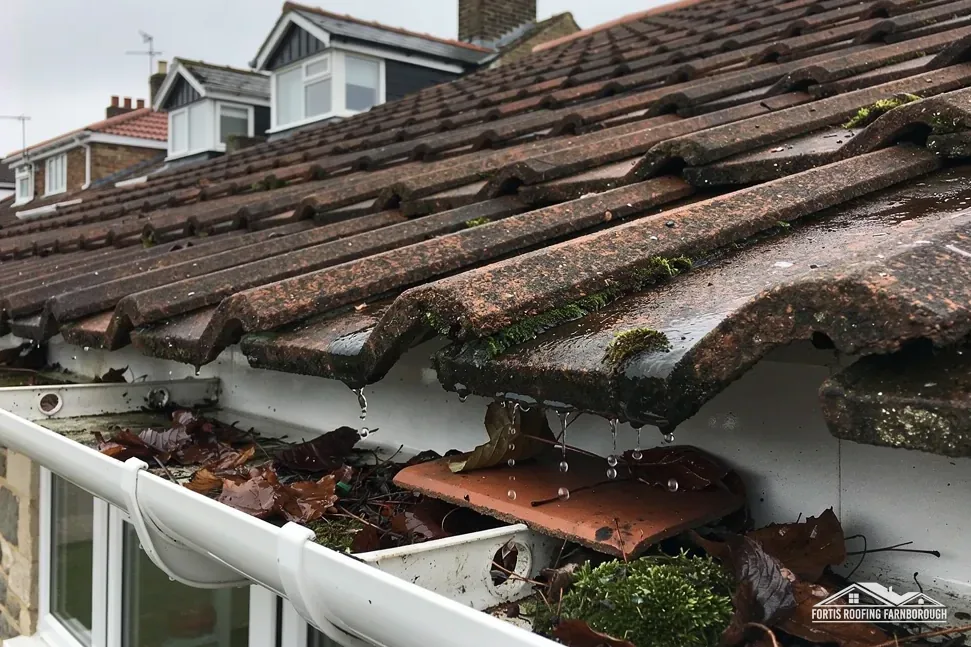
Moss and shade matter on a steep clay roof because water lies longer on a tile that never dries. Cleaning stays gentle because Marley does not recommend jet washing tiles, and leaf litter is cleared from the gutters before the result is photographed.
Because the council's study notes how small most of the cottages are, a rear extension or a loft room is a likely next step for many owners. If you plan any change in future, such as a roof window or a re-cover in a different material, tell us at the survey. Asking the council once, with the roof fully described, is simpler than asking twice.
South Oxfordshire's character study encourages owners of historic properties to replace concrete tiles with traditional clay tiles, so the idea is worth discussing. Clay and concrete weigh differently, and a covering adding 15 per cent or more in weight needs Building Regulations approval. We weigh the existing roof first and ask the planners before pricing.
Yes, by the right route. HSE treats careful removal of asbestos cement without breaking it up as non-licensed work, while substantially breaking it up makes it notifiable non-licensed work. The sheets are fragile, and waste is double-wrapped and labelled, travelling on a consignment note. The survey flags suspect sheeting before any price is set.
No, because it is a church in Anglican use. St John the Evangelist is listed Grade II, so the ecclesiastical exemption applies and the faculty system covers its roof. A listed house such as Church Farmhouse or Bodgers is different, and South Oxfordshire District Council grants listed building consent for work on it.
That is for South Oxfordshire District Council's planners to decide. With a conservation area inside the Chilterns National Landscape, Stoke Row is a place where we raise any dormer with the council at the outset. Repairs are a different category, and ordinary maintenance can go ahead on the usual footing.
Get your free roof quote
Pass us your Stoke Row address and any symptoms you have noticed, and a survey date will be arranged.
10-year workmanship guarantee, in writing.