All Saints and its bell-turret
Chancel and nave share one roof, topped at the west gable by a bell-turret with a pointed shingled roof.

Roofs in a small village below the North Downs chalk
Little Bookham is a small village below the chalk of the North Downs, with a Grade II* church and listed cottages. Our survey reads each roof for what it shows.
Chancel and nave share one roof, topped at the west gable by a bell-turret with a pointed shingled roof.
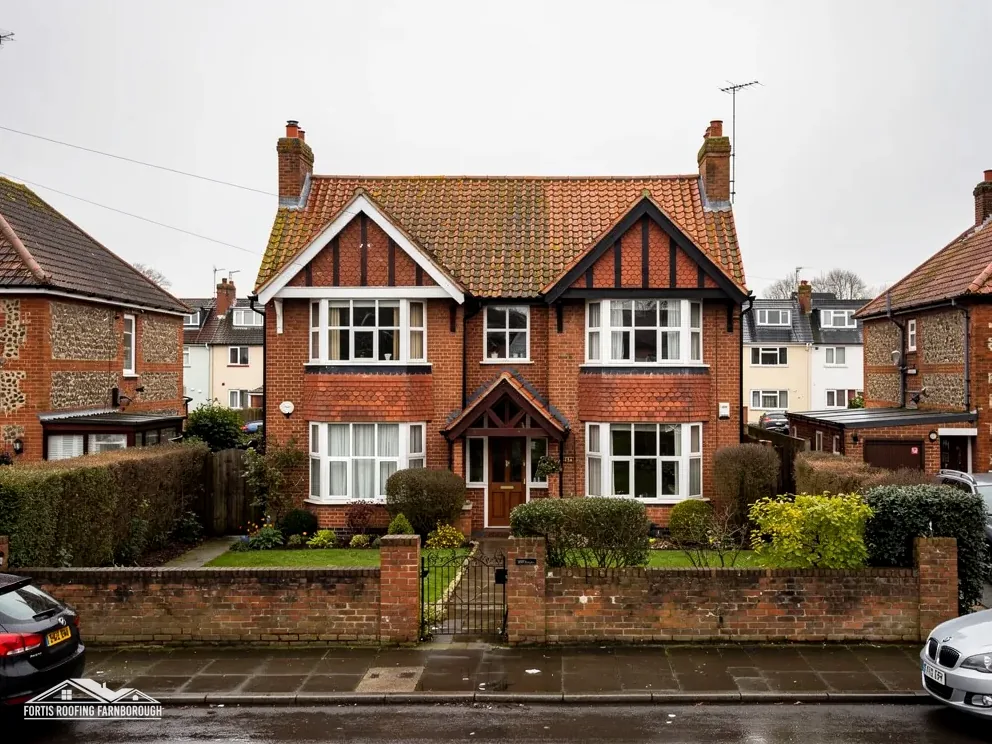
Dawes Cottage and Half Moon Cottage, both Grade II, are two of 11 listed buildings within 500 m.
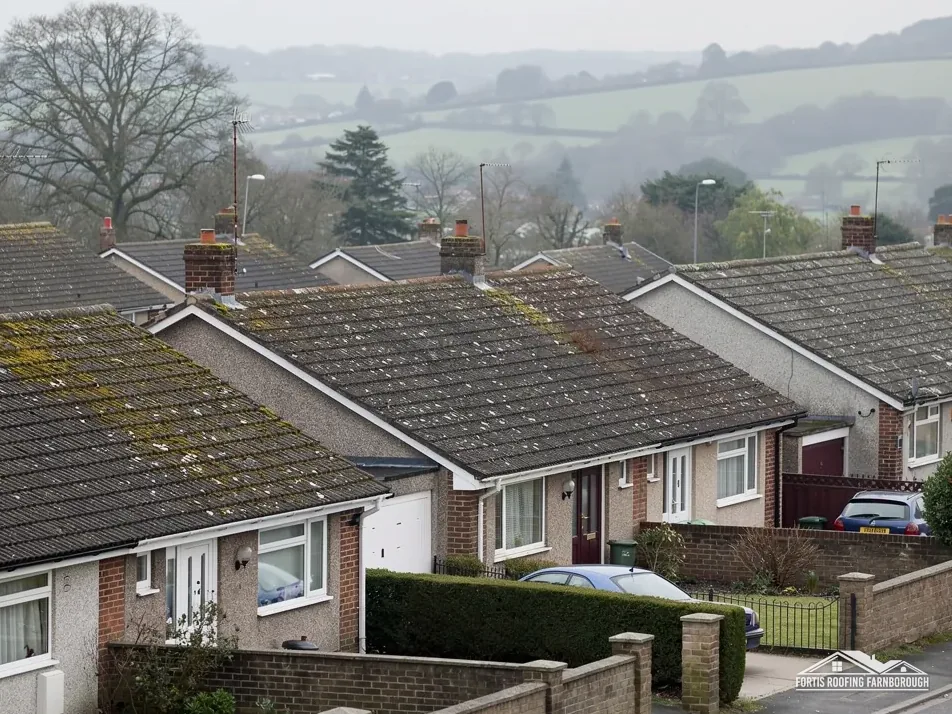
Probably of the 18th century, the Victoria County History thought it too large to have been built as a rectory.
Map of Little Bookham with Effingham, Great Bookham, Fetcham, East Horsley marked around it.
Map data © OpenStreetMap contributors. Loads only when you ask for it.
Effingham lies south-west, Great Bookham east, Fetcham and Leatherhead north-east, and East Horsley to the west. The village reaches north towards the Mole.
About 24.8 road miles east of Farnborough · Mole Valley District Council and Surrey County Council.
Roof facts for Little Bookham
The councils behind a Little Bookham roof job, the church and old houses described in the Victoria County History of 1911, and the way conservation and listing change what a repair involves.
| No. | Chapter | The figure it turns on |
|---|---|---|
| 01 | Who signs off a Little Bookham roof job | Mole Valley plans, Surrey licenses scaffold |
| 02 | Chalk foot, clay beds and a village church | Thanet and Woolwich Beds below the chalk |
| 03 | Conservation area, listed cottages and All Saints | All Saints, Grade II*, by faculty |
Chapter 01 of 03
| Role | Body for Little Bookham addresses |
|---|---|
| District council and planning authority | Mole Valley District Council |
| County council and highway authority | Surrey County Council (until 31 March 2027) |
| Building control | The council's building control team, or a registered building control approver |
| Scaffold licence on the highway | Surrey County Council, by 28-day period |
| Council from 1 April 2027 | East Surrey Council from 1 April 2027 |
| Distance from our base | 24.8 road miles east of Farnborough, from the A325 |
Mole Valley District Council plans for Little Bookham, and Surrey County Council runs the roads and footways until 31 March 2027. On 1 April 2027 East Surrey Council replaces both. A roof booked today is handled under the present set-up, and the dates in this chapter are the ones that apply now.
For re-roofing the national guide is the Planning Portal's yardstick: a job is normally exempt while it touches under 25 per cent of the building envelope and under 50 per cent of the roof. Fitting a covering 15 per cent or more heavier is the second trigger, and the Planning Portal then suggests that a structural engineer or surveyor judge whether the roof frame can bear the load, a check that costs little beside a failed re-roof later. Small repairs stay far inside these figures, and most slipped-tile jobs never come near either line.
We take measurements slope by slope, so whether your job lies under or over those limits is settled at the survey and not discovered halfway through the work. Where an application is required, it is lodged either with the council's building control team or with a registered building control approver, whichever you prefer, and we tell you which route the job will take before it is booked.
Section 169 of the Highways Act 1980 puts any scaffold that blocks part of the lane or footway under the highway authority's control. Surrey County Council's rate is £208 per 28-day period, and it expects the application a minimum of 10 working days in advance, while its page leaves the applicant unnamed. We therefore ask who applies before the booking is made and arrange the licence with the scaffolder. A scaffold kept inside your own boundary falls outside the licence altogether.
The plot decides whether that is possible, and the survey tells you. Where a house stands right on the lane, the licence and its notice period are written into the plan from the first day, with the dates that follow. If a structure is unsafe and the scaffold cannot wait the 10 days, Surrey County Council asks applicants to telephone it.
Chapter 02 of 03
Little Bookham in four published details
The 1911 volume of Surrey's county history sets Little Bookham on the Thanet and Woolwich Beds, directly beneath the North Downs chalk, and records that the village had by then spread on to the chalk itself. It is a small place, west of Great Bookham, and its older buildings are the ones the history describes. The same account carries on north across London clay towards the river Mole, so the parish is not all chalk.
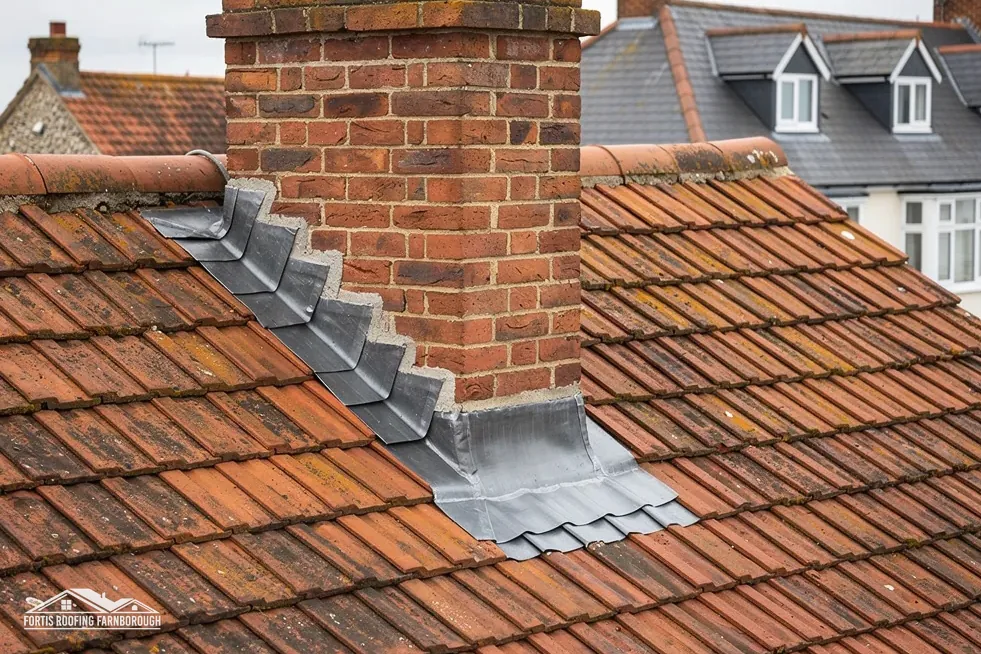
The history describes the small church as having its chancel and nave under one roof. Its walls are plastered flint, the west gable is weather-boarded timber, and above it rises a bell-turret with a pointed shingled roof, while the other roofs are tiled. One long roof over two parts of a building, a timber gable and a turret each need their own treatment where they meet, and joints like those are where water gets in first.
None of that tells us what any house in the village carries today. A description from 1911 is a starting point, and a century of repairs sits on top of it. So at a Little Bookham survey the covering on each slope is identified by raising a few pieces and taking pictures, and we mark where a later repair was matched to the older roof and where it was not.
The old rectory house shows why we look slope by slope. The history dates it as probably of the 18th century and thought it too large to have been built as a rectory. A house of that age and size will have been altered and re-covered more than once, and an old roof can show several periods side by side. Our pitched roofing page describes slate and tile repairs from ridge to valley, and our chimney repairs page covers the stacks that older houses carry above them.
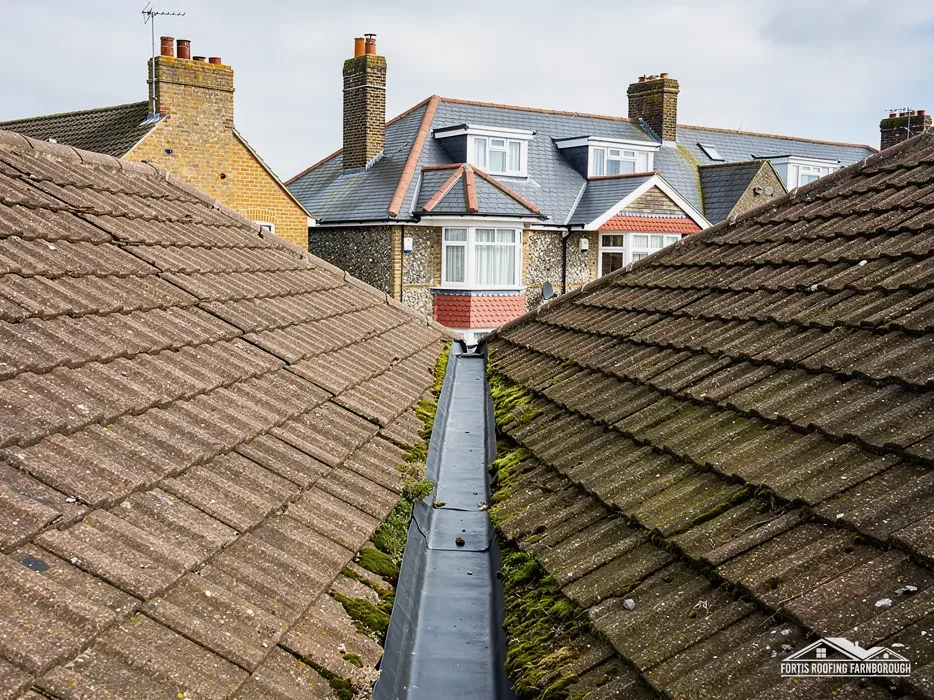
Houses built after 1911 sit beside these older buildings, and they need the same care for different reasons. Whatever the age, a re-roof with a heavier covering may call for a structural check first, so the rafters and the span are measured at the survey and reported in writing, with the pictures attached.
Chapter 03 of 03
| Designation | In Little Bookham | For roof work |
|---|---|---|
| Conservation area | Little Bookham, within about 0.75 km of the centre | Ask Mole Valley before any change to the roof's look |
| Grade II* listed church in use | Church of All Saints (NHLE 1028606) | Church of England faculty, not council consent |
| Grade II listed | Dawes Cottage (NHLE 1028602) | Listed building consent where character is affected |
| Grade II listed | Half Moon Cottage (NHLE 1293421) | Listed building consent where character is affected |
| Grade II listed | Half Way House (NHLE 1028600) | Listed building consent where character is affected |
| Surrey Hills National Landscape | Partly: 5% of the 1.5 km area | Check the address with Mole Valley |
A conservation area lies within about 0.75 km of the centre of Little Bookham, and the national dataset's area query also touches the neighbouring Effingham one. That does not tell you whether your own house is inside a boundary. Mole Valley District Council keeps the map, and one telephone call to its planners settles the question before any work that alters a roof's appearance. Put to Mole Valley the question of whether an Article 4 direction reaches your property, and whether the conservation area boundary includes your roof slope as well as your garden.
Roughly 5 per cent of the 1.5 km area surrounding Little Bookham falls within the Surrey Hills National Landscape, formerly the AONB. The village centre itself lies beyond the line, yet the line runs near, so a particular house could stand on either side of it. For a plain repair near the National Landscape line, the work itself is the same as anywhere else: matched tiles, sound battens and lead dressed properly at every junction. Our planning permission for roof work guide sets out what the planning rules mean for a dormer or for swapping the covering, so that detail lives there rather than on this page.
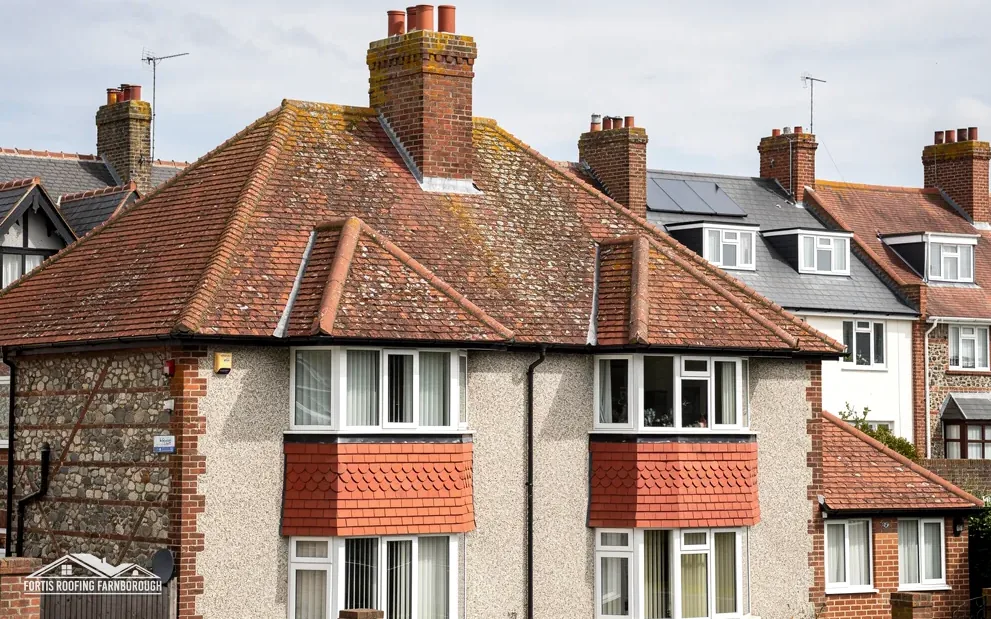
All Saints is a Grade II* church where the Church of England still worships, which sends its roof repairs through the faculty procedure of the ecclesiastical exemption. Listed building consent from Mole Valley is not the route for it. Three more houses, Dawes Cottage, Half Moon Cottage and Half Way House, are listed at Grade II, and 11 listed buildings in all lie within 500 m of the village centre. Should a house be listed, a change in character calls for listed building consent, and the planning team gets the question before we price more than a plain like-for-like repair. Ask the council early, because the answer decides whether the job can be booked at all.
Section 55 of the Town and Country Planning Act 1990 leaves out works that leave a building's outside look materially unchanged. Where a house is not listed, a repair that matches what was already there is therefore the plainest kind of job, and our photographs of ridge, verges and chimneys are the proof that it matches. For flashings and valleys on older roofs, see lead roofing and lead work.
Mole Valley District Council decides on listed building consent where work affects a building's character, and the village has several Grade II listed buildings. Ask its planning team before anything is ordered. Our survey photographs and measures each detail to be matched, which gives the council a clear record to review when you apply.
Partly: some 5 per cent of the 1.5 km area surrounding the village falls inside it, so your own address decides. Mole Valley's planning team holds the boundary map. Any change in the roof's appearance goes to the council before we price it, so the consent route is settled first.
Not for the church. Its Grade II* listing sits alongside continuing Church of England worship, which brings the ecclesiastical exemption, so repairs follow the faculty route. Mole Valley's listed building consent applies to the Grade II cottages and to any other listed house that the exemption does not cover, so ask which applies.
Only if it obstructs the road or footway, and then the licence comes from the highway authority, Surrey County Council until April 2027, at £208 for each 28-day period with 10 working days of notice. Poles inside your own boundary need none, and the survey shows which case you are in.
Get your free roof quote
Send your Little Bookham address and the fault you have noticed, and we will agree a survey date.
10-year workmanship guarantee, in writing.