Church slabs and tiles
At the parish church the north transept has Horsham stone slabs and tiles, and the south transept has tiles only.
Roofs in a Mole market town, from church slabs to tile works
Leatherhead stands on the River Mole where it cuts the North Downs, with a church roofed in stone slabs and tiles and fifty-three listed buildings nearby.
At the parish church the north transept has Horsham stone slabs and tiles, and the south transept has tiles only.

The village began as one long street with a cross-street down to a bridge of fourteen arches over the Mole.

By 1911 building had spread north and east, and there were a brewery and brick and tile works.
Map of Leatherhead with Fetcham, Ashtead, Great Bookham, Oxshott marked around it.
Map data © OpenStreetMap contributors. Loads only when you ask for it.
Leatherhead is a market town beside the River Mole, where the river cuts through the North Downs, and the A325 at Farnborough is 28.2 road miles from it, westward.
About 28.2 road miles east of Farnborough · Mole Valley District Council and Surrey County Council.
Leatherhead, slabs, bridge and duties
What a homeowner owes under the construction rules when hiring a roofer in Leatherhead, how the Mole, its bridge and its tile works shaped the town, and where its Grade II* buildings change a repair.

| No. | Chapter | The figure it turns on |
|---|---|---|
| 01 | Hiring a roofer: a domestic client's duties | One contractor means a construction phase plan |
| 02 | A bridge of fourteen arches over the Mole | Fourteen arches, fifty-three listings nearby |
| 03 | Four Grade II* buildings and a conservation area | Grade II* church, inns and manor |
Chapter 01 of 03
| Question | Answer for Leatherhead addresses |
|---|---|
| Planning authority | Mole Valley District Council |
| County council and highway authority | Surrey County Council (until April 2027) |
| More than one contractor on the job | Both a principal designer and a principal contractor are required |
| One contractor on the job | That contractor must draw up a construction phase plan |
Leatherhead sits in Mole Valley, where Mole Valley District Council handles planning and Surrey County Council, until April 2027, is the highway authority. The councils matter less to most owners than a question nobody raises when they ask for a quote: as the person paying, what do you owe under the construction rules?
The Health and Safety Executive defines a domestic client as anyone paying for building work on their own house, or a relative's, where no business is involved. A Leatherhead householder re-roofing a semi-detached house fits that description. The Construction (Design and Management) Regulations 2015 place lighter duties on such a client than on a commercial one, and the extra duties turn on how many contractors there are, never on whether the job has been notified to anyone.
Once a project has more than one contractor, regulation 5 asks for a principal designer as well as a principal contractor. With one contractor only, regulation 15 instead has that contractor produce a construction phase plan. A roofer who brings in a separate scaffolder under a separate contract, or a lead specialist, can turn a one-contractor job into a two-contractor one. For that reason you are told before work starts who will be on site and who answers for which part.
A scaffold frame over a Leatherhead road or footway requires Surrey County Council's licence. The council's guidance wants 10 working days between application and the intended start, and quotes the same figure for processing. For an unsafe structure it asks owners to ring about an emergency licence. Nothing on the page says who submits the form. We raise that with the scaffolder, and the answer shapes our plan.
Everything else follows the usual order. The survey comes first, then one written price, then a start date that allows for the licence and any notice, with the scaffold taken down as soon as the roof is finished.
Keep the paperwork from the job. A copy of the construction phase plan, where one exists, and the survey photographs are what a buyer's solicitor may ask for in years to come.
Chapter 02 of 03
Leatherhead on the Mole in four figures
The Victoria County History's 1911 account describes Leatherhead as a village that originally consisted of one long street, with a cross-street down to the bridge. Leatherhead Bridge is carried on fourteen arches with stone piers and brick parapets over a wide part of the Mole, where there was formerly a ford. By 1911 building had recently spread, especially north and east, and there were a brewery and brick and tile works. Fragments of Roman tile are common near Pachevesham, which gave its name to the Domesday manor and suggests the main early settlement was there.
The history gives a useful detail about roofing. At the parish church the north transept is covered with Horsham stone slabs and tiles, the south transept with tiles only, and the north aisle roof with stone slabs. One building and three coverings means three different jobs if each needs repair. Tiles are fixed with nails or clips, while stone slabs are heavy and are laid in a different way, so a repair on one part has little to do with a repair on the next.
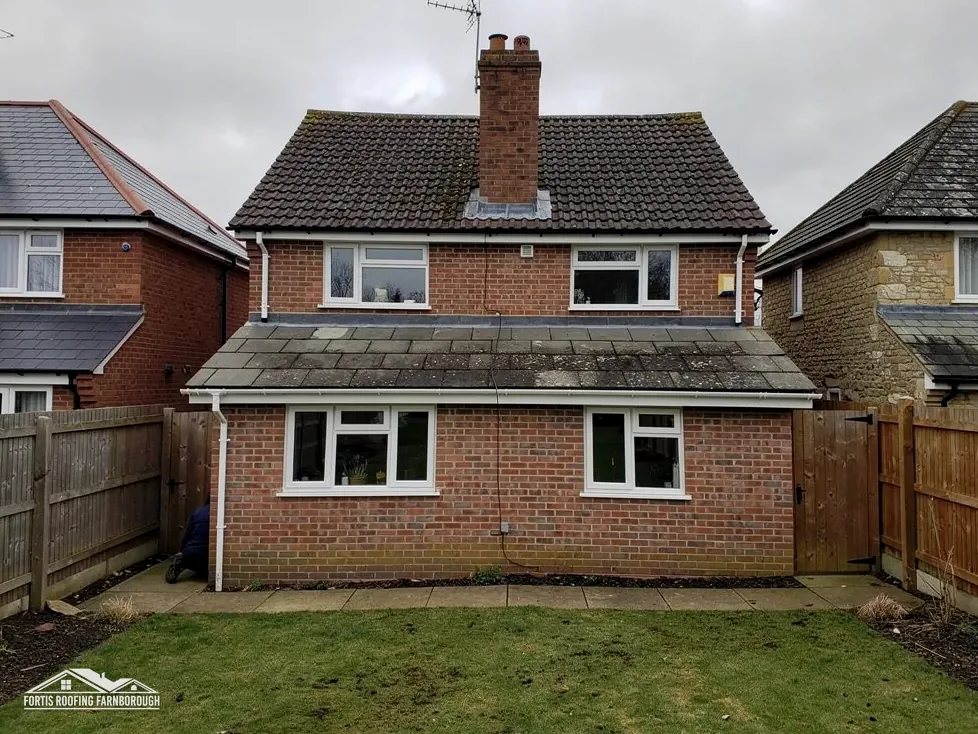
The lesson for a house is that a roof can change its covering from one part to another, and an older building often has. A Leatherhead roof that has been altered and extended can carry slate on one slope, tile on another and a flat section over a rear addition. We photograph each part on its own and describe what we find in plain words, alongside the photographs.
The 2021 Census counted 11,495 usual residents in the Leatherhead built-up area, and the 53 listed buildings within 900 metres of the centre show how many older buildings the town keeps. Roman tile, a bridge licensed for repair money in 1362 and a brick and tile works all appear in the record, so what lies under any one house is for the survey to establish, not for the street's history to suggest.
Bridge and listings
The brick and tile works recorded at the town's edge in 1911 point to clay goods being made near their market. That makes matching an older tile a real possibility, though it never guarantees it, and we try matching on a slope before we promise anything.
Chapter 03 of 03
| Record | In Leatherhead | For roof work |
|---|---|---|
| Conservation area | Leatherhead | Matching repairs; ask Mole Valley about changes |
| Grade II* listed church in use | Church of St Mary and St Nicholas (NHLE 1190429) | Church of England faculty system |
| Grade II* listed | Former Old Rising Sun (NHLE 1028662) | Listed building consent for work affecting character |
| Grade II* listed | Running Horse Public House (NHLE 1293800); Thorncroft Manor (NHLE 1389370) | The same consent route |
St Mary and St Nicholas church has been listed Grade II* since 7 September 1951, the date shared with the Former Old Rising Sun. The Running Horse Public House and Thorncroft Manor are also listed Grade II*. Listing leaves permitted development in place, though any work that changes a building's character also needs listed building consent. Our planning permission and roof work guide explains where repair stops and alteration begins.
Anglican worship continues at St Mary and St Nicholas, which places its roof under the Church of England's faculty system and the ecclesiastical exemption, outside the council's consent process. That route belongs to the church alone. The inns and the manor, and any listed house nearby, go to Mole Valley District Council for listed building consent.
Leatherhead has a conservation area, and Mole Valley's planning team holds its boundary. Inside it, matching materials are the easy case, while a different covering should be put to the planners first. The council can say too if an Article 4 direction reaches your address, and that is asked before pricing, so your figure already allows for it.
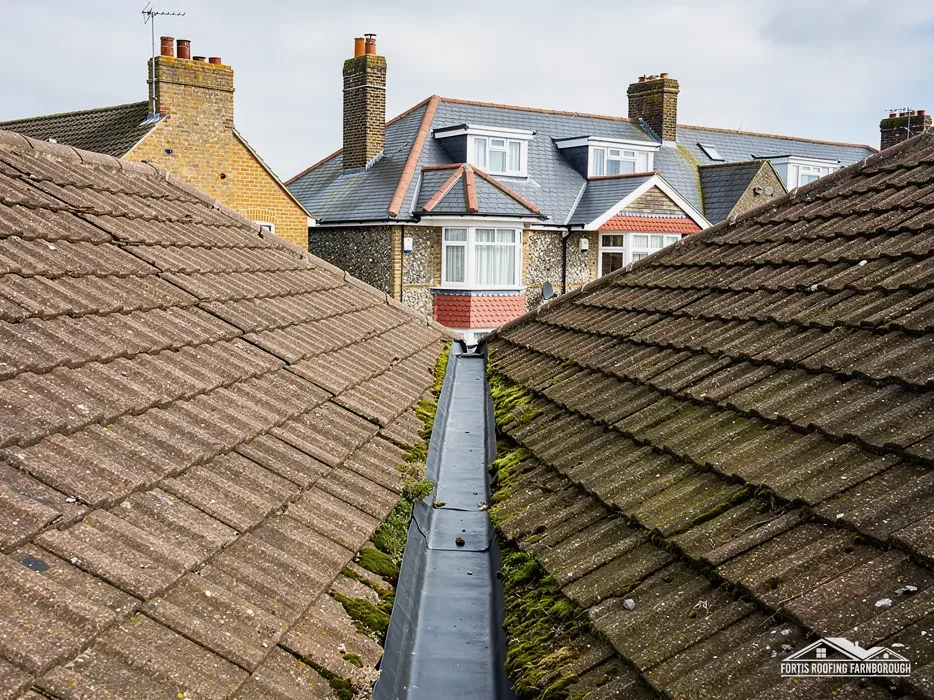
Older buildings of this standing often carry lead in their valleys, parapet gutters and around chimneys. MyJobQuote gives over 80 years as the life of lead flashing, a minimum and no promise, so a sound old flashing is often worth repairing in the same code instead of replacing. Our lead roofing and lead work page explains the codes, and chimney repairs covers stacks and flaunching.
One more habit is worth describing. On a listed building, courses are numbered in photographs before any slab or tile is lifted, so salvaged material returns to its original place. That is cheap insurance against a mismatched finish and gives the planners something concrete to approve.
Roofs of this kind are photographed, with dates, at ridge, valley, flashing and chimney, both before and after the work, and you receive the set with the price.
A parapet gutter, the lead-lined channel behind a low wall at the edge of a roof, deserves a word of its own. It carries a great deal of water and fails quietly, which is why we flow-test it with a hose on the survey instead of judging it by sight.
Each part gets its own assessment, because the coverings differ in weight and fixing. The parish church shows the pattern, with slabs and tiles under one roof. We photograph every slope, check the timbers beneath where we can reach them, and tell you plainly which parts can be repaired and which have reached the end of their life.
Surrey County Council wants 10 working days between application and your intended start, and quotes 10 days for processing. For an unsafe structure it invites a call about an emergency licence. A frame set up wholly inside your boundary needs no licence at all, and the survey establishes which case you are in.
Yes, for work that changes their character. The Former Old Rising Sun, the Running Horse Public House and Thorncroft Manor are listed Grade II*, so the route is listed building consent from Mole Valley District Council. The parish church differs, because Anglican worship puts its roof under the faculty system.
As a domestic client, your client duties pass to the contractor. With one contractor, that contractor draws up a construction phase plan. Where a project has more than one contractor, both a designer and a contractor must be named as principal. You will know before work starts who is on site, so you can see which case applies.
Get your free roof quote
Tell us your Leatherhead address and the symptoms you have noticed, and we will plan a survey visit.
10-year workmanship guarantee, in writing.