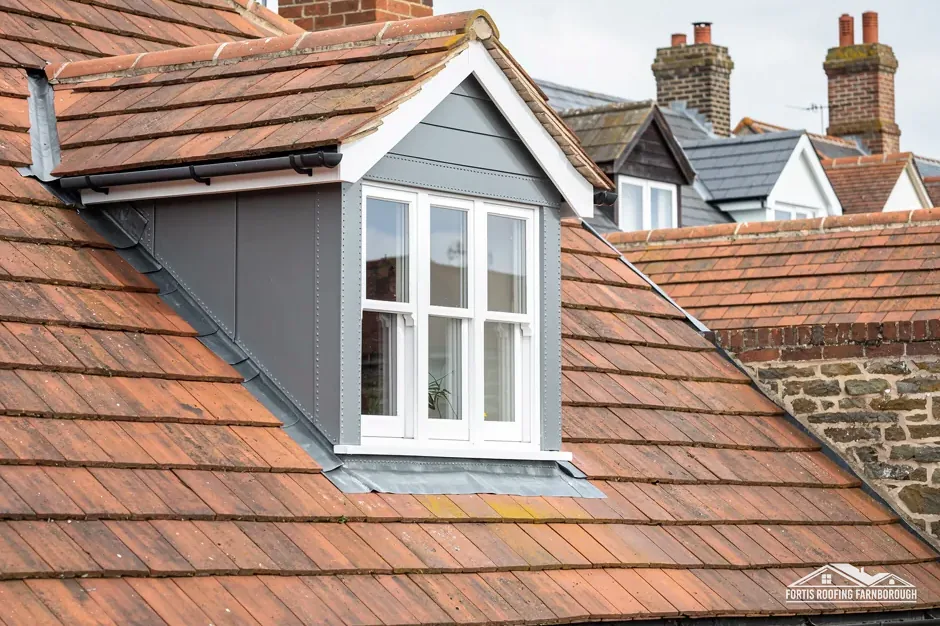
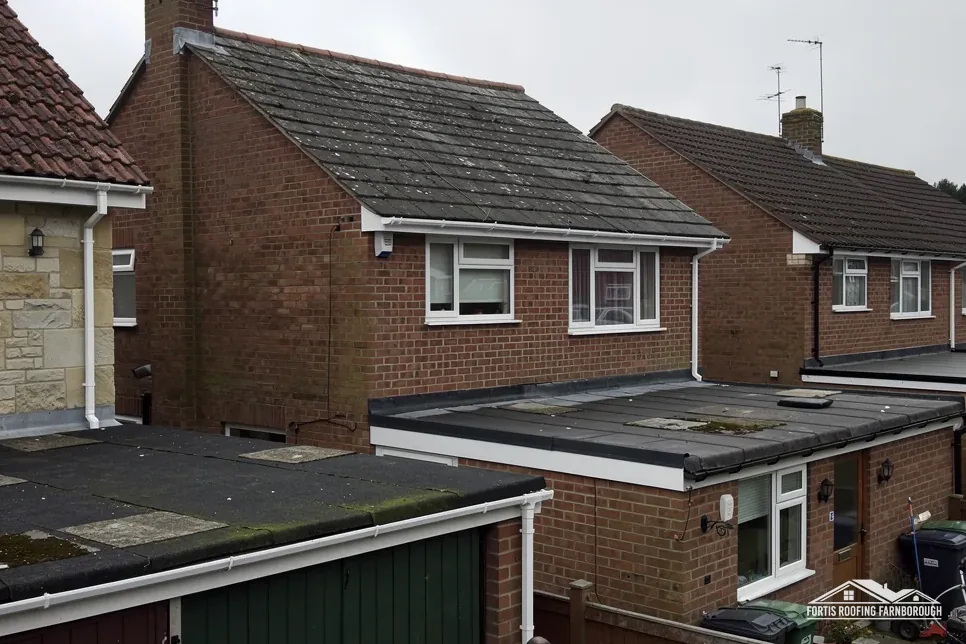
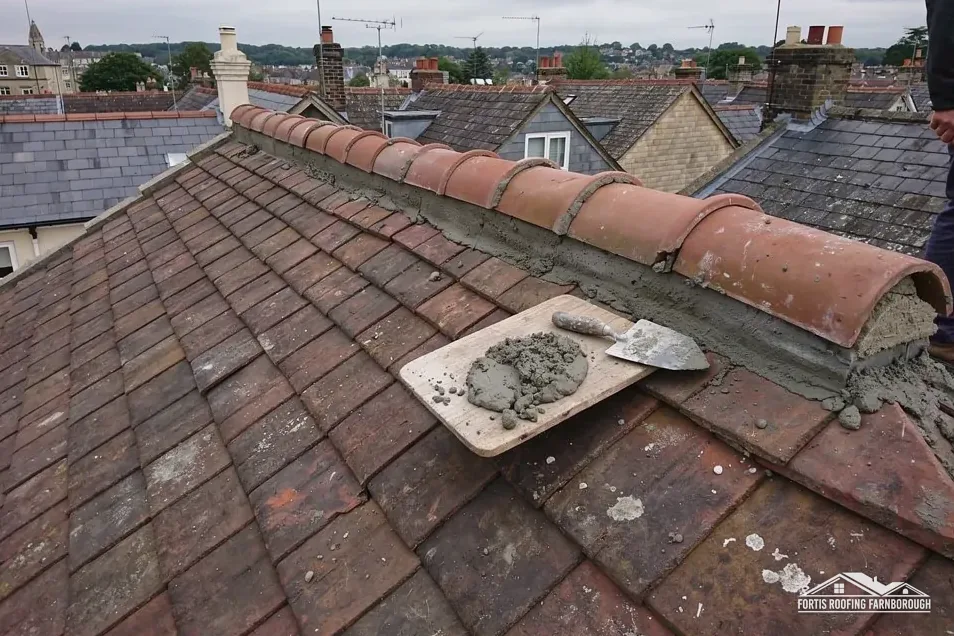
Brick and tile works
In 1911 the county history recorded brickfields and special brick and tile manufactories at the Ashtead Brick Works.
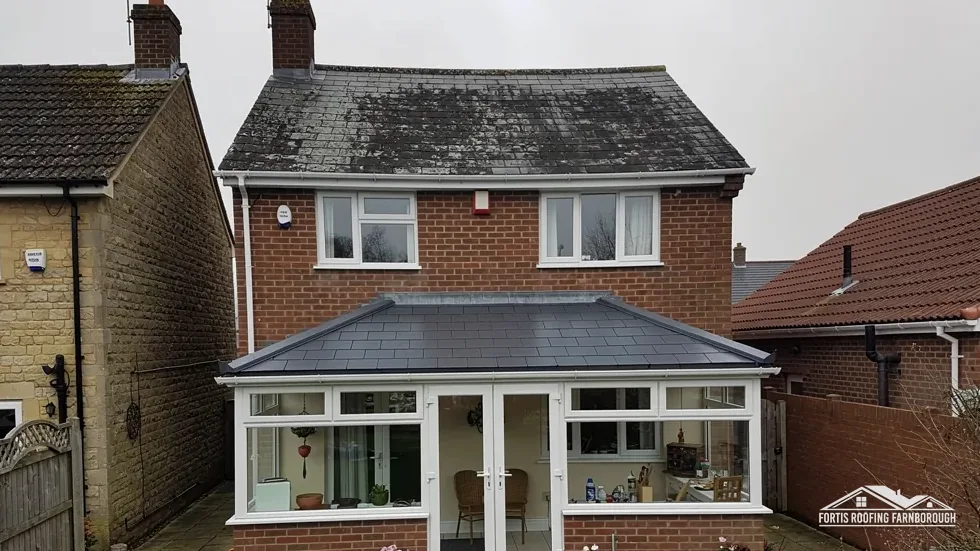
Roofs near the Ashtead Brick Works and a Roman-tiled church
Ashtead's station opened in 1859, the county history of 1911 found brick and tile works and new houses springing up, and Roman tiles turned up by the church in 1830.
In 1911 the county history recorded brickfields and special brick and tile manufactories at the Ashtead Brick Works.

St George's, near the station and built in 1905, is of red brick in 13th-century style.

When the church was restored in 1830, many Roman tiles and part of a hypocaust were found round it.
Map of Ashtead with Leatherhead, Fetcham, Oxshott, Great Bookham marked around it.
Map data © OpenStreetMap contributors. Loads only when you ask for it.
Ashtead lies between Leatherhead and Epsom, on the slope from the North Downs to Ashtead Common, and Farnborough is 28.9 road miles to the west.
About 28.9 road miles east of Farnborough · Mole Valley District Council and Surrey County Council.
Ashtead, gutters and brick works
What published figures say about gutter falls and fascia life, how the Ashtead Brick Works and the 1859 railway shaped the village, and what its conservation area and Grade II cottages ask of a repair.

| No. | Chapter | The figure it turns on |
|---|---|---|
| 01 | Gutters: how much fall, and how long they last | 1 mm of fall for every 600 mm |
| 02 | A station of 1859 and the brick works | Station opened in 1859 |
| 03 | The Ashtead conservation area and Agates Lane | Conservation area within 0.75 km |
Chapter 01 of 03
| Question | The published answer |
|---|---|
| Fall for a gutter run | 1 mm for every 600 mm (Brett Martin) |
| Standard for roof drainage layout and calculation | BS EN 12056-3:2000, current |
| Life of a uPVC fascia board | Between 20 and 40 years (a retailer's figure) |
| Who licenses scaffold on an Ashtead road | Surrey County Council (until April 2027) |
Many roof leaks that owners blame on tiles start at the gutter. A gutter that holds water, spills over a joint or has pulled away from rotten timber sends water down the wall and into the eaves, and the stain on a ceiling appears far from the cause. In 1911 the county history saw many new houses springing up about Ashtead, and houses of every age depend on their gutters as much as their coverings. A tile roof can be sound for decades while a failing gutter rots the timber beneath it.
Brett Martin says a rainwater gutter should be laid with a fall of 1 mm for every 600 mm of run, a gentle slope that carries water to the outlet without leaving a pool. BS EN 12056-3:2000 is the current British Standard on roof drainage layout and calculation. In practice we test by running water along the gutter on the survey and watching where it stands. Water that pools at a joint means the fall has gone, and water that runs past the outlet means the outlet is too small or blocked.
The fascia is the board that carries the gutter, and a uPVC fascia is often fitted when a house is re-roofed. A retailer's guide gives uPVC fascia boards between 20 and 40 years. It is an interested party, as it sells them, so we treat the range as a rough guide. What matters is the timber or the fixings behind it. A new board fixed to rotten rafter ends will not hold a gutter for long.
So a gutter repair at Ashtead starts with the eaves. We look at rafter feet, the soffit under the overhang and the fixing points, replace what has rotted and then re-lay the gutter to the fall. If a roof is being re-covered, the gutter is usually renewed at the same time, since the scaffold is up, and the outlets are sized to the roof area they serve, which a patch repair alone rarely does.
Surrey County Council's page places Mole Valley in East Surrey Council from 1 April 2027 and says that for now nothing changes, so until 31 March 2027 Surrey County Council licenses scaffold on roads.
Chapter 02 of 03
Ashtead's growth, in four published figures
The Victoria County History of 1911 says many new houses were springing up about Ashtead. Ashtead station had been opened by the London and South Western Railway in 1859, and St George's church near the station, built in 1905, is of red brick in 13th-century style. The same account records brickfields and special brick and tile manufactories at the Ashtead Brick Works in Barnett Lane.
A brick and tile works at the edge of a growing village means that bricks and tiles were made close to where houses were being built. That is a fair reason to expect clay tiles on some of Ashtead's older roofs, but it is not evidence for any particular house, and we never assume. When a roof needs matching tiles, we compare a sample on the slope for colour, size and thickness before promising anything.
The 2021 Census counted 14,837 usual residents in the Ashtead built-up area, so Ashtead is a large village, and its houses come from many decades. A house of the railway years has a roof that is over a century old, and quite possibly renewed more than once. Each slope has its own entry in our notes, and the notes say which coverings look original and which look like later repairs.
A pair of neighbouring houses can look alike from the street and still have been re-roofed at different times, by different firms and in different tiles. We never assume that the house next door tells us about yours.
When the church was restored in 1830, many Roman tiles and part of a hypocaust were found in the rectangular enclosure round it, and Roman bricks are mixed into the flint and stone of the nave's south wall. Fired clay has been used on this site since Roman times. It is a good reminder of how durable fired clay is, and of why a sound old tile is often worth keeping. Fired clay does not rot, and the usual cause of a failing tile roof is the nails, battens or underlay beneath, not the tiles on top.
Parish and station
Where a roof meets a neighbour's, we photograph the junction from our side and describe what is visible, without stepping onto the neighbour's roof.
Chapter 03 of 03
| Record | In Ashtead | For roof work |
|---|---|---|
| Conservation area | Ashtead, within about 0.75 km of the centre | Matching repairs; ask Mole Valley about changes |
| Grade II listed | 60 and 62 Agates Lane (NHLE 1028679) | Listed building consent for work affecting character |
| Grade II listed | The Old Cottage (NHLE 1028652) | The same consent route |
| Listed buildings nearby | 3 within 500 m of the centre | Check before work on an older home |
The Ashtead conservation area lies within about 0.75 km of the village centre, and Mole Valley District Council's planning team holds its boundary. Inside it, a repair that uses matching materials respects the designation, and a change of covering belongs with the planners before work is booked. Whether an Article 4 direction applies at your address is for them to say, and we ask before pricing, so the figure you see already reflects the answer. The council can usually answer in a short call, and we put the reply in your file.
Numbers 60 and 62 Agates Lane have been listed Grade II since 23 November 1973, and The Old Cottage is also listed Grade II. Three listed buildings stand within 500 metres of the centre, so most Ashtead houses are not listed, though any older cottage is worth checking against the list. The National Heritage List for England is public, and entries can be read online, so you can look at the official description of a cottage before we visit. On a listed house, listed building consent is needed for work that would alter its character, whatever permitted development would otherwise allow. Our planning permission and roof work guide sets out the line between repair and alteration.

For older cottages we keep dated photographs of ridges, eaves, gutters and chimneys, taken before work and again afterwards, and they come to you with the written price. Our gutters, soffits and fascias page covers renewal of eaves boards and gutter runs, and pitched roofing covers the slopes above them.
If a planning officer asks what the roof looked like before a repair, you will have the answer. The same pictures also help when a buyer's surveyor asks about the roof, which is a common moment for roof questions to surface.
Scaffold for a gutter job is often a lighter frame than for a re-roof, but on a road it still needs the licence that section 169 of the Highways Act 1980 provides for, and a frame wholly inside your boundary does not. Which applies to your house is settled at the survey.
Chimney stacks are the other place where repair and alteration meet. A leaning stack is rebuilt before it is re-flashed, and its height and pots are recorded first, so the rebuild matches what was there.
Sometimes. A works nearby does not mean your tiles came from it, so we compare a sample against the slope for colour, size and thickness before promising a match. Reclaimed tiles are an option, and a conservation area calls for a conversation with Mole Valley's planners before a different tile is chosen.
A retailer's guide gives between 20 and 40 years, and as a seller of them it is an interested party, so treat the range as rough. The life of the board matters less than what is behind it. If the rafter ends or soffit have rotted, a new board will not hold a gutter, so we check the timber first.
Three listed buildings stand within 500 metres of the centre, among them 60 and 62 Agates Lane and The Old Cottage, both Grade II. Most Ashtead houses are not listed, but an older cottage is worth checking against the National Heritage List. Listed building consent from Mole Valley is needed for work that changes a listed building's character.
The Ashtead conservation area lies within about 0.75 km of the village centre, which does not settle your own address. Mole Valley District Council's planning team holds the boundary and knows whether an Article 4 direction applies. We ask before pricing any change to how a roof looks, and the reply goes into your file.
Get your free roof quote
Give us your Ashtead address and any overflow or stains you have seen, and we will fix a survey visit.
10-year workmanship guarantee, in writing.