Brick and tile works
In 1911 the Victoria County History recorded brick and tile works near Claygate station.

Roofs on London clay, in a village the station grew
Claygate takes its name from the London clay beneath it, and its station of 1885 brought rapid growth. Each Claygate roof is surveyed on its own evidence.
In 1911 the Victoria County History recorded brick and tile works near Claygate station.

The line through Cobham to Guildford opened Claygate station in 1885, and by 1911 the village had grown very much.

Holy Trinity church and Claygate War Memorial both carry Grade II listings.
Map of Claygate with Esher, West End, Elmbridge, Thames Ditton, Oxshott marked around it.
Map data © OpenStreetMap contributors. Loads only when you ask for it.
Claygate stands on London clay south of Thames Ditton and east of Esher, with Farnborough 27.2 road miles to the west.
About 27.2 road miles east of Farnborough · Elmbridge Borough Council and Surrey County Council.
Claygate, clay and station
Who regulates a Claygate roof job and licenses its scaffold, how London clay and the 1885 station shaped the village, and what its two conservation areas and listed buildings ask of a repair.

| No. | Chapter | The figure it turns on |
|---|---|---|
| 01 | Elmbridge, EBCS and Surrey's roadside licence | Elmbridge plans, Surrey licenses scaffold |
| 02 | London clay, tile works and a new station | Claygate station opened in 1885 |
| 03 | Two conservation areas and a Grade II church | Claygate Village conservation area, 1990 |
Chapter 01 of 03
| Role | Body for Claygate addresses |
|---|---|
| District council and planning authority | Elmbridge Borough Council |
| County council and highway authority | Surrey County Council (until April 2027) |
| Building control | Elmbridge Building Control Services (EBCS) |
| Scaffold licence on the highway | Surrey County Council (until April 2027) |
Claygate is in Surrey, in the borough of Elmbridge. Elmbridge Borough Council decides planning for Claygate addresses, and Surrey County Council is the county council and highway authority for the roads. Surrey's councils are being reorganised. From 1 April 2027 East Surrey Council replaces both Elmbridge and the county council, and for now nothing changes in how services are received. This page describes the arrangements as they stand today, and the table names each body for the job in hand. A roof repair on a quiet Claygate road may meet none of them, while a re-roof with scaffold across the pavement meets all three.
Elmbridge's own page says Elmbridge Building Control Services, known as EBCS, provides the building control service on behalf of the borough. That is the body a larger Claygate roof job goes to. The Planning Portal's guide tells you when. If the work affects less than 25 per cent of the building envelope and less than 50 per cent of the roof, an application is not normally needed, so a few tiles or a lead flashing can be put right without one. Re-covering the whole roof crosses both figures. A new covering adding 15 per cent or more weight needs approval plus a structural check too.
A registered building control approver, the private route, can take the application instead. At the survey we tell you which side of the line your roof falls on, so nobody is surprised once the tiles are off. Where an application is needed, its timing goes into the plan you receive before work is booked.
For scaffolding on a public road, pavement or highway, Surrey County Council issues the licence. The council asks for at least 10 working days between application and the start you want, and quotes 10 days for processing. Where a structure is unsafe and a licence is needed inside the 10 days, its page says: please call us. The fee sits in the card beside this chapter. Surrey's page is silent on who submits the form, so we settle that with the scaffolder and keep the licence in step with the job. Scaffold that stays inside your own boundary needs none.
Chapter 02 of 03
Claygate in four published figures
The Victoria County History's account of the district begins with the ground. As its name implies, Claygate stands on the London clay, capped in places by sand in the south. In 1911 the history recorded brick and tile works near the station, a reminder that clay here was dug and fired close to where it was used. Claygate was formed as an ecclesiastical parish out of Thames Ditton in 1841, and its manor had earlier been given to the Abbot and convent of Westminster by Tosti.
The station on the line through Cobham to Guildford opened in 1885. By 1911 the history noted that Claygate had grown very much since the line opened. A village that expands quickly after a station tends to be built in several campaigns, so roofs of different ages and coverings can stand a few doors apart. The 2021 Census counted 7,263 usual residents in the parish.
None of this tells us what a particular Claygate roof carries today. A tile works close by does not prove that your own tiles came from it. The survey lifts and photographs each slope, and the findings are explained in plain words before a price is fixed.
On a street built over several decades, an extension or a later re-cover often meets an older roof at a valley or an abutment, the joint where a roof slope butts against a wall. That junction is where lead flashings fail first, and it is where we spend time on the survey. We look at gutters and downpipes in the same visit, because water that spills past a blocked gutter finds its way behind the fascia long before it shows inside the house. The fascia is the board along the eaves that carries the gutter, and rot there is easy to miss from the ground.
Parish and station
The clay under Claygate matters to roofs in a quieter way too. Clay soils move with the seasons, and a house that has shifted slightly can show it as a cracked ridge or a hairline gap at a chimney. Those joints are checked for movement as well as wear, and what we see is reported without guessing at the cause.
Where a repair only needs to blend with its neighbours, that is what you are told. Where an old covering has reached the end of what patching can do, the photographs show it and you are told that too.
Chapter 03 of 03
| Record | In Claygate | For roof work |
|---|---|---|
| Conservation area | Claygate Village, designated 28 November 1990 | Matching repairs; ask Elmbridge about changes |
| Conservation area | Claygate Foley Estate, designated 23 November 1994 | Ask Elmbridge about your address |
| Grade II listed church in use | Church of Holy Trinity (NHLE 1377413) | Church of England faculty system |
| Grade II listed | Claygate War Memorial (NHLE 1426566) | Listed building consent for work affecting character |
| Grade II listed | Fee Farm House (NHLE 1377433) | Listed building consent for work affecting character |
Elmbridge has 26 designated conservation areas, covering more than 2,000 properties, and two of them touch Claygate: Claygate Village, designated on 28 November 1990, and Claygate Foley Estate, designated on 23 November 1994. A conservation area does not prevent roof repairs, but it sets the standard. A roof patched in the same material, to the same detail, keeps the look the designation exists to protect. Our planning permission and roof work guide explains where repair ends and alteration begins.
Article 4 directions that Elmbridge lists concern particular sites in Cobham and deal with fences, gates and temporary uses, not roofs. Whether a direction applies to your Claygate address is still a question for Elmbridge's planning team, and we put it to them before a conservation-area roof is priced.
The Church of Holy Trinity has been listed at Grade II since 25 April 1984. Being an Anglican church in use for worship, its repair work follows the Church of England's faculty system and not listed building consent from the council. The war memorial and Fee Farm House share that grade, and three listed buildings stand within 500 metres of the village centre. Work that affects the character of either of those two needs listed building consent from Elmbridge.
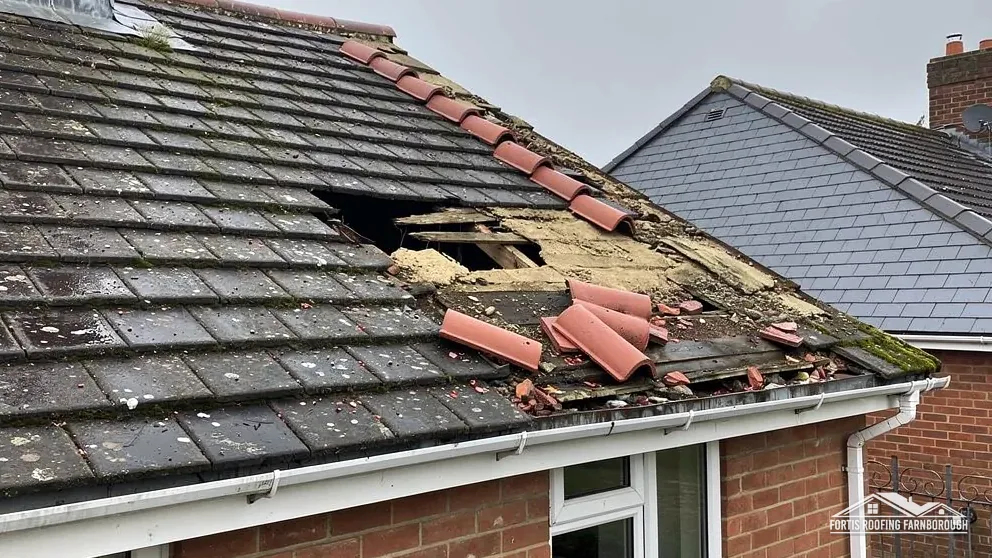
For a house inside either conservation area we photograph the ridge, hips, verges and chimney junctions before work starts, then again when it ends. If a planner asks what was on the roof before, the answer is a set of dated pictures. Our pitched roofing page describes how tiled slopes are repaired and re-covered, and chimney repairs covers the stacks that often sit on the line between repair and alteration.
Because Claygate Village and Claygate Foley Estate are both on the national dataset's map around the village, check which boundary your street sits inside. Elmbridge's conservation area page for Claygate carries the details and links the character appraisal for the Village area. If your address is near an edge, a quick call to Elmbridge's planning team settles it, and we make that call during the survey so the answer arrives with the price.
Whichever route a Claygate job needs, you receive one written price after the survey, with the findings explained alongside it.
A repair or re-cover in the same material and detail is the plain case, and Elmbridge's planning team can confirm it. Changing the covering alters how the roof looks, so we raise that with Elmbridge before pricing. We also ask whether an Article 4 direction applies to your address, because that would remove some permitted development rights.
Elmbridge Building Control Services, known as EBCS, provides the building control service on behalf of Elmbridge Borough Council, so that is the body for a re-roof that passes the Planning Portal limits. A registered building control approver is the private alternative. We tell you at the survey which route your roof needs.
No. Holy Trinity is Grade II listed, but Anglican worship continues there, so it comes under the ecclesiastical exemption and the Church of England's faculty system. Elmbridge's listed building consent covers listed buildings outside that exemption, for instance the war memorial or a listed farmhouse, and we raise it with the council before any roof on one is priced.
A scaffold licence for a job booked now comes from Surrey County Council, at £208 per 28-day period, applied for at least 10 working days ahead. Surrey's councils are replaced from 1 April 2027, so if a job could run close to that date, we raise it at the survey and plan the scaffold with the scaffolder.
Get your free roof quote
Give us your Claygate address and describe the problem overhead, and we will fix a date to survey the roof.
10-year workmanship guarantee, in writing.