Timber tower, shingled spire
The church tower is masonry only to the first floor, timber above, with an octagonal shingled spire.
Roofs round a timber-towered church below the downs
Great Bookham is a large village below the North Downs chalk, with a Grade I church whose tower is timber above the first floor. We survey each roof as found.
The church tower is masonry only to the first floor, timber above, with an octagonal shingled spire.
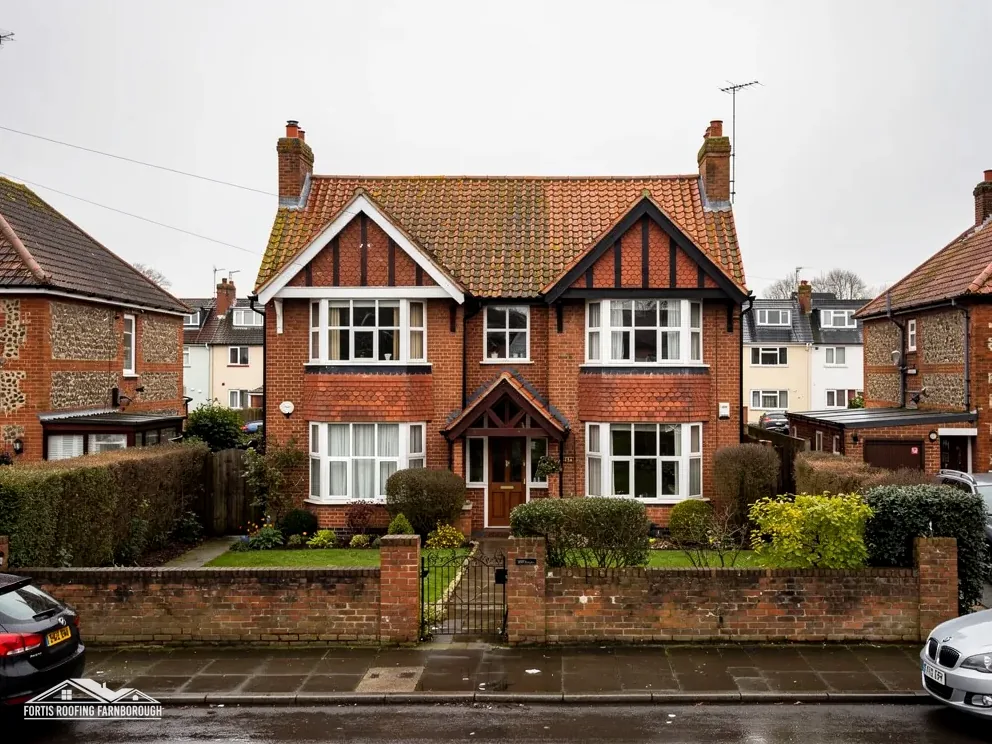
Numbers 2, 4, 6 and 8 and numbers 10, 12, 14 and 18 Church Road are each listed Grade II.
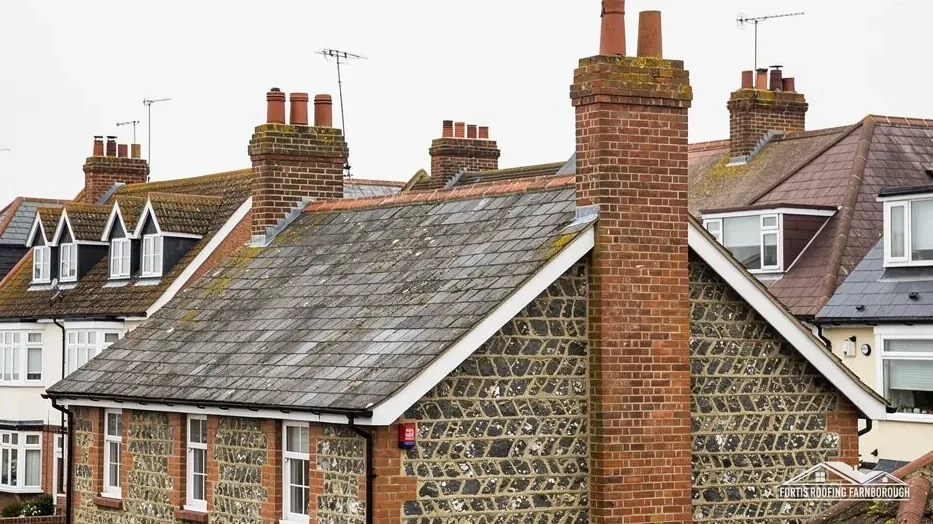
Bookham Grove is listed Grade II, one of 25 listed buildings within 500 m of the village centre.
Map of Great Bookham with Little Bookham, Effingham, Fetcham, Leatherhead marked around it.
Map data © OpenStreetMap contributors. Loads only when you ask for it.
Little Bookham lies west of Great Bookham, Effingham further west, Fetcham and Leatherhead north-east, Ashtead beyond them, and Stoke D'Abernon north.
About 25.4 road miles east of Farnborough · Mole Valley District Council and Surrey County Council.
Great Bookham, tower and chalk
How Mole Valley and Surrey divide a roof job in Great Bookham, what the 1911 history records about the church tower, the chalk and the railway, and what 25 listed buildings nearby add to a repair.

| No. | Chapter | The figure it turns on |
|---|---|---|
| 01 | Mole Valley, Surrey and a built-up village | 21,659 residents in the built-up area |
| 02 | A timber tower, Domesday and the 1885 railway | Tower timber above the first floor |
| 03 | Church Road's listings and the Bookham conservation area | Grade I church, Grade II cottages |
Chapter 01 of 03
| Role | Body for Great Bookham addresses |
|---|---|
| Planning authority | Mole Valley District Council |
| County council and highway authority | Surrey County Council (until 31 March 2027) |
| Council from 1 April 2027 | East Surrey Council from 1 April 2027 |
| Building control | The district's service, or a registered building control approver |
| Built-up area population | 21,659 usual residents at the 2021 Census |
| Distance from our base | 25.4 road miles east of Farnborough, from the A325 |
With 21,659 usual residents in its built-up area at the 2021 Census, Great Bookham is more than a village in size, and some of its roofs may sit over flats as well as houses. Planning belongs to Mole Valley District Council and the highways to Surrey County Council until 31 March 2027, after which East Surrey Council takes over from both on 1 April 2027. That timetable matters only if a job is slow to start: a roof booked now and finished soon is arranged entirely under the present councils.
If your roof is over a flat, the usual planning shortcuts do not apply. The national permitted development order defines a dwellinghouse so as to leave out flats, which means rights that help a house owner do not help a flat owner, and Rushmoor's planning pages put it plainly: flats have no permitted development rights. Speak to Mole Valley District Council's planning team before altering how a flat roof looks. Mention when you first ring that the property is a flat, because the freeholder and the lease may also have a say, and because the roof may be shared with the flats above or beside yours.
For a house, the measure is the Planning Portal's. A re-roof limited to under 25 per cent of the building envelope and under 50 per cent of the roof generally needs no Building Regulations application, whereas a covering 15 per cent heavier or more does not. Our survey puts figures to your roof before we advise, slope by slope, with the arithmetic shown. If an application is needed, Mole Valley's service or a registered building control approver can take it.
Under section 169 of the Highways Act 1980, scaffold that stands on a street edge needs a licence. Surrey County Council's fee is £208 for each 28-day period, with applications due 10 working days or more beforehand, and the council's published page says nothing on who submits the form. We confirm the applicant and the dates before booking.
In a built-up area with shops and a station, deliveries and parking shape the job. We note where a lorry can stand and for how long, and plan the days of roof work around it.
Chapter 02 of 03
The Bookham church and parish in four details
Writing in 1911, the Victoria County History of Surrey describes Great Bookham's church tower in unusual detail. It is masonry only to the first floor. Above that it is timber, carried on heavy oak posts and boarded, with stone slabs where it gathers in over the walls, and it ends in an octagonal shingled spire. The church is mentioned in Domesday, and the history thought the present nave may be the size of the 11th-century building and include some original stones.
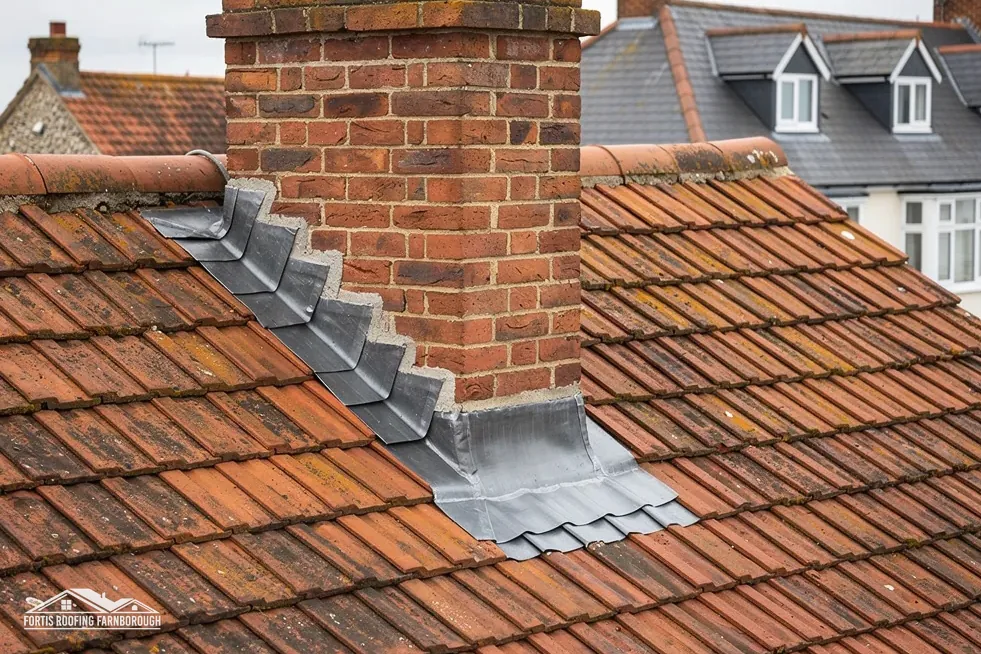
A timber tower on a stone base has several different materials meeting at each level, and each joint is where weather tests it. Stone slabs, boarding and a shingled spire all need to shed water, and they do it by different means. Houses do not carry spires, but the lesson carries over: wherever two materials meet, such as brick and tile at a chimney or lead and slate at a valley, the junction is the part to look at first.
The history places the village and church on the Thanet and Woolwich beds, with the parish reaching from the brow of the chalk, capped by clay and gravel, across London Clay to the Mole. We draw no conclusion about any roof from that; the point is only that the ground changes across the parish, and drainage, fixings and foundations can all differ between one end and the other.
Bookham station opened in 1885 on the London and South Western line between Leatherhead and Guildford. The railway made the village easier to reach, and houses of later periods now stand beside older ones, with different roofs and different faults. Each house gets its own survey, and Church Road's listed cottages need the extra care described in the next chapter.
For roofs of tile, our pitched roofing page describes repairs to slipped tiles, ridges and valleys, and our lead roofing and lead work page covers the flashings and gutters at junctions.
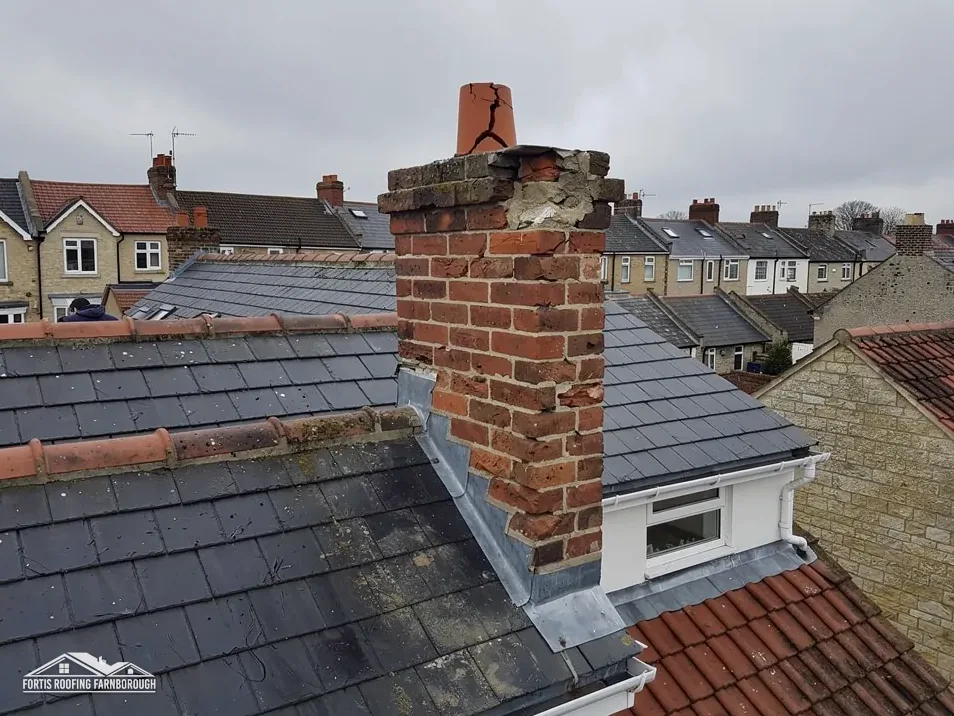
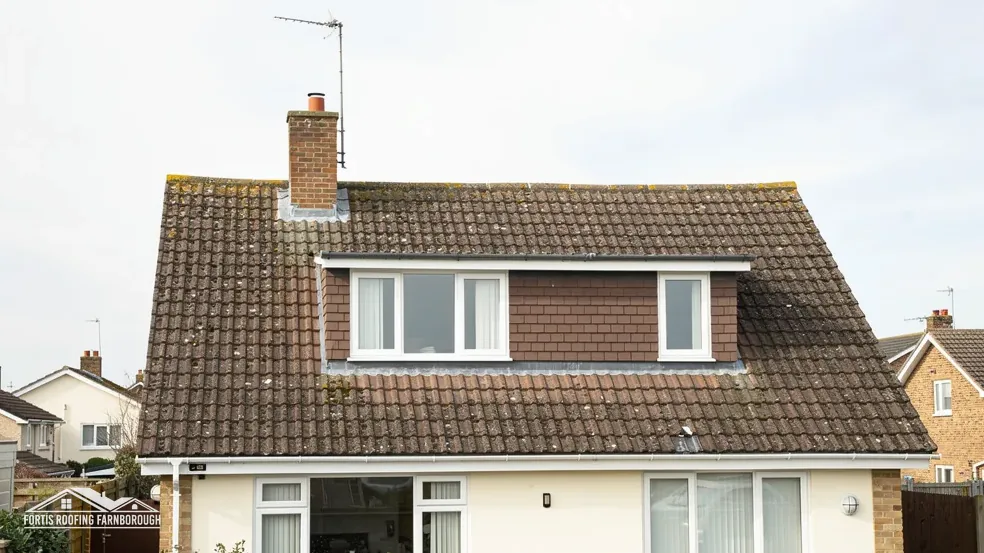
Because the tower combines stone, oak and boarding, its repair history is probably a long one. Houses with extensions, porches and dormers are the same in miniature: each addition is a seam where old and new construction meet.
Chapter 03 of 03
| Designation | In Great Bookham | For roof work |
|---|---|---|
| Conservation area | Great Bookham, within about 0.75 km of the centre | Ask Mole Valley before changing a roof's look |
| Grade I listed church | Church of St Nicholas (NHLE 1028641) | Church of England faculty, not council consent |
| Grade II listed | 10, 12, 14 and 18 Church Road (NHLE 1294524) | Listed building consent where character is affected |
| Grade II listed | 2, 4, 6 and 8 Church Road (NHLE 1028666) | Listed building consent where character is affected |
| Grade II listed | Bookham Grove (NHLE 1028634) | Listed building consent where character is affected |
| Surrey Hills National Landscape | Partly: 5% of the 1.5 km area | Check your address with Mole Valley |
The Great Bookham conservation area lies within about 0.75 km of the centre, and the same area search also touches the separate Little Bookham one, and the national list shows 25 listed buildings within 500 m. Whether your roof is inside the boundary is for Mole Valley District Council's map to say, and whether an Article 4 direction applies is a question for its planning team. Planners there should hear about any dormer or new covering material first, and Mole Valley will want to see the existing detail before agreeing a change.
Numbers 2, 4, 6 and 8 Church Road, numbers 10, 12, 14 and 18 Church Road, and Bookham Grove are each listed Grade II. On any of them, work that affects the character needs listed building consent from Mole Valley, and we put the question before we price. The survey records ridge lines, verges, chimney pots and lead, which are the details a conservation officer will ask about. Where a listed roof needs a repair that matches an old detail, such as a particular ridge or verge, we flag it at the survey, so that the specification is agreed before materials are ordered.
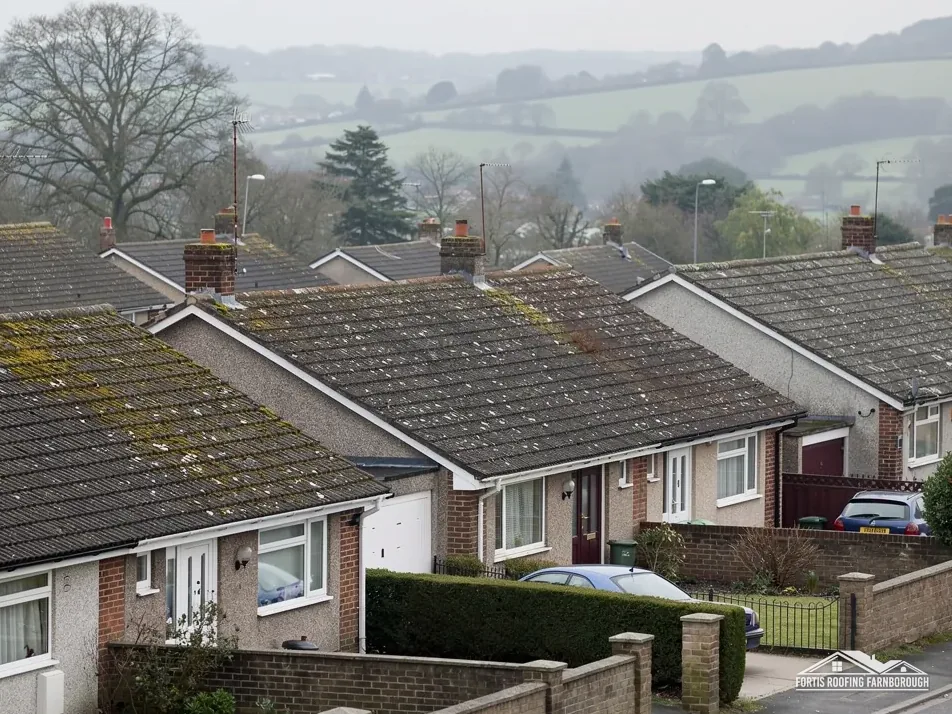
The Church of St Nicholas, spelt St Nicolas by its parish, is listed Grade I and serves as a Church of England church on Lower Road with services every week. That puts its roof repairs through the faculty system under the ecclesiastical exemption, not Mole Valley's listed building consent, and the parish leads any application.
About 5 per cent of the 1.5 km area round Great Bookham lies inside the Surrey Hills National Landscape, formerly the AONB, though the village centre is outside it. Your own house may or may not be inside, and Mole Valley's map answers that. A dormer or a new roof shape goes to the planners as a question first. Our planning permission for roof work guide sets out the rules.
A matching repair to an unlisted house is the straightforward job, since section 55 of the Town and Country Planning Act 1990 does not count works that leave a building's outer look unchanged as development.
A shared stack belongs to the houses it serves, so a repair normally involves both owners, and a party wall surveyor if the work affects the shared wall. We photograph the stack from your side, record the flashings and pointing, and give you a clear account to show the neighbour before anyone agrees a plan.
Numbers 2, 4, 6 and 8 and numbers 10, 12, 14 and 18 Church Road are each listed Grade II. Mole Valley's planning team and the national list confirm any other address. Where work would affect a listed house's character, listed building consent is needed, and the council gets our question before a price is given.
About 5 per cent of the 1.5 km area round the village is inside it, and the village centre is outside, so only some addresses are affected. Mole Valley's map settles it for yours. A new dormer or any change in covering goes to the council as a question first, wherever the house stands.
A street-side scaffold needs Surrey County Council's licence, which costs £208 for each 28-day period and wants applications 10 working days ahead at least. Its guidance leaves the applicant unnamed, so we ask before booking and fix the dates in writing. Poles within your boundary need no licence, which the survey checks.
Get your free roof quote
Tell us your Great Bookham address and what looks wrong, and we will find a survey slot.
10-year workmanship guarantee, in writing.