Farmland turned to housing
Guildford's profile says the village was farmland or orchards until around 1900, with the north developed from the 1930s.

Orchard land that filled in from the 1930s below the chalk
West Horsley was farmland or orchards until around 1900, and its north was developed from the 1930s. We survey old farm buildings and newer houses roof by roof.
Guildford's profile says the village was farmland or orchards until around 1900, with the north developed from the 1930s.
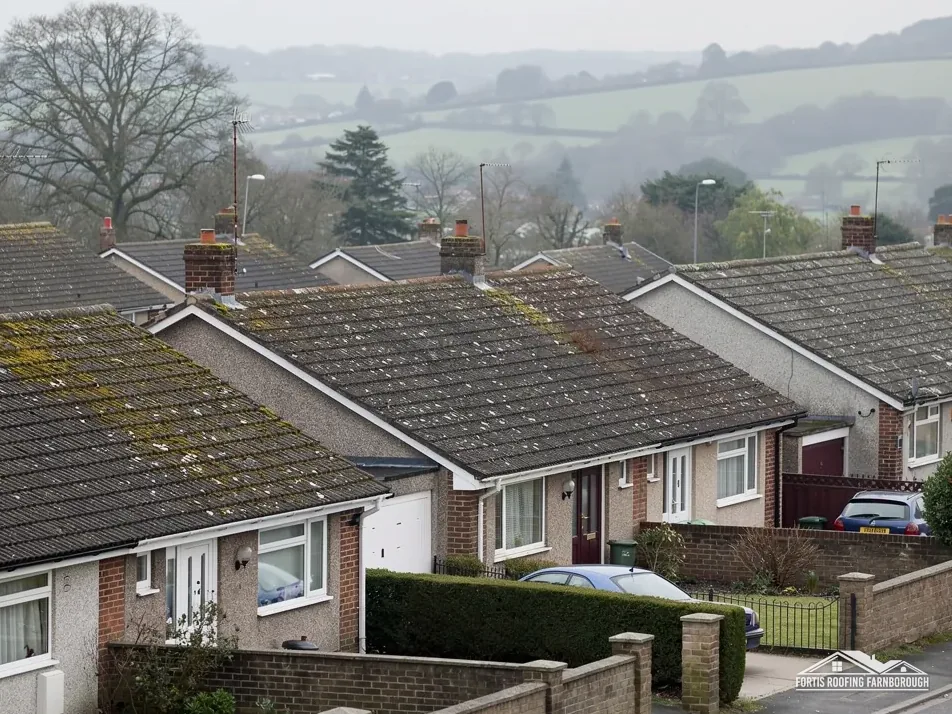
More significant building followed just after the Second World War, according to the council's settlement profile.

Barcombe Farm House, a barn at Pincott Farm and a barn and dovecot at Hammonds Farm are Grade II.
Map of West Horsley with East Horsley, West Clandon, Effingham, Ripley marked around it.
Map data © OpenStreetMap contributors. Loads only when you ask for it.
East Horsley lies to the north-east, West Clandon to the west, Effingham and Little Bookham to the east, Ripley to the north-west, and Gomshall and Shere to the south.
About 21.4 road miles east of Farnborough · Guildford Borough Council and Surrey County Council.
West Horsley, orchard to village
Which councils sit behind a West Horsley roof job, how an orchard village on the chalk's edge grew from the 1930s, and what the conservation area, the listed farm buildings and the Surrey Hills edge mean for a repair.
| No. | Chapter | The figure it turns on |
|---|---|---|
| 01 | Guildford and Surrey, and the Downs' edge | Surrey Hills edge touches the area |
| 02 | An orchard village that filled in from the 1930s | 2,931 residents, West Horsley parish |
| 03 | West Horsley conservation area and the listed farm buildings | Three listed farm buildings, Grade II |
Chapter 01 of 03
| Role | Body for West Horsley addresses |
|---|---|
| District council and planning authority | Guildford Borough Council |
| Building control | Guildford Borough Council's own service |
| County council and highway authority | Surrey County Council (until 31 March 2027) |
| Landscape designation | Surrey Hills National Landscape touches the area's edge |
| From 1 April 2027 | West Surrey Council replaces Guildford and the county |
West Horsley is a Guildford borough village. Planning applications in West Horsley go to Guildford Borough Council, which also runs the building control service, while the roads fall to Surrey County Council. The village is 21.4 road miles away to the east, with the A325 at Farnborough as the starting point, and 13.1 miles directly. In the planning data the edge of the Surrey Hills National Landscape just touches the surroundings, with only a small share of the area inside it, so Guildford's own map settles any single address, and we print what it shows and attach it to the report.
A National Landscape is one of the designations planners take into account when a roof's shape or look would change, as a conservation area is. A repair that leaves the roof as it stands is a different matter, and so is a plain re-cover. Our job at the survey is to establish which designations reach your address and say so in writing, before a price is attached to anything that alters the shape of the roof.
For a larger re-cover the Planning Portal's test sets the ground rules. A re-roof that is under 25 per cent of the building envelope and under 50 per cent of the roof keeps out of the application route; a covering heavier by 15 per cent or more is the other trigger, calling for approval and structural advice whatever the area, which is why we weigh old and new coverings before choosing one. Our report sets the old covering's weight beside the new one's and gives the measured area, which is what Guildford's team asks about first.
Where a lane has no pavement, a scaffold may stand on the carriageway, where Surrey County Council's licence applies: £208 for each 28 days, with applications wanted at least 10 working days beforehand. A scaffold on your own drive stays off the highway altogether. The survey notes which situation you have, and the scaffolder and we deal with the licence between us, so the start date already allows for the notice. Surrey's councils are replaced on 1 April 2027, when West Surrey Council succeeds Guildford, and until then the existing councils remain responsible.
Chapter 02 of 03
West Horsley, as the records give it
Guildford's settlement profile says West Horsley was farmland or orchards until around 1900, that the northern part of the village was only developed from the 1930s, and that more significant building came just after the Second World War. The 2021 Census counted 2,931 usual residents in the civil parish. The county history of Surrey, written in 1911, describes the village as scattered on the soil next to the chalk, with the church just on the edge of the chalk and a few houses clustered at Horsley Green.
The history also describes West Horsley Place as a large red-brick house, much altered, with parts of the back timber and possibly 16th-century, and the front rebuilt in 1749. So the village holds buildings from several centuries beside newer houses, with roofs of many ages. A 1930s house and a post-war house share an age band with others in their street, but each owner renews a roof on their own timetable, so the age of the building does not tell us the age of the covering. We never date a roof from the street.
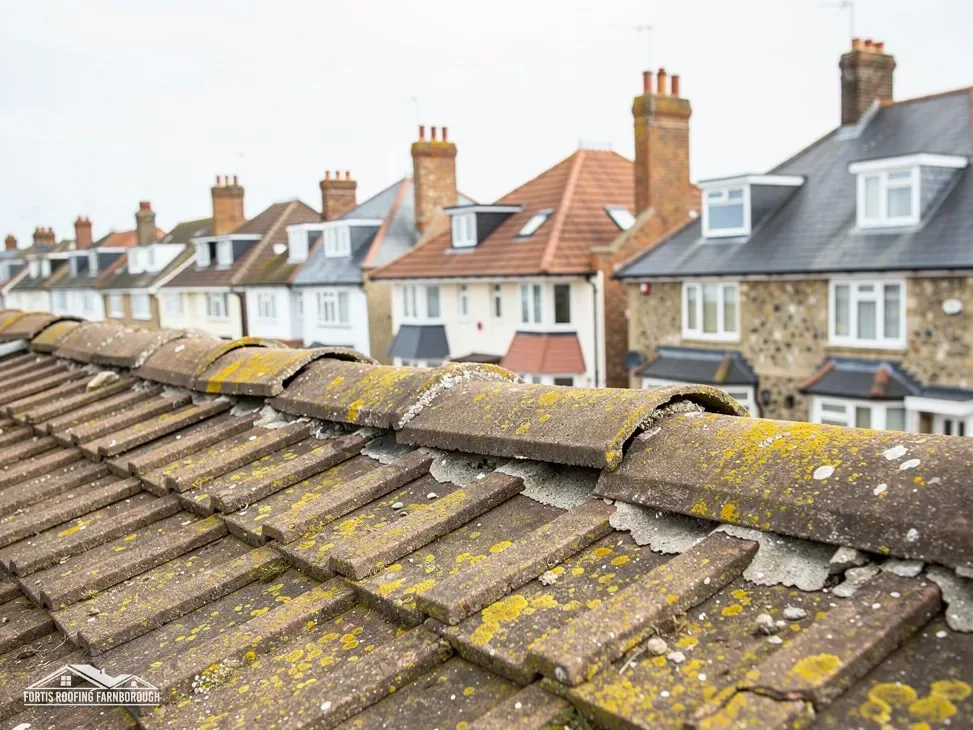
That is why the survey starts from the roof, not the date. For each slope we note the covering, peek under a handful of tiles to read the battens and underlay, and examine the ridge, the verge and any valleys. Where a house has had a loft conversion or an extension, those roofs are treated separately. Our pitched roofing page explains how a repair and a re-cover are chosen between.
Village roofs built across many decades also carry different generations of flashing. When we find a patch of lighter or newer flashing, we note it as a past repair, because past repairs show where water has found a way in before, and that is where we look hardest.

Gutters and fascias matter on a village where houses sit below a chalk escarpment and water has to be moved away from the walls. We check outlets, joints and falls, and note any run holding water. Our gutters, soffits and fascias page covers those jobs, and we report them together with the roof so that you see the whole path the water takes.
Chapter 03 of 03
| Designation | In West Horsley | For roof work |
|---|---|---|
| Conservation area | West Horsley | Changes to the look checked with Guildford |
| Grade II listed | Barcombe Farm House (list entry 1029332) | Listed building consent for works affecting character |
| Grade II listed | Barn north of Pincott Farm House (list entry 1189000) | Listed building consent for works affecting character |
| Grade II listed | Barn and dovecot at Hammonds Farm (list entry 1377851) | Listed building consent for works affecting character |
| Article 4 direction | Check by address on Guildford's map | Chimneys where a direction applies |
The planning dataset places the West Horsley conservation area within about 0.75 km of the village centre. Guildford's online map shows both the conservation area boundary and an Article 4 Direction layer, and at an address where a direction applies the council's page rules out removing or changing a stack without permission. Before we price chimney work in the village, we look up the address and tell you what the map shows.
Historic England lists Barcombe Farm House at Grade II, along with a barn to the north of Pincott Farm House and a barn and dovecot at Hammonds Farm. Listing changes how a roof is treated, because listed building consent comes into play for works affecting its character as a listed building, and a barn roof is often a large, simple plane where swapping the covering would be highly visible. Listed houses keep their permitted development rights, with the consent required alongside.
Matching is more demanding on a farm building, since a barn roof is seen from the lane and the field. We note the size, tone and texture of the tile already there, and where a few replacements are needed we look for reclaimed tile of the same kind before ordering new. A barn roofed in sheet or slate is treated the same way, keeping what is there before anything else.
A farm roof has its own questions. The area is large, the pitch is often long, and old roof timbers may be irregular. We measure the whole slope, photograph it in sections so the condition is on record, and give a single written price for the work once the findings are in. Our planning permission guide explains how the planning side works for a house.
For the many unlisted houses, the working rule is that a repair should look like what was there. Matching tile, keeping the pitch and keeping the chimney as it is all leave the roof's look intact, and a new covering or window on a visible slope goes to Guildford first. Our chimney repairs page covers chimney stacks, flaunching and the flashings around them, and we record those details before the work begins.
Barns at Pincott Farm and Hammonds Farm are listed Grade II, and putting a different covering on a listed barn can alter its character. Listed building consent applies to works affecting a listed building's character. Guildford judges whether a matching repair counts, so the council receives photographs and our method before any pricing.
The planning data shows only the edge of the National Landscape touching the area around the village, with a small share inside. Whether your own address is inside is a question for Guildford's map. It matters for any change to the roof's shape, so we check it before such work is priced, and the routes are set out in our planning permission guide for roof work.
It can, but coverings are replaced house by house, so the age of a house does not fix the age of its roof. Guildford's profile says the northern part of the village was developed from the 1930s. We lift a sample on each slope and note what is there, instead of assuming from the date.
Guildford Borough Council runs its own building control service, and a registered building control approver is the private route. Either can say whether a job needs an application. A re-roof touching under 25 per cent of the building envelope and under 50 per cent of the roof usually falls outside building control's application route, and our survey measurements show where a job falls.
Get your free roof quote
Tell us your West Horsley lane and the roof trouble, and we will suggest survey dates.
10-year workmanship guarantee, in writing.