Steep clay-tiled old houses
Guildford's appraisal says the 16th and 17th-century buildings have low eaves and steep clay-tiled roofs.
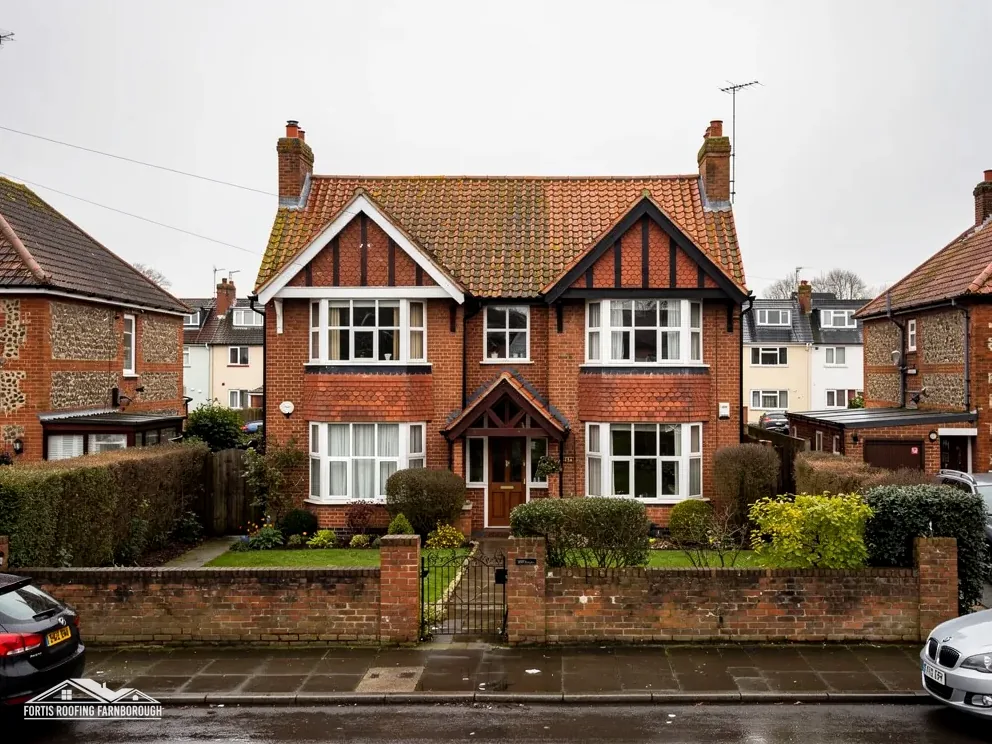
Handmade clay tile, Welsh slate cottages and a Georgian Clock House
Ripley's buildings came from local clay, timber and flint, and the railways later brought Welsh slate to its cottages. We read each roof for what it actually carries before pricing.
Guildford's appraisal says the 16th and 17th-century buildings have low eaves and steep clay-tiled roofs.
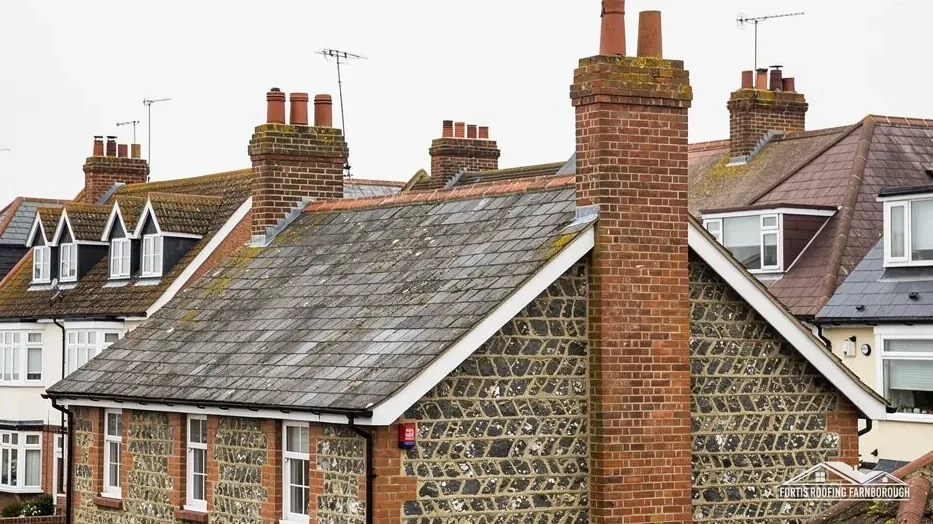
After the railways arrived in the mid-19th century, cheaper Welsh slate roofed many mid to late Victorian cottages.

Eighteenth-century prosperity brought new brick houses, among them the Clock House with its black-glazed and red brick front.
Map of Ripley with Send, Pyrford, Old Woking, West Byfleet marked around it.
Map data © OpenStreetMap contributors. Loads only when you ask for it.
West Clandon and West Horsley lie to the south and south-east, the Byfleets to the north, Pyrford to the north-west, and Send and Old Woking to the west.
About 20.5 road miles east of Farnborough · Guildford Borough Council and Surrey County Council.
Ripley, tile, slate and flint
Who decides roof work in a Guildford-borough village, what the council's own appraisal says about Ripley's clay, slate and flint, and how the conservation area and its listed buildings shape a repair.

| No. | Chapter | The figure it turns on |
|---|---|---|
| 01 | Guildford decides, Surrey licenses the scaffold | 15 per cent heavier needs approval |
| 02 | Clay from the brickmakers, slate from the railway | 2,024 residents, Ripley parish |
| 03 | Ripley's conservation area, The Talbot and St Mary's | Conservation area designated 29 February 1972 |
Chapter 01 of 03
| Role | Body for Ripley addresses |
|---|---|
| District council and planning authority | Guildford Borough Council |
| Building control | Guildford Borough Council's own service |
| County council and highway authority | Surrey County Council (until 31 March 2027) |
| Scaffold licence on the highway | Surrey County Council |
| From 1 April 2027 | West Surrey Council replaces Guildford and Surrey County Council |
Ripley belongs to Guildford borough, which means Guildford Borough Council takes its planning decisions and operates the building control service itself. Surrey County Council, as the highway authority, licenses scaffolding on the road and pavement. By road Ripley is 20.5 miles east, taking the A325 at Farnborough as the start, though the straight-line figure is 11.3 miles, and we plan the day around the longer one.
Ripley has clay-tiled houses and slate-roofed cottages side by side, and swapping one covering for the other changes the load on the rafters. Per the Planning Portal, a new covering 15 per cent or more heavier than the current one needs Building Regulations approval, and the portal suggests a surveyor's or engineer's opinion on the structure before work begins. Planning permission is a separate question and does not turn on weight. So a move from slate to a heavier tile is the case to flag early, and we compare the weights of old and new before a covering is chosen. The new battens and underlay are photographed and priced alongside the covering, so the whole build-up is visible to you.
Beyond weight, the Planning Portal's two limits, 25 per cent of the building envelope and 50 per cent of the roof, are the starting point for a bigger re-cover. A few slipped tiles are far inside them, and a whole-roof strip is far outside. We measure the affected area on the survey and put a close case to Guildford's team before anything is booked.
A scaffold that stands on the road or pavement needs a Surrey County Council licence. Surrey charges £208 for every 28 days of licence, and expects the application at least 10 working days beforehand. For an unsafe structure, or where there is a serious safety risk, the council's page tells you to phone about an emergency licence instead of waiting. Where the scaffold goes on a drive or in a garden, we agree its position at the survey, and the licence, where one is needed, is arranged with the scaffolder.
Surrey's councils are due to change on 1 April 2027, when Guildford joins West Surrey Council. The county council expects services to continue as now until that date, so a job booked now follows today's arrangements.
Chapter 02 of 03
What the records give for Ripley
Guildford's conservation area appraisal for Ripley, written in July 2017, is specific about the village's materials. Its buildings drew on what was close by: woodland timber, bricks and handmade clay tiles from local brickmakers, and flint from the North Downs. After the railways came in the mid-19th century, cheaper Welsh slate roofed many mid to late Victorian cottages. The 16th and 17th-century buildings follow the Surrey vernacular, with low eaves and steep clay-tiled roofs, while 18th-century prosperity brought brick houses such as the Clock House, with its black-glazed and red brick Georgian front.
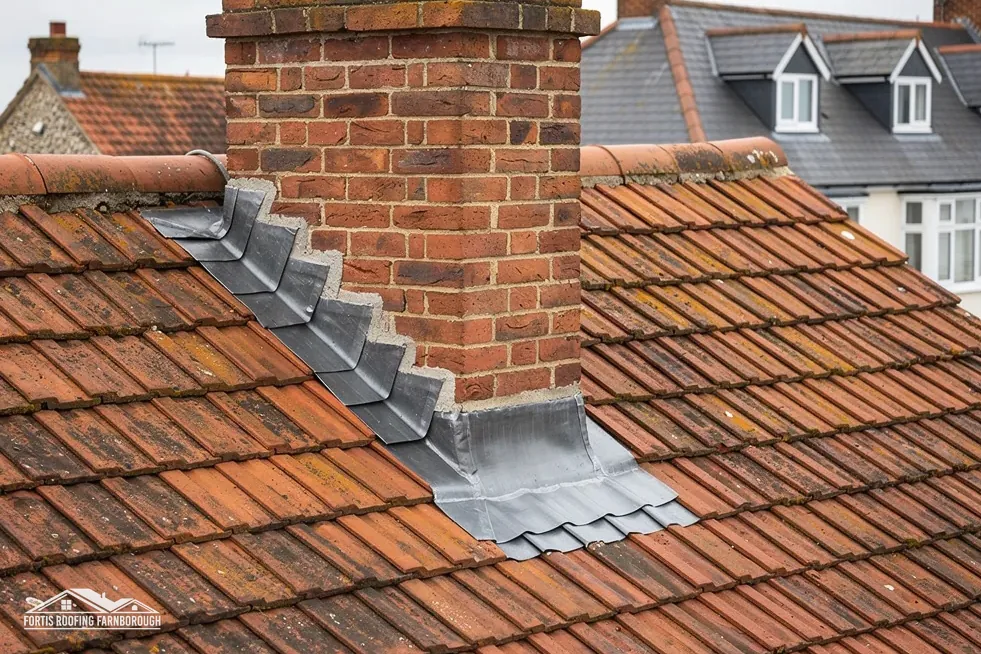
A steep clay-tiled roof with low eaves leaves little room at the gutter line. The tiles overhang a short distance, the fascia sits close to the wall, and a blocked gutter sends water straight down the brickwork. We check the eaves course, the gutter fall and the first rows of tiles on every older Ripley house, because that is where the oldest roofs fail first. Handmade clay tile also varies in size and colour, so replacements are matched by eye on the roof, from the sound tiles around them.
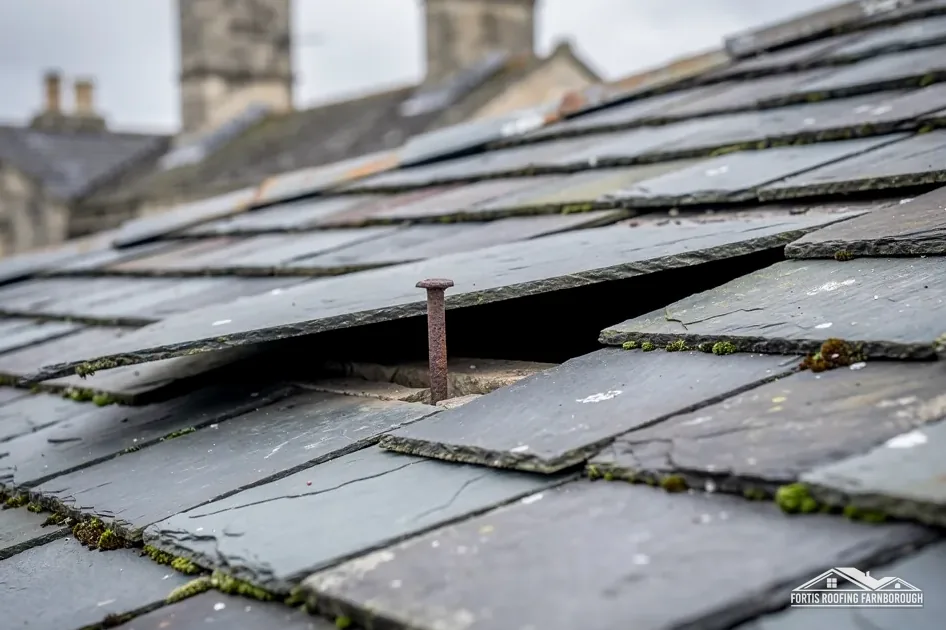
A slate cottage has different weak points. The slates may be sound while the nails or hooks holding them have rusted, so a slipped slate can be a sign of a fixing problem across the slope rather than a single failure. A few get lifted, the battens and fixings are photographed, and you are told whether the slope wants refixing, partial replacement or a full re-cover. Our slate roofing page explains how those choices differ.
The appraisal adds that between the wars the village changed greatly as traffic on the Portsmouth road grew, and that in the 1880s Ripley was known as the Mecca of all good cyclists. That means newer building sits among the old, and the roofs on the same street can be centuries apart in age. We never assume one house's roof tells us about its neighbour's. Each is surveyed on its own evidence.

Flint from the North Downs also shows in the village's walls, and flint walls meet roofs at gables, chimneys and verges, where lead or mortar flashings take the strain. We check those junctions closely, because a roof can be sound while the flashing at a flint wall is not, and that gap lets rain in quickly.
Chapter 03 of 03
| Designation | In Ripley | For roof work |
|---|---|---|
| Conservation area | Ripley (designated 29 February 1972, reviewed February 1994) | Changes to the look checked with Guildford |
| Grade II* listed | The Talbot (list entry 1029372) | Listed building consent for works affecting character |
| Grade II* listed church | St Mary the Virgin (list entry 1188603) | Denomination and use decide the route |
| Grade II listed | 5 (Rambler Cottage), 7 and 9 (list entry 1029380) | Listed building consent for works affecting character |
| Article 4 direction | Check by address on Guildford's map | Chimneys where a direction applies |
Guildford Borough Council's records show the Ripley conservation area designated on 29 February 1972 and reviewed in February 1994. Part of Guildford's grip on conservation areas is the article 4 direction, and for an address under one, the council's page rules out taking down or altering a stack without permission. With the Article 4 Direction layer turned on, the online map shows which addresses are covered. Our check of it comes before pricing any chimney work and pass you the result, so a stack is never priced on an assumption about its status.
Historic England lists The Talbot at Grade II*, with the Grade II houses numbered 5 (Rambler Cottage), 7 and 9. Works affecting a listed building's character need listed building consent, so recovering one of those roofs, or taking down a stack, goes to Guildford first. Listed houses keep their permitted development rights, with the consent required on top. Our planning permission guide shows how the routes fit together.
St Mary the Virgin's church was rebuilt in 1845-6 apart from a chancel of about 1160, whose walls are flint mixed with conglomerate and chalk dressings, and it is listed Grade II*. We would confirm its present use with the parish. If worship there is Anglican, the faculty system replaces listed building consent from Guildford for any roof work, so we would check before pricing anything close to it.
For an ordinary house in the conservation area, the sensible start is like-for-like. Matching handmade clay tile, keeping the steep pitch and the low eaves, and re-pointing or re-flaunching a stack with a mortar that suits the old brick all keep the roof looking as it did. Our chimney repairs page covers the stacks, flaunching and flashings in more detail.
A conservation-area survey takes longer than an ordinary one because the record is part of the work, so allow for that when you book. Coursing, ridge and hip details, verges, chimney pots, lead and any flint-wall flashings are all photographed, giving Guildford's team a clear view of the roof as it is and of what we would change.
Often, yes. Guildford's appraisal describes steep clay-tiled roofs with low eaves on Ripley's oldest buildings. Slipped tiles can be refixed and matching handmade tiles slipped in, with the battens and eaves checked underneath. A full re-cover is for when the survey shows the fixings or timbers are failing, not just the tiles.
It depends on the address. Guildford Borough Council states that under an article 4 direction a stack cannot be removed or changed without permission; its online map shows the addresses affected. We check the map during the survey and talk the answer through before any chimney work is priced.
The Talbot is listed Grade II*, so works affecting its character need listed building consent from Guildford. The church is also Grade II*, and a working Church of England church would use the faculty system instead. Neither route touches the ordinary houses around them, which follow their own rules. Both are checked individually.
On 1 April 2027 Guildford is one of the councils joining West Surrey Council, which replaces the current Surrey councils. Surrey County Council says for now, services carry on unchanged. Check the council named on any notice or licence, and file it with your quote and photographs for reference. That small habit saves confusion if responsibilities have moved by the time a question arises.
Get your free roof quote
Tell us your Ripley street and describe the fault, and a survey will be booked.
10-year workmanship guarantee, in writing.