Byfleet Corner Parade
The parade dates from the late 19th century, with steep 45-degree roofs, brick chimney stacks and tile-hung gables.

Roofs above the parades built after the station of 1887
West Byfleet did not exist before its station opened in 1887. We survey the steep-roofed parades, the flats above them and the homes that followed.
The parade dates from the late 19th century, with steep 45-degree roofs, brick chimney stacks and tile-hung gables.
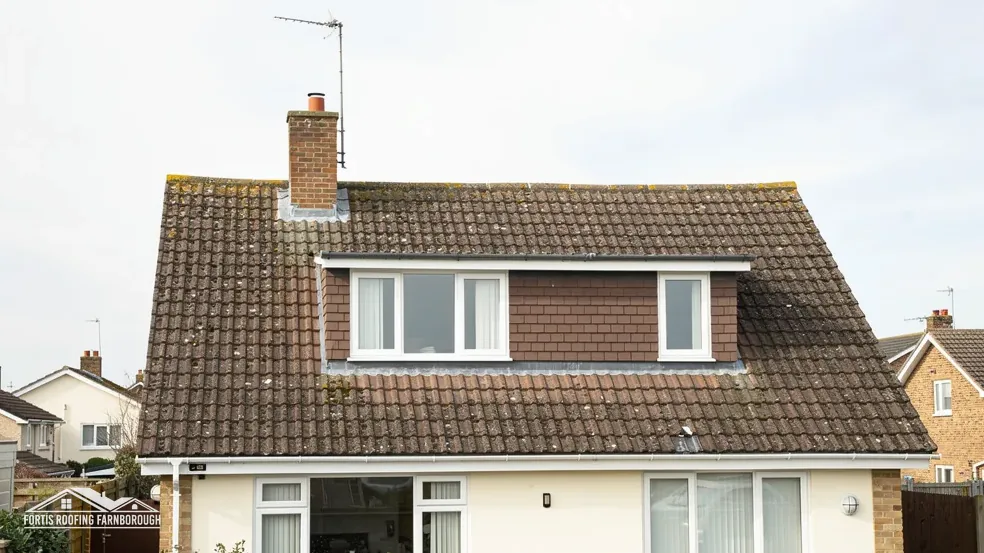
Built from 1907 on the grounds of Rosemount House, it shares the steep tiled roofs of its neighbour.

High-quality housing was planned after 1887, but many properties were soon redeveloped as shops.
Map of West Byfleet with Pyrford, New Haw, Byfleet, Ottershaw marked around it.
Map data © OpenStreetMap contributors. Loads only when you ask for it.
West Byfleet sits on the A245 between Woking and Byfleet, on the Wey valley gravels, while Farnborough is 15.2 road miles off, to the west of it.
About 15.2 road miles east of Farnborough · Woking Borough Council and Surrey County Council.
West Byfleet, parades and the station
How Woking's rules and Surrey's licence apply to parade roofs and homes in West Byfleet, what the council's 2003 appraisal records about the steep roofs and tile-hung gables, and where the 1992 conservation area fits.
| No. | Chapter | The figure it turns on |
|---|---|---|
| 01 | A parade, a pavement and a licence | Woking plans, Surrey licenses pavement scaffold |
| 02 | No village before 1887, then a boom | Steep roofs of 45 degrees |
| 03 | The 1992 conservation area and St John's Church | Designated April 1992 |
Chapter 01 of 03
| Question | Answered by |
|---|---|
| Planning decisions | Woking Borough Council |
| Building control | Woking Borough Council's own service |
| Scaffold or hoarding on the pavement | Surrey County Council, until 31 March 2027 |
| Parish status | Woking, unparished area |
| Distance from Farnborough | 15.2 road miles east, measured from the A325 |
West Byfleet sits in Woking's unparished area, and Woking Borough Council decides its planning and carries out its building control inspections. Scaffold and hoarding on the public highway are licensed by Surrey County Council until 31 March 2027; on 1 April 2027 a new West Surrey Council inherits both roles. From the A325 in Farnborough, West Byfleet is 15.2 road miles to the east.
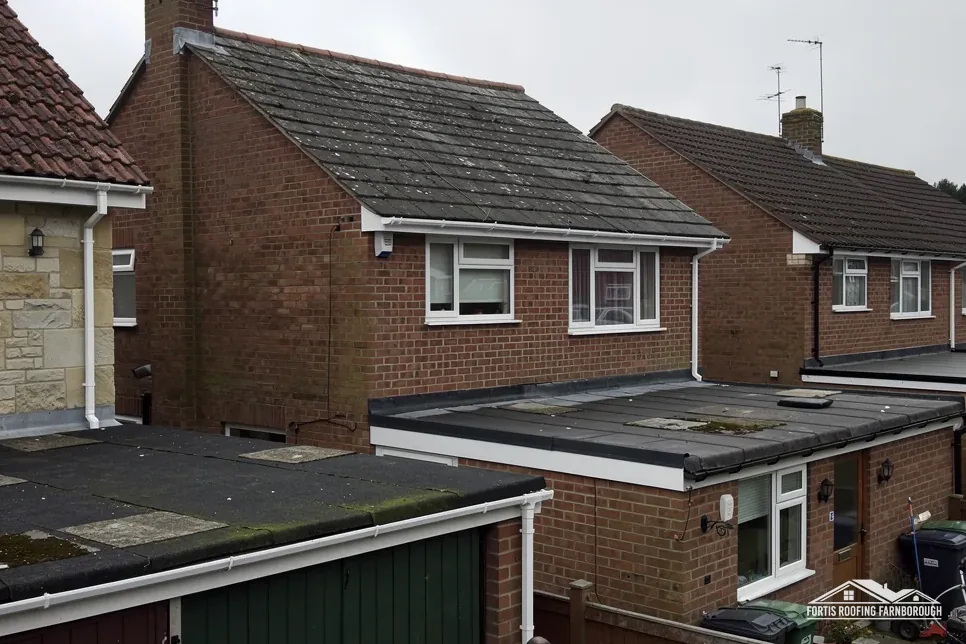
A parade of shops with homes above has a roof that serves two uses at once. The shopkeeper below cares about the pavement and the shopfront; the household above cares about the ceiling. A roofer working on such a roof needs the owner's agreement on access, and often a managing agent's too. We survey the roof from the ladder and from a platform where the street allows, and we write up each section so an owner or agent can plan and share the cost.
Flats have no permitted development rights, so work going further than a straight like-for-like repair could require planning permission, and Woking, not the roofer, decides that. For building control the Planning Portal's yardsticks still apply: 25 per cent of the envelope, 50 per cent of the roof, and extra weight of 15 per cent as a trigger of its own that brings approval and a structural check.
Because a parade is shared property, work on one roof section can affect the next. A valley gutter between two blocks, a party wall flashing or a shared stack belongs to more than one owner, and the deeds say who pays. We describe each fault and where it sits, with photographs, so that owners and agents can talk from the same evidence.
On a parade, scaffold nearly always has to stand on the pavement, so Surrey County Council's licence is the rule of the job. Its fee is £208 for each 28-day period, renewals cost the same, and its page wants 10 working days of notice, with a phone number to ring if an unsafe structure needs an emergency licence sooner. Hoarding is covered by the same licence as scaffold. Who lodges the form is not on the council's page, a point for the scaffolder when you book.
Pedestrians matter on a parade. Customers and residents need a safe way past, deliveries need space and shopfronts need to stay open, and we plan scaffold with covered walkways and clear signs where the footway is the only route.
Chapter 02 of 03
West Byfleet's parades in the council's appraisal
Woking's 2003 appraisal says West Byfleet did not exist until the railway station was built in 1887. It was first developed for high-quality housing, but many properties were soon redeveloped as shops in the early Edwardian period. Byfleet Corner Parade dates from the late 19th century, and Rosemount Parade, built on the grounds of Rosemount House, dates from 1907 onwards, with W. G. Tarrant of Byfleet involved in its earlier parts.
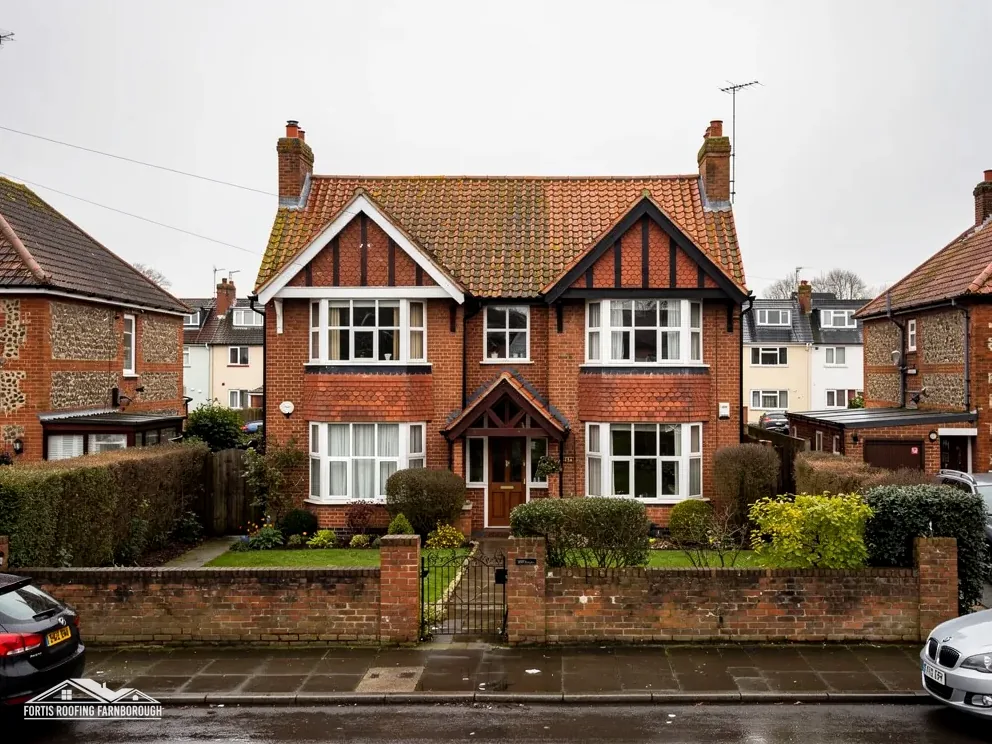
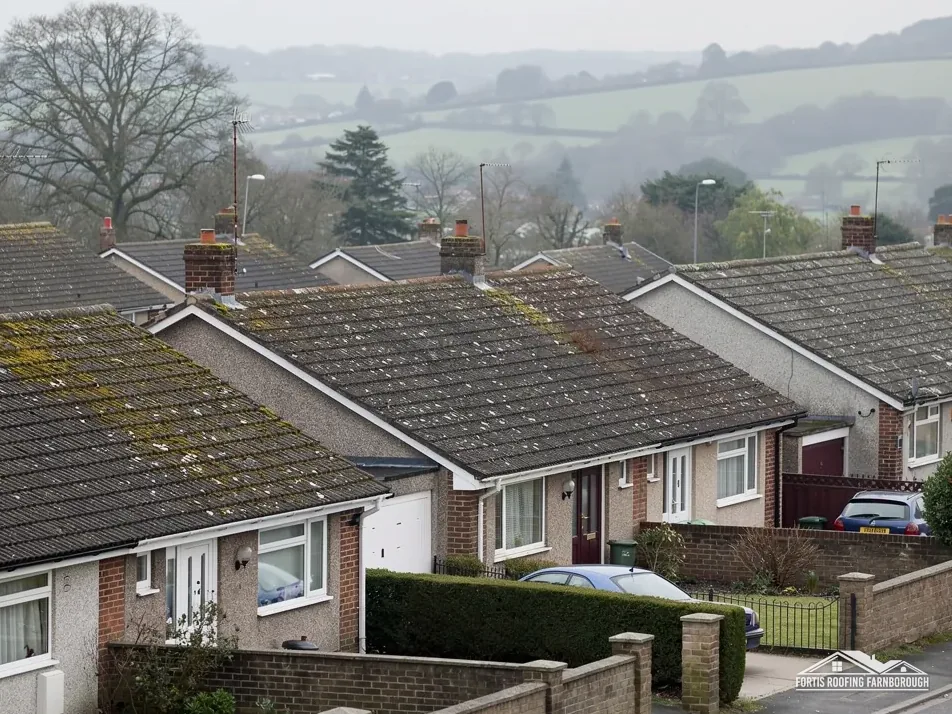
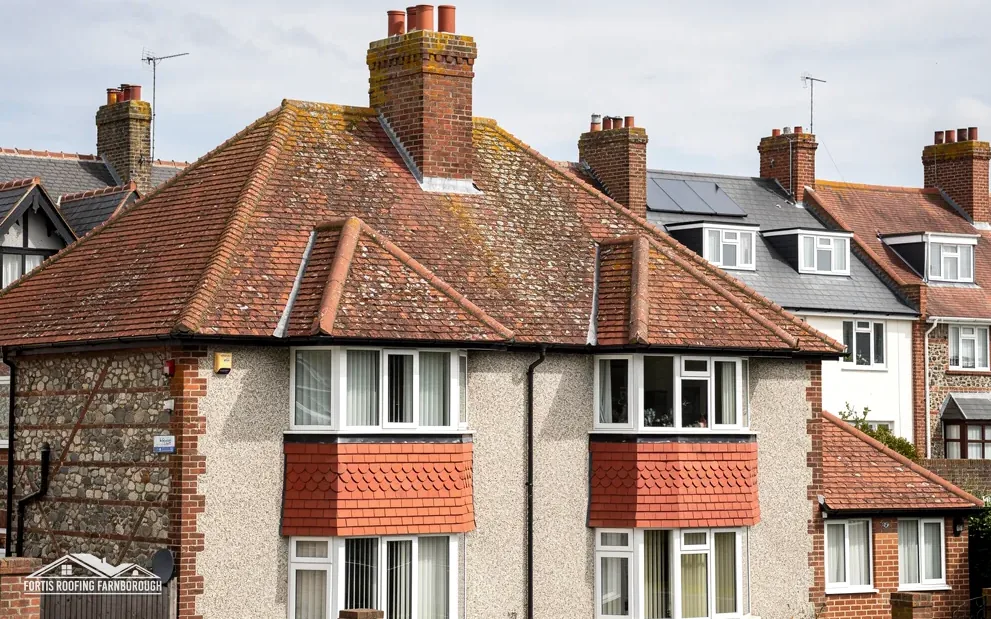
The appraisal describes both parades as having steep 45-degree roofs of machine-made plain clay tiles, with hips and gables, many original brick chimney stacks, and tile-hanging in hand-made clay tiles on the gable ends. That is the council's description of two named parades, and it guides what a repair there should respect. Other roofs in the village need their own look.
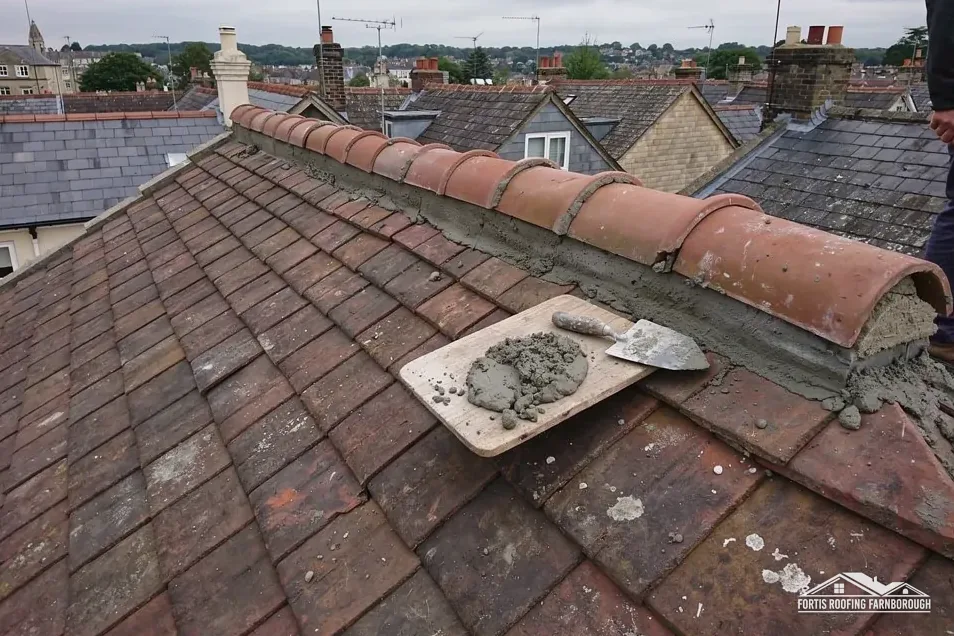
A steep roof sheds water quickly, which is its strength, but it is hard to work on, and its hips, ridges and edge tiles are mechanically fixed, not simply bedded or hung. Replacement is done from scaffold with roof ladders, and a few tiles are a larger job than they look. Hips and ridges on such roofs take the wind and are bedded on mortar or dry-fixed with clips, and Marley explains that since the 2014 revision of BS 5534 the tensile strength of mortar by itself cannot be counted on to hold them.
Tile-hanging on gable ends is the other detail to protect. Hand-made hung tiles weather unevenly, and a patch of machine-made tile stands out against them. We photograph the pattern first, and look for reclaimed tile where a few need replacing. Our pitched roofing page explains how ridges, hips and tiled gables are repaired.
A railway village grows in a burst, and its buildings share an age. Roofs of a shared age tend to wear together, and a careful survey sets out what is sound, what is wearing and what will need work in the next few years, so owners can budget and agree who pays what.
Brick chimney stacks complete the picture, and on a parade there are many of them, with flashings that each need a look. A leak in a flat above a shop often begins at a stack.
Chapter 03 of 03
| Designation | In West Byfleet | For roof work |
|---|---|---|
| Conservation area | Byfleet Corner/Rosemount Parade and Station Approach, designated April 1992 | Changes to the look checked with Woking |
| Conservation areas nearby | Birchwood Road; Old Avenue; Basingstoke Canal | Check Woking's map |
| Grade II listed | Church of St John the Baptist (NHLE 1264419) | Church or listed building consent |
The Byfleet Corner/Rosemount Parade and Station Approach conservation areas were designated in April 1992. The national dataset also shows Birchwood Road, Old Avenue and the Basingstoke Canal conservation areas near the village centre. Woking says it has 27 conservation areas across the borough, and Woking's map answers whether your address is in one.
A conservation area made in 1992 has a settled description in its appraisal. A repair that follows the appraisal's own words about the roofs is likely to be understood at once, and we write our survey notes in those terms, so you can pass them on if you are asked.
Repair is ordinary upkeep in a conservation area, and the appraisal's description of the parades is the standard for matching: steep tiled roofs, brick stacks, tile-hung gables. Another covering, a changed pitch or a rebuilt stack would all alter the roofline, and Woking's planners should hear about them before any price is agreed. We also ask Woking Borough Council whether an Article 4 direction covers the address, and wait for the answer before pricing such a change.
St John the Baptist is the village's listed church. Listed Grade II on 6 January 1984, St John's is the only listed building within 500 m of the village centre. Should it be an Anglican church in use, its roof falls to the faculty system.
Registers of work matter on a parade, where a lease, a managing agent and a council may all want to know what was done to a roof and when. Our survey notes, photographs and written price are kept together, and we hand them to the owner or agent at the end, so the roof's history is not lost between owners.
Two designation dates
Some of the land within about 250 m of the centre lies in Flood Zone 3, according to the Environment Agency's Flood Map for Planning. A flood map concerns land and not individual roofs, yet it is a prompt to keep roof water draining. On parades, where valley gutters between roofs carry water from two slopes, a blocked outlet can flood a flat below. We test and photograph them.
For a house or a parade outside the conservation areas, repair is simply good practice, with approvals as they apply. Our commercial roofing page explains how shop and parade roofs are surveyed and renewed.
Start with the stack, because the flashing and pointing around its foot are the usual route for water on a parade roof. We examine the stack from the ladder, photograph each joint, test the gutter beside it and tell you whether repointing and new flashings will do or the stack needs more.
Another material would alter the look the appraisal describes, so it goes to Woking's planners first. A like-for-like repair with hand-made or matched clay tile is ordinary upkeep. We photograph the existing pattern and look for matching or reclaimed tile before we suggest anything else.
Surrey County Council (until April 2027) licenses scaffold or hoarding on a public pavement at £208 per 28 days, and wants 10 working days of notice. The applicant is not named there, so ask who applies. On a parade the pavement is usually the only place for the poles, so plan the dates early.
That depends on use. An Anglican church in use falls under the faculty system through the ecclesiastical exemption, and St John's is listed Grade II. Were another body to use it, Woking Borough Council's listed building consent would apply. The church itself is the best place to start.
Get your free roof quote
Give your West Byfleet street or parade and describe what you have noticed, and we will send a surveyor.
10-year workmanship guarantee, in writing.