St Margaret's flint and brick
St Margaret's is brick faced with flint, in the early 14th-century style, with a low embattled tower.

Roofs on former heathland north of Iver
Iver Heath became a parish of its own in 1862, with a flint-faced church, a school of 1872 and a hall of 1902. We survey each roof as it stands, slope by slope.
St Margaret's is brick faced with flint, in the early 14th-century style, with a low embattled tower.
Iver Heath School was built in 1872 and the village hall in 1902, after the parish formed in 1862.
Within Iver parish, 2,462 acres were inclosed under an Act of 1799 to 1800, with the award given in 1804.
Map of Iver Heath with Iver, George Green, Langley, Uxbridge marked around it.
Map data © OpenStreetMap contributors. Loads only when you ask for it.
Iver lies south-east of Iver Heath, George Green south-west, Langley and Richings Park south, Uxbridge east, Stoke Poges west and Denham north-east.
About 25.8 road miles north-east of Farnborough · Buckinghamshire Council (unitary).
Iver Heath, storms and roofs
What to do first when a storm damages an Iver Heath roof, what the 1925 history records about the parish, its church and its inclosure, and what is and is not designated near the village.
| No. | Chapter | The figure it turns on |
|---|---|---|
| 01 | A storm, a leak, and the first three steps | Tell your insurer first, then make safe |
| 02 | A parish made from heath and field | Iver Heath parish formed in 1862 |
| 03 | What is and is not designated near Iver Heath | No listed buildings within 500 m |
Chapter 01 of 03
After roof damage in Iver Heath: four published pointers
When wind lifts tiles or opens a valley, the order of the next three steps matters more than the speed of the first. Ring your insurer before anything is repaired, so that nothing is done which the policy would refuse. Then have the roof made safe: for us that means stopping water entering and removing whatever could fall, with permanent work left until the position is clear. Keep every photograph and receipt, because the Institution of Structural Engineers describes pictures of the damage as vital evidence for a claim.
Before you decide that a gale counts as a storm, find the wording in your own policy. The Financial Ombudsman Service explains how it judges the question: it looks for violent wind, usually with rain, hail or snow, though it accepts that a storm can occur without high wind, and that heavy rain, hail or snowfall alone can qualify. It also considers the Beaufort Scale, and notes that some insurers set a wind threshold of their own. Never assume a figure that is not printed in your documents.
The Ombudsman adds a caution: it would be reluctant to side with an owner whose roof was already in poor shape and who knew it, or where the weather simply exposed an old defect. For that reason, an Iver Heath survey records the state of the roof as well as the damage: old repairs, slipped tiles, worn flashing, all with pictures. You can show the report to your insurer if you wish.
Should your insurer give no final response within 8 weeks, you may take the complaint to the Financial Ombudsman Service, which is free to use. After a final response you have 6 months to complain. We cannot tell you what any insurer will decide, and no result is promised, but a clear written record helps whichever way a claim goes. For consumer advice beyond roofing, Citizens Advice runs a helpline on 0808 223 1133.
A small opening lets water in for weeks, so even a roof that looks lightly damaged is checked for cracked tiles, debris and blocked valleys, and the report says what was found.
Chapter 02 of 03
| Subject | What the history records |
|---|---|
| Ecclesiastical parish | Formed out of Iver in 1862, about 2,000 acres; a great part of Iver parish is taken up by Iver Heath |
| St Margaret's church | Brick faced with flint, early 14th-century style, with a low embattled tower |
| School and hall | Iver Heath School built in 1872; the village hall in 1902 |
| Inclosure | In Iver, 2,462 acres inclosed under an Act of 1799 to 1800; award given in 1804 |
| Setting | A village on former heathland north of Iver, between Uxbridge and Slough |
Writing in 1925, the Victoria County History of Buckinghamshire says the ecclesiastical parish of Iver Heath was formed out of Iver in 1862, with an area of about 2,000 acres, and that a great part of Iver parish is taken up by Iver Heath. The 2021 Census counted 5,157 usual residents in the Iver Heath built-up area. Those are matters of land and parish; the roofs themselves are judged on the survey, slope by slope.
St Margaret's church is described as brick faced with flint, in the early 14th-century style, with a low embattled tower. Iver Heath School was built in 1872 and the village hall in 1902. Public buildings of those dates have large roofs of their own, and a roofer approaches a hall differently from a house: longer spans, more outlets, perhaps a flat section at the back. Our flat roofing page explains how membranes, falls and outlets are checked, which matters for any hall, extension or garage.
Inclosure is the other fact worth keeping in view. In Iver, 2,462 acres were inclosed under an Act of 1799 to 1800, with the award given in 1804. The same account calls the soil loamy, over gravel, and says brickworks and gravel-pits were then dotted about the parish. Every Iver Heath roof is still surveyed as it stands, with each slope photographed before any price is written.
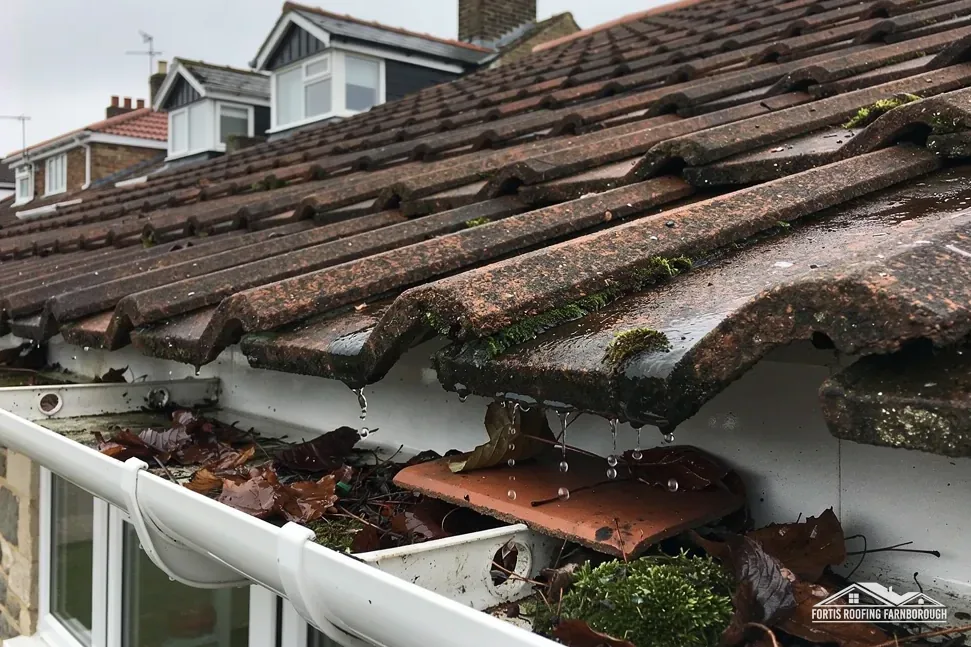
Where trees stand close to houses, leaves and moss collect at the corners of a roof, and a blocked gutter or valley can do more harm than its size suggests. Marley says powerful jet washes can harm tile surfaces and are not recommended, so our roof cleaning and moss removal page describes gentler methods. On every survey we clear the valleys and outlets we can reach, then look again at the roof, since a leak that looks like a cracked tile can prove to be a choked valley, or the reverse.
Two dates on record
The survey also covers the roofline: fascias, soffits and the gutters that run along them. Rot in a fascia board can let water behind a gutter and back into the wall, and it shows from the ground as a stain or a sagging run.
Chapter 03 of 03
Designations round Iver Heath in three figures
Within 500 m of the centre of Iver Heath, the national list records no listed buildings. That is a fact about that distance and nothing more, so a particular house further out could still be listed, and the quickest check is the national list entered by address. For a listed house, Buckinghamshire Council's consent is required before any change of character, and we put that to the council before pricing.
One conservation area is named near Iver Heath in the national dataset, within about 2.5 km: Framewood Road, Iver. It does not touch the 1.5 km area around the village centre, so most Iver Heath houses will not be in it, but it is near enough that a house at the edge of the village is worth checking. Buckinghamshire Council's conservation map shows each boundary. Ask also whether an Article 4 direction applies to your street, since a direction can bring a small alteration under planning control.
Inside a conservation area the planning order removes permitted development for dormers. Our planning permission for roof work guide explains where that leaves a loft conversion. Outside any designation, repairs that reproduce the roof already there are a straightforward job: section 55 of the Town and Country Planning Act 1990 leaves outside development any work that keeps a building's outward look materially as it was.
Anyone responsible for St Margaret's should start with the national list, searched by name. An Anglican church still holding services sends roof repairs through the faculty system, not listed building consent; for other denominations the route depends on the body, and some need the council's consent. The people who run the building will know which applies, and they will want the same evidence we collect for a house: pictures of each slope and a plain written account. Parochial church councils and trustees often ask for exactly that before they commission work.
A roof outside any designation is an ordinary repair or re-roof job, but the same survey, the same pictures and the same plain account apply to it as to a listed house. That is the point of working the same way every time.
Your policy has its own storm definition, so read it first. The Financial Ombudsman Service looks for severe weather, normally strong wind with rain, hail or snow, but accepts that a storm can happen without high wind. Tell your insurer before any repair, and keep photographs and receipts for the claim, because the evidence matters as much as the repair.
The national dataset names Framewood Road, Iver, within about 2.5 km of the village, though it does not touch the 1.5 km area round the centre. Buckinghamshire Council's map confirms whether your house is inside any boundary, and whether an Article 4 direction applies, before a change to the roof's look is agreed or priced.
The national list records none within 500 m of the village centre. That does not rule out a listing elsewhere in the village, so check the list for your own address. Where a house is listed, work affecting its character needs listed building consent from Buckinghamshire Council, which we raise before pricing, and the survey photographs go with any application.
If an insurer has given no final response after 8 weeks, a complaint can be taken to the Financial Ombudsman Service, whose service is free. Once a final response arrives you have 6 months to bring one. No claim is certain to succeed, but our survey report records the damage and the earlier condition of the roof clearly, and you can share it with the insurer when you like.
Get your free roof quote
Tell us where in Iver Heath you are and what the weather did, and we will set a visit date.
10-year workmanship guarantee, in writing.