

Old farm and cottage buildings
The county history describes a farmhouse and 16th and 17th-century cottages keeping original work, much altered and added to.
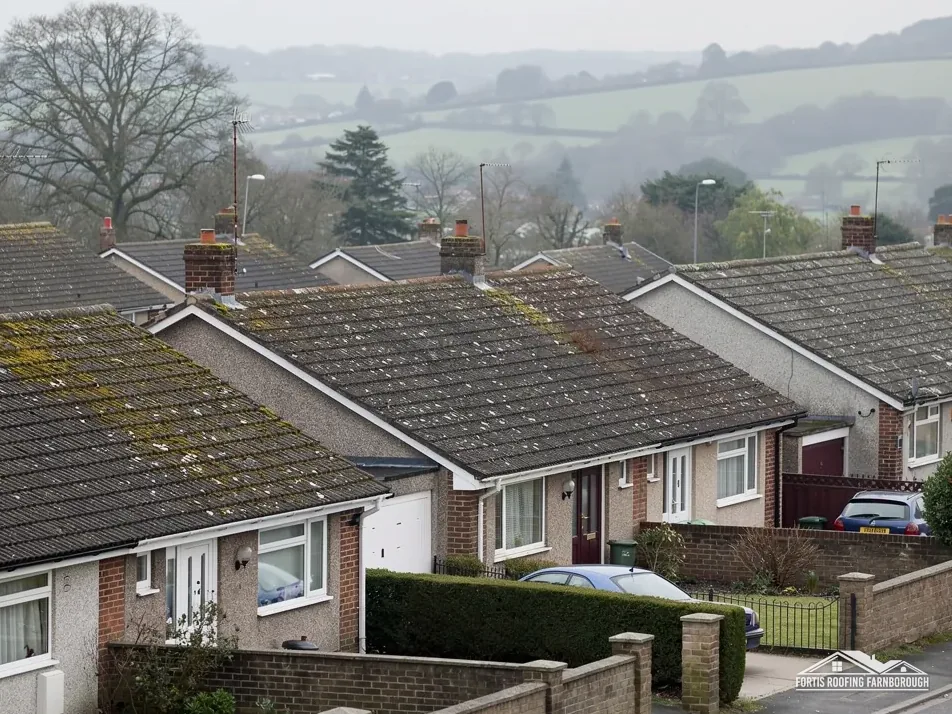
Sixteenth-century cottages, a listed farmhouse and Wexham's red brick
George Green is a hamlet of old farm and cottage buildings, much altered and added to over the centuries. We survey each roof for the alterations it has had.
The county history describes a farmhouse and 16th and 17th-century cottages keeping original work, much altered and added to.
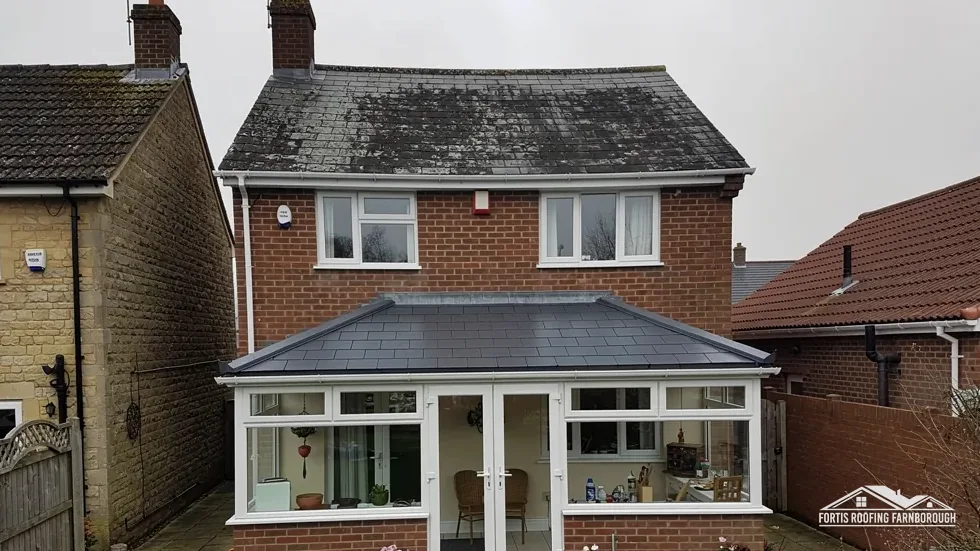
Historic England lists All Souls Farmhouse and Elizabeth Cottage at Grade II, which brings in listed building consent.

In 1925 Wexham Park was a red brick house in Elizabethan style, and Wexham Court's outbuilding looked 16th-century.
Map of George Green with Langley, Iver Heath, Slough, Stoke Poges marked around it.
Map data © OpenStreetMap contributors. Loads only when you ask for it.
Langley lies to the south, Iver Heath to the north-east, Slough to the south-west, Stoke Poges to the north-west, Iver to the east, and Farnham Royal to the west.
About 21.9 road miles north-east of Farnborough · Buckinghamshire Council (unitary).
George Green, farm and hamlet
Who signs off roof work in a Buckinghamshire hamlet, what the 1925 county history records about its cottages and Wexham's soil, and which designations to check near Langley before any repair. Sources are named.
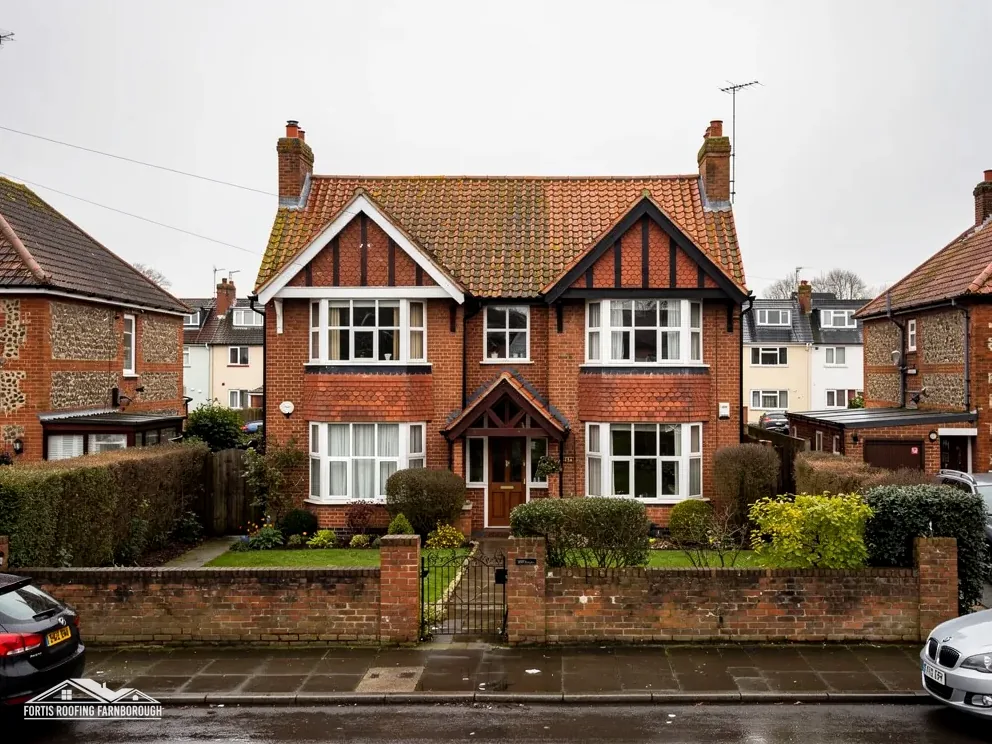
| No. | Chapter | The figure it turns on |
|---|---|---|
| 01 | Buckinghamshire Council covers every George Green roof question | One unitary council, no county tier |
| 02 | Altered cottages and Wexham's clay and gravel | 993 residents in the built-up area |
| 03 | Langley's conservation areas and George Green's listed farm | All Souls Farmhouse, Grade II |
Chapter 01 of 03
| Role | Body for George Green addresses |
|---|---|
| Council and planning authority | Buckinghamshire Council (unitary) |
| Building control | Buckinghamshire Council building control |
| Highway authority | Buckinghamshire Council |
| Private building control | A registered building control approver |
George Green sits north-east of us, 21.9 miles by road from the A325 at Farnborough, and falls in the area of Buckinghamshire Council. It is a unitary council, so planning, building control and the highway all come under one roof, and no separate county council has a say. That is helpful when a job spans two questions at once, such as a re-roof that needs a scaffold on the lane outside: the council can be asked both together.
Whether a re-roof becomes a building control matter is settled by the Planning Portal's yardstick. Where under 25 per cent of the building envelope is affected, and under 50 per cent of the roof, no application is normally needed. Beyond that the job is an application, and a covering that makes the roof 15 per cent heavier or more is an application whatever the area, with a structural look. Our survey measures each slope and the extensions, adds up the affected area, and tells you which way the job falls.
On an altered cottage, the roof can be a patchwork. A section re-covered in one decade, a later extension with a different covering, a replaced valley: the area worked out from the ground can be wrong, so we measure on the roof wherever we can safely reach.
A scaffold on the lane or footway needs the highway authority's licence, which here means Buckinghamshire Council. Fee, notice and who lodges the form are matters for that council; the scaffolder is questioned at the survey, and the reply is noted in the report ahead of any start date. A hamlet lane can be narrow, and the position of the scaffold, the skip and the deliveries are planned around it. Where a plot is large enough, scaffold on your own land avoids the highway question altogether.
In a hamlet there may be little to show where a lane ends and a drive begins. We check on site where the highway stops, because that line settles the licence question, and a short conversation with the council can settle it before anyone orders scaffold.
A small repair needs none of this. A ladder or a short tower is enough for a slipped tile, a flaunching crack or a blocked valley, and those jobs can often be quoted in writing straight after the survey.
Chapter 02 of 03
George Green's published figures
The 1925 county history of Buckinghamshire describes George Green as a hamlet about a mile north of Langley village, with a farmhouse and a number of 16th and 17th-century cottages that keep a good deal of original work but have been much altered and added to. The 2021 Census counted 993 usual residents in the George Green built-up area. For a roofer, the phrase that matters is much altered and added to.
An old cottage that has been extended has several roofs meeting at several junctions. Each junction is a valley, an abutment or a flat link, and each depends on a lead flashing or a soaker that was fitted at one time and aged at its own rate. A cottage built in the 16th or 17th century may also have a roof timber frame that has settled, so the plane of the roof is not flat, and tiles on it do not all sit evenly. We look at the line of the ridge and the eaves from the ground before we go up, because a sag tells us about the structure beneath.
Wexham's own record adds two details. In 1925 the county history recorded loam and clay soil over gravel in Wexham parish, with gravel being worked, and described Wexham Park as a red brick house in the Elizabethan style and a timber-framed outbuilding at Wexham Court that appeared to date from the 16th century. Those entries are about Wexham parish as a whole, and we treat them as context for the area, not as a description of any one George Green house.
Old cottages often have a chimney stack that has outlived several coverings. The flaunching on top, the lead round the base and the pointing in the brickwork are all checked at the survey, since a stack stands in the weather on every side. Our chimney repairs page explains how those parts are renewed. On a hamlet lane, deliveries and parking for materials are worth planning too, and we note them in the report.

What covers a particular roof today is always found by looking. Our pitched roofing page explains how tiles are refixed and replaced, our lead roofing page covers the abutments and valleys, and the survey photographs show which of them your house needs.
Chapter 03 of 03
| Designation | Near George Green | For roof work |
|---|---|---|
| Grade II listed | All Souls Farmhouse (list entry 1125033) | Listed building consent for works affecting character |
| Grade II listed | Elizabeth Cottage (list entry 1332427) | Listed building consent for works affecting character |
| Grade II listed | George Green Lodge, Langley Park (list entry 1125031) | Listed building consent for works affecting character |
| Conservation areas within about 2.5 km | Framewood Road; St Bernard's School; St Mary's Church, Langley | Check the boundary with Buckinghamshire Council |
The national planning dataset names three conservation areas within about 2.5 km of George Green: Framewood Road, St Bernard's School and St Mary's Church, Langley. It records more nearby at Stoke Green, Stoke Park and Upton. Being near one is not being in one, and boundaries run in awkward lines, so before any visible roof change we ask Buckinghamshire Council which designation, if any, covers the address, and hold off until it replies. Inside a conservation area, repairs stay possible, though the roof's appearance turns into a planning question.
Historic England lists All Souls Farmhouse, Elizabeth Cottage and George Green Lodge in Langley Park, each Grade II. A listing means works affecting character require listed building consent, which sits on top of the permitted development rights listed houses still hold. A farmhouse roof recovered in a different material is a change the council would want to see; one slipped tile put back in the matching material usually is not. We send the council the survey photographs and the method, and it decides.

On a cottage that has been added to over centuries, the original and the later work often carry different tiles. For a repair, the aim is to match the roof section being mended, not to impose one covering across the lot. We record the tile on each section, its size, colour and fixing, and the written price states the match for each. Our planning permission guide explains how the routes fit together.
Several of these houses stand close to Langley and Slough, so boundaries can change from one lane to the next. We never assume a neighbour's answer is yours: each address is checked on its own, and the reply is kept with the written price. If the council asks for a particular tile, the written price names it, and the same photographs show the council what the finished roof will look like beside its neighbours.
The photographs also serve beyond the job. A future buyer's surveyor will want to see what work has been done, and an altered cottage has more to explain than most. Keep the record with the written price, and with any council reply, in one folder.
The junction between an extension's roof and the original is a valley, an abutment or a flat link, each relying on lead or flashing that has aged on its own timetable. We photograph the junction, trace the stain back to it, and say whether new flashing would end the leak. The photographs go to you with the price.
The national dataset places three conservation areas within about 2.5 km, at Framewood Road, St Bernard's School and St Mary's Church, Langley. That does not put your house inside one. Buckinghamshire Council can confirm the boundary for your address, and we hold off on anything that alters the roof's appearance until it replies. Your copy of the reply stays with the survey.
The highway authority, which for George Green is Buckinghamshire Council, under section 169 of the Highways Act 1980. Fee, notice and who lodges the form are the council's to state, so the scaffolder is questioned at the survey and the reply recorded. Land within your boundary is not highway. Dates follow the licence.
A listing covers only the listed building, so changes to its character need listed building consent. A neighbouring house is judged on its own status, whether listed or in a conservation area. We check each address with the council before a price is written, so the answer fits your house. That is how a listing near you is handled.
Get your free roof quote
Tell us your George Green lane and the roof's symptoms, and we will organise a visit.
10-year workmanship guarantee, in writing.





