Tudor houses refronted in brick
In 1925 the houses on Church Street's west side were nearly all 16th-century, refronted in brick.

Roofs in the Wye valley, from refronted Tudor houses to factories
High Wycombe's older streets hold 16th-century houses refronted in brick, and by 1925 the town led a vast chair-making trade. Each roof here is surveyed slope by slope.
In 1925 the houses on Church Street's west side were nearly all 16th-century, refronted in brick.
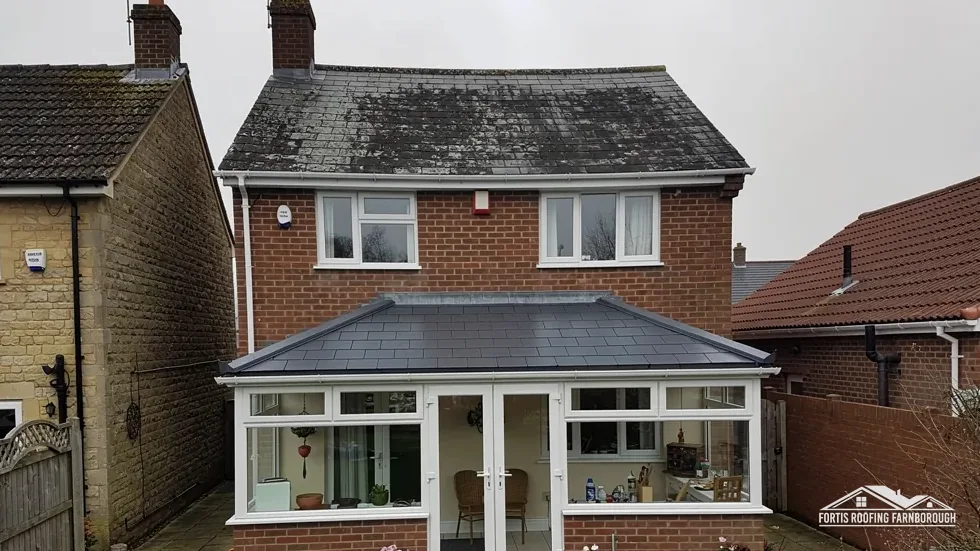
The old Wheatsheaf Inn is a three-storeyed brick and timber house of about 1600, partly refaced.

By 1925 roads of small houses had grown north of Easton Street and London Road, near the railway.
Map of High Wycombe with Marlow Bottom, Lane End, Little Marlow, Bourne End marked around it.
Map data © OpenStreetMap contributors. Loads only when you ask for it.
High Wycombe is a Chiltern market town in the valley of the River Wye, and Farnborough lies 29.9 road miles to the south.
About 29.9 road miles north of Farnborough · Buckinghamshire Council (unitary).
High Wycombe, Article 4, old fronts
What an Article 4 direction is and where such directions reach roofs near us, how a Tudor street, a timber inn and chair-making shaped High Wycombe, and what its Grade I buildings ask.

| No. | Chapter | The figure it turns on |
|---|---|---|
| 01 | Article 4 directions and roofs | Article 4 withdraws permitted development |
| 02 | A Tudor street, an inn and a chair-making town | About 1600, the Wheatsheaf Inn |
| 03 | Grade I landmarks and five conservation areas | 75 listed buildings within 900 m |
Chapter 01 of 03
| Council | Roof-relevant detail | Where |
|---|---|---|
| Rushmoor Borough Council | Installing, altering or removing a chimney or flue | Cargate, Aldershot |
| Rushmoor Borough Council | Antennas on a chimney, wall or roof slope facing a highway | Wellesley, Aldershot |
| Hart District Council | Alterations to frontage roof slopes and chimneys | Most conservation areas, 1998 directions |
| Basingstoke and Deane Borough Council | Roof changes, roofline and solar panels | Four Basingstoke conservation areas |
| Guildford Borough Council | Removing or altering a chimney without permission | Where a direction applies |
Buckinghamshire Council is the planning authority for High Wycombe and has its own building control team. Before any roof job in a town with so many conservation areas, one question deserves a plain answer: what is an Article 4 direction, and could it touch your roof?
Government guidance describes an Article 4 direction as a direction under article 4 of the General Permitted Development Order, which lets the Secretary of State or the local planning authority withdraw specified permitted development rights across a defined area. In plain terms, something you could normally do without a planning application becomes something you must apply for. Each direction is different, and each lists exactly what it covers.
The table shows what some councils near us have published. In parts of Aldershot, Rushmoor's directions reach chimneys and flues, and antennas on a roof slope that faces a highway. Hart's 1998 directions on most of its conservation areas cover alterations to frontage roof slopes and chimneys. Basingstoke and Deane's directions bring roof changes, the roofline and solar panels under control in four Basingstoke conservation areas. Guildford's page adds that wherever a direction applies, chimney work needs permission first.
Buckinghamshire Council keeps its own list of Article 4 directions, and it includes one for land at Four Ashes, High Wycombe. Without reading a direction we cannot say which classes it removes, so the question is always put to the council about your address. A like-for-like repair rarely falls inside a direction, but a changed chimney, a new covering material or a new roof window might. A direction is the council's own decision, so a short enquiry to its planners settles the question, and it costs you nothing.
The way to find out is simple: ask Buckinghamshire's planning team whether any direction covers your street, and ask before the job is priced, because a direction can change what the job is allowed to be. We do that on your behalf, and the answer goes into the written price.
The same habit helps with the services we link to here. Our pitched roofing and commercial roofing pages explain how tiled slopes and larger workshop or shop roofs are surveyed and repaired.
Chapter 02 of 03
High Wycombe's town and buildings, in published figures
The Victoria County History of 1925 says the houses on the west side of Church Street and the south side of White Hart Street are nearly all of the 16th century, refronted in brick. The old Wheatsheaf Inn on the north side of the High Street is a three-storeyed brick and timber house of about 1600, partly refaced. In 1925 a network of roads with small houses had recently grown up north of Easton Street and London Road near the railway, on the site of the demesne of Bassets Bury Manor.
A house refronted in brick keeps an older structure behind a newer face. For a roof surveyor the point is that the front and the frame may belong to different centuries, and the roof may belong to a third. A brick front does not date the roof, and a Tudor frame does not make its roof Tudor. We photograph the covering slope by slope and record what is there, then give you the findings in plain words.
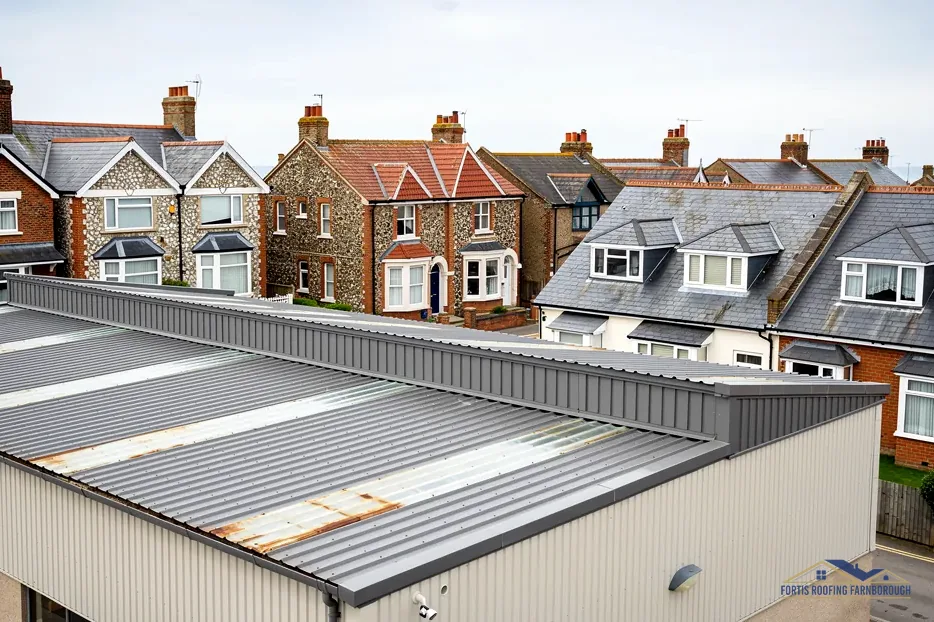
The history also noted that Wycombe had become the centre of a vast chair-making industry, which added to the town's prosperity while detracting from its picturesqueness. Industry means workshops, yards and larger roofs: flat sections, lean-tos and long ranges. A roof on a former workshop may be flat, pitched or both, and our survey separates each part and gives each its own notes.
The 2021 Census counted 83,523 usual residents in the High Wycombe built-up area, so this is a large town with every kind of roof, and no single repair fits all. Scaffold on a town street needs a highway licence under section 169 of the Highways Act 1980 where it stands on the road or pavement, and the frame is planned around shopfronts, doors and pedestrians.
Inn and town
Rows of small houses near a railway also share walls and chimney stacks. A shared stack or wall is photographed from our own side, and what shows of the rest is reported to you.
A timber-framed inn such as the Wheatsheaf has a roof that must accommodate movement in the frame. We look for rigid repairs that have cracked, and for flashings fixed hard where flexibility was needed.
Chapter 03 of 03
| Record | In High Wycombe | For roof work |
|---|---|---|
| Conservation areas | High Wycombe; Leigh Street Furniture Heritage; Amersham Hill; Priory Avenue; Wycombe Abbey | Ask Buckinghamshire which covers your address |
| Grade I listed church in use | Church of All Saints (NHLE 1125180) | Church of England faculty system |
| Grade I listed | Guildhall (NHLE 1332349) | Listed building consent for work affecting character |
| Grade II* listed | 30 High Street (NHLE 1159966); 33 High Street (NHLE 1332337) | The same consent route |
Five conservation areas appear in the national dataset around High Wycombe: High Wycombe itself, Leigh Street Furniture Heritage, Amersham Hill, Priory Avenue and Wycombe Abbey. The name Leigh Street Furniture Heritage points back to the chair-making trade. Which, if any, covers your street is for Buckinghamshire's planning team to say. Our planning permission and roof work guide sets out where a repair ends and an alteration begins.
The Church of All Saints and the Guildhall have been listed Grade I since 9 January 1954. Anglican worship continues at All Saints, so its roof falls under the faculty system, and the council's consent process does not apply to it. The Guildhall is a civic building, and consent from the council is needed for any work that alters its character. Numbers 30 and 33 High Street are listed Grade II*, and the same consent route applies, which makes a matching repair the straightforward course on a High Street frontage.
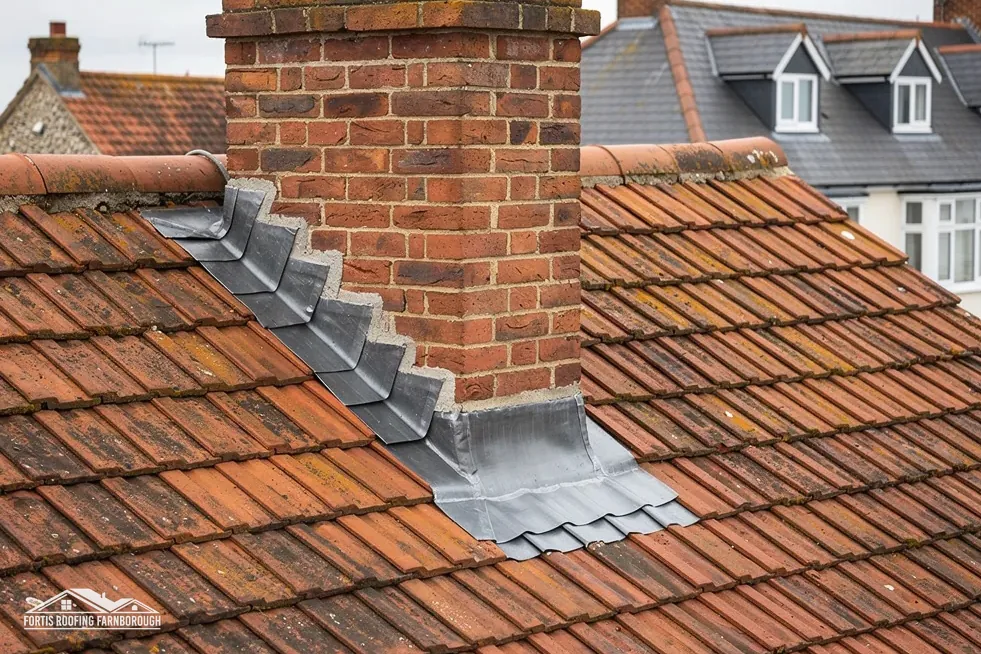
Seventy-five listed buildings stand within 900 metres of the centre. With so many listed buildings close together, a roof re-covered in an unsuitable material can stand out among its neighbours, from the High Street frontages to the lanes behind. For a listed house, permitted development does not disappear, yet listed building consent is also needed for work that touches its character. Our lead roofing and lead work page explains the flashings and valleys that older town roofs rely on.
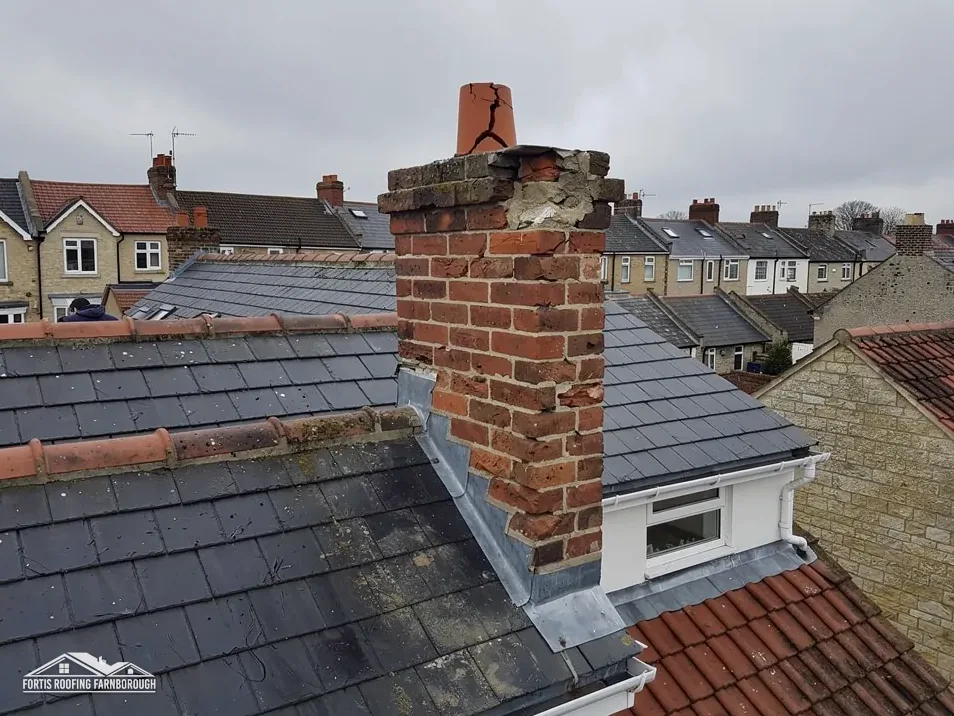
For every older roof we hold dated photographs from before the work and after it, handed over with the written price. If a planner asks what covered the roof before, the file answers.
Where a town-centre building has lead valleys or parapet gutters, they are where water collects when an outlet blocks. We flow-test them on the survey. A leak from a hidden gutter can run down inside a wall for months before it shows, so finding one early saves a good deal of damage.
If you manage a shop, office or workshop, tell us about the building's use. A commercial roof can have different access, drainage and consent needs from a house, and we plan for them.
No. The 1925 county history says houses on Church Street and White Hart Street are nearly all of the 16th century, refronted in brick, so front, frame and roof may belong to different centuries. Each slope gets a photograph and a covering named in our notes, so the survey says what is actually up there.
It is a direction under article 4 of the General Permitted Development Order that withdraws specified permitted development rights across a defined area. Whether one reaches your roof depends on its terms and your street. The council holds the answer, and a chimney, covering or roofline change is put to it before we price.
It is a faculty matter. All Saints is Grade I listed, but its congregation is Anglican, so the ecclesiastical exemption covers its roof. The Guildhall and listed houses are different, because Buckinghamshire Council grants listed building consent for them, and we raise that with the council before any pricing begins.
The dataset lists five: High Wycombe, Leigh Street Furniture Heritage, Amersham Hill, Priory Avenue and Wycombe Abbey. The boundary maps are held by Buckinghamshire's planning team, which also knows if an Article 4 direction applies. We put any visible alteration to the planners before pricing, and their reply goes into your file.
Get your free roof quote
Send your High Wycombe address with a few words on the roof's trouble, and we will book a survey.
10-year workmanship guarantee, in writing.