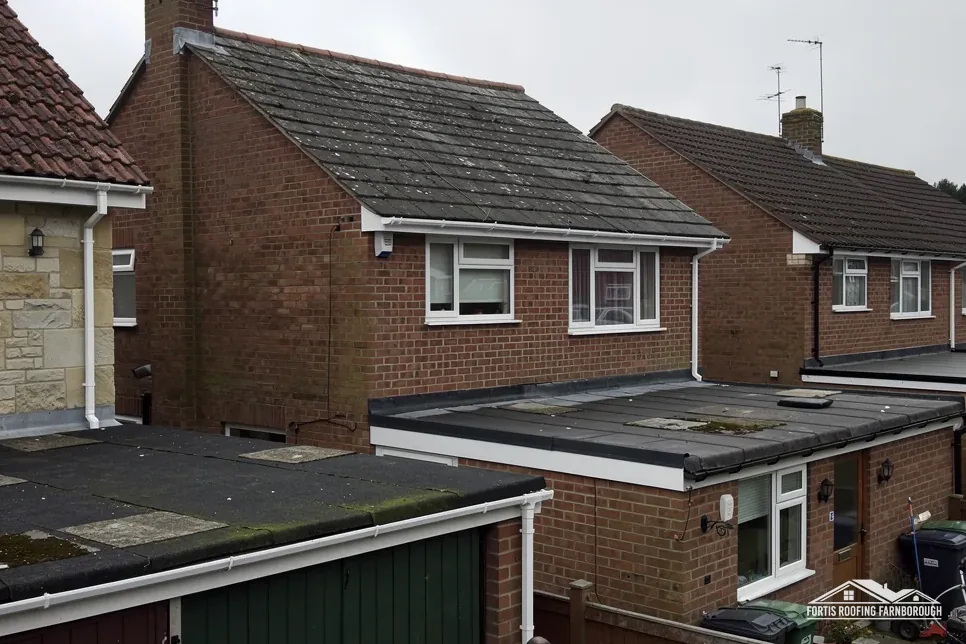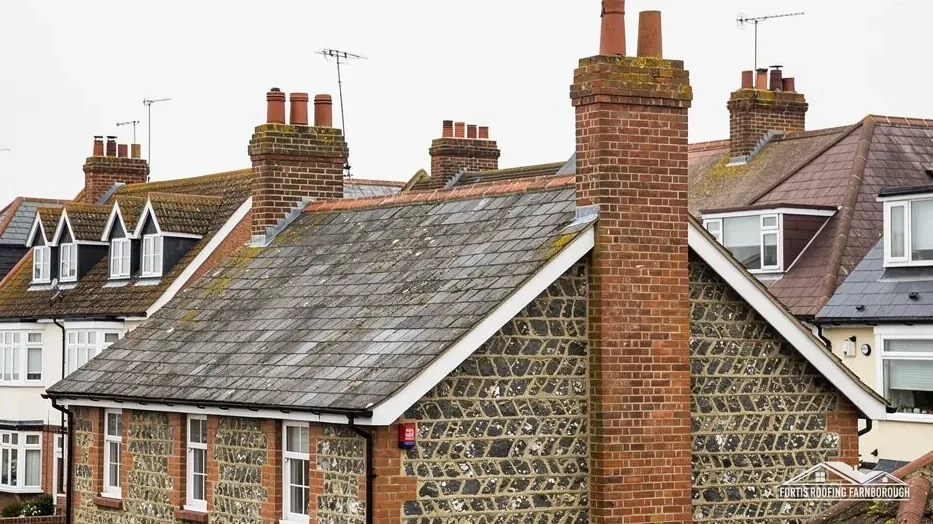
Royal Holloway's red brick
The college on Egham Hill, founded in 1879 and opened in 1886, is red brick round two quadrangles.

Roofs behind Egham's red-brick college and late Victorian streets
Egham grew after its 1856 station and the 1881 Woking line. We survey roofs on its late 19th-century streets slope by slope, then price the job once in writing.
The college on Egham Hill, founded in 1879 and opened in 1886, is red brick round two quadrangles.
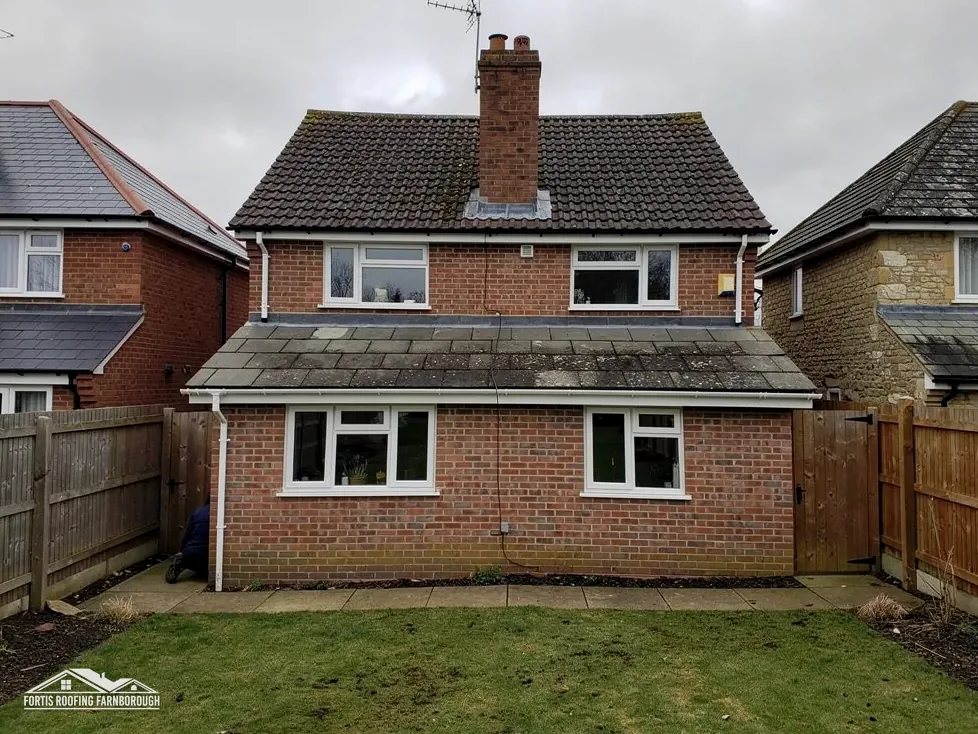
Runnymede's 2020 appraisal says the residential streets north of the town centre were developed in the late 19th century.
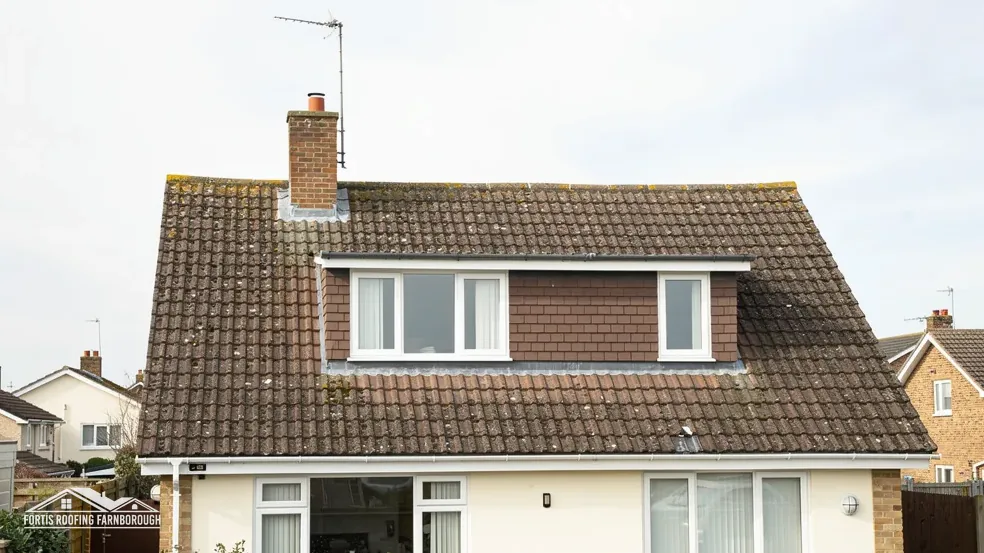
The same appraisal describes a town centre palette of brick in different colours, and render, around the High Street.
Map of Egham with Englefield Green, Staines-upon-Thames, Thorpe, Wraysbury marked around it.
Map data © OpenStreetMap contributors. Loads only when you ask for it.
Englefield Green is the nearest neighbour on the west, then Virginia Water, Thorpe and Wraysbury, with Staines-upon-Thames across the river and Old Windsor beyond Wraysbury.
About 18.3 road miles north-east of Farnborough · Runnymede Borough Council and Surrey County Council.
Egham, council by council
The councils behind a roof job in Egham, how the railway and Royal Holloway shaped its streets, and what the town centre conservation area and its listed buildings mean for repairs, each figure with its published source.

| No. | Chapter | The figure it turns on |
|---|---|---|
| 01 | Runnymede, Surrey and the April 2027 change | Surrey replaced 1 April 2027 |
| 02 | A railway town built on a causeway | Station 1856, Woking line 1881 |
| 03 | Egham's conservation area and its listed buildings | Egham conservation area, 22 April 1993 |
Chapter 01 of 03
| Role | Body for Egham addresses |
|---|---|
| District council and planning authority | Runnymede Borough Council |
| County council and highway authority | Surrey County Council (until 31 March 2027) |
| Building control | Runnymede Borough Council's own team |
| Scaffold licence on the highway | Surrey County Council |
| From 1 April 2027 | West Surrey Council replaces both councils |
Egham sits 18.3 road miles from Farnborough, counting from the A325 Farnborough Road, in the north-east of our patch. It sits in Surrey, in the borough of Runnymede. Runnymede is the planning authority for Egham addresses, and the roads and pavements outside those houses fall to Surrey County Council, as highway authority.
Surrey's 12 councils will give way to two new ones on 1 April 2027, and Egham falls under West Surrey Council. For the moment, Surrey tells residents that service arrangements stay as they are, so a roof booked this winter runs on today's arrangements. From 1 April 2027 Guildford, Spelthorne, Surrey Heath, Waverley and Woking join Egham under West Surrey Council, so neighbours across the borough boundary will share one council. We word everything here as current until 31 March 2027.
Refixing a few slipped tiles or bedding a ridge again counts as a repair. The Planning Portal's test for a re-roof asks whether less than 25 per cent of the building envelope is affected and less than 50 per cent of the roof. Runnymede publishes no percentage of its own, so that is the test we use. A whole-roof re-covering goes beyond it, and then building control or a registered building control approver signs the work off. A heavier covering is a separate trigger: once the new material is 15 per cent or more heavier, Building Regulations approval is needed, and the Planning Portal suggests a structural engineer or surveyor looks first.
Section 169 of the Highways Act 1980 puts scaffold on or over a pavement or road under licence. Surrey County Council wants a licence wherever scaffolding stands on a carriageway, footway or other highway, asks for 10 working days' notice or more and charges £208 per 28-day period. Surrey is silent on which party applies, so we handle the licence jointly with the scaffolding firm and tell you the dates. The renewal fee is the same as the first, so a job that overruns pays for a second period. We plan the programme to fit inside the first.
The survey settles the access before any date is booked: where the scaffold stands, how much footway it leaves and whether the front slope can be reached from the rear. You see the plan in writing alongside our photos of the roof.
Chapter 02 of 03
Egham: distance, population and two opening dates
Runnymede's town centre appraisal explains how Egham grew. The town began to expand after its station on the London to Reading line opened in 1856, and the Woking to Egham line of 1881 stimulated much greater expansion. The residential streets in the north of the town centre were developed in the late 19th century. The 2021 Census counted 27,997 people in the Egham built-up area.
Older still is the Causeway. The Victoria County History of Surrey says it was built in the time of Henry III, from the town to Staines Bridge, as both a highway and a dyke against flooding by the Thames. The same history calls Egham important for inns in coaching days, when the old south-western road from London came over Staines Bridge and through the town.
A street built in the late 19th century shares its age, but not necessarily its history. One house may keep its first covering while its neighbour has been re-roofed twice, and a rear extension adds a third roof with its own junctions. So we do not guess a covering from the pavement. On the survey we lift and photograph each slope, name what is on it and measure how much of it is sound.
That record is what separates a repair from a re-roof. If twelve tiles on one slope have slipped, the fix is twelve tiles, and the photographs show why. If the timber strips under the tiles, called battens, crumble when we lift the covering, you see that too, and the price follows from the area affected. A leak that a repair cannot fix is said plainly, with the evidence beside it.
Gutters and fascias on these streets get the same treatment. Overflowing gutters stain brickwork below and push water behind the fascia board, so a roof survey includes the roofline as well as the covering, and we note each length of gutter that has sagged or come away from its brackets.
Railway dates
Royal Holloway shows the other end of the scale: the Victoria County History says its red-brick quadrangles follow generally the model of the Chateau de Chambord, with W. H. Crossland as architect. Most Egham roofs are far smaller, and they are the work our pitched roofing team knows, from slipped tiles to ridges that need re-fixing.
Chapter 03 of 03
| Designation | In Egham | For roof work |
|---|---|---|
| Conservation area (22 April 1993) | Egham Town Centre | Check with Runnymede before any change of look |
| Grade II* listed church | Church of Saint John the Baptist (NHLE 1189321) | Consent route depends on denomination and use |
| Grade I listed | Runnymede Park (NHLE 1028921) | Listed building consent for works affecting character |
| Grade II listed | 169 and 170 High Street (NHLE 1189353) | Listed building consent for works affecting character |
| Grade II listed | 176 High Street (NHLE 1028980) | Listed building consent for works affecting character |
Egham Town Centre was designated a conservation area on 22 April 1993. A conservation area leaves repairs allowed, but it changes what counts as the same roof. Putting back the same covering in the same way keeps the look. Changing the material, the ridge or the stacks changes it, and that is a conversation with Runnymede's planning team before any price is fixed. Our planning permission guide sets out the rules, and the survey tells us which side of the line your job sits. The conservation area is the town centre, so many Egham streets lie outside its boundary, and the council's map shows where it runs.
Runnymede's published guidance covers permitted development in conservation areas, and its planning team confirms the detail. For any Egham address we check whether an Article 4 direction applies with Runnymede before pricing, because a direction can remove rights that would otherwise apply.
Numbers 169 and 170 High Street are listed Grade II, as is number 176. Listing leaves a house's permitted development rights alone, yet work touching its character also needs listed building consent, and a small repair in matching material is judged case by case. We photograph the covering, flashings and chimney before we suggest anything and put that record in front of the conservation officer if consent is needed.
Saint John the Baptist's church carries a Grade II* listing, and which consent route applies depends on how it is used today and by which church. A Church of England building still in use goes through the faculty system, while other denominations follow their own systems or apply for listed building consent. Whoever looks after the building will know which. The same question matters for any older chapel or hall, so we ask it at the start of the survey, before we plan any access or materials.
Ask any roofer working on a listed building to show you the consent in writing before the scaffold goes up, and keep a copy beside the survey photographs.
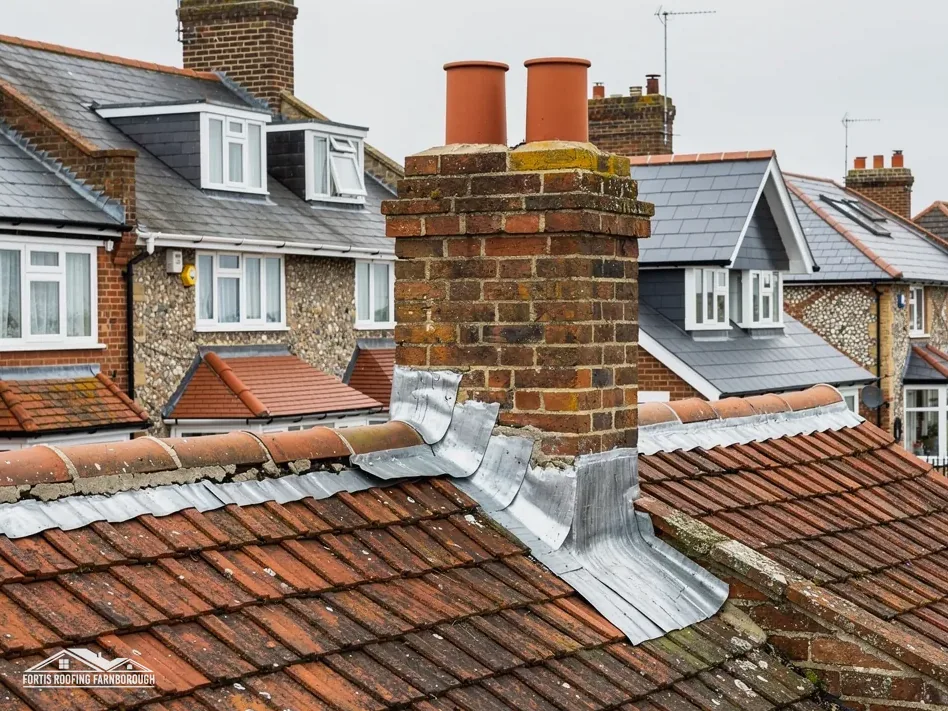
For a house that sits in neither category, the work is simpler. Valleys, flashings and chimney flaunching are renewed in lead of the right code, and our chimney repairs team works from the scaffold already in place.
The valleys, the flashings round stacks and the covering on each slope, because those are the places a century-old roof leaks first. We lift and photograph each slope separately, then explain what we found before a written price is given, so you can see the evidence for yourself and decide what to do first.
It does not stop them, but a repair that changes how the roof looks is judged differently from a like-for-like one. We check with Runnymede's planning team before pricing anything that alters the covering, ridge or stacks, and we keep the survey photographs as the record of what was there before we started.
Until then, Surrey's own page says day-to-day services continue as they are. A job booked and scaffolded this winter is licensed under Surrey County Council's current arrangements, and we tell you the dates in writing so you know what happens each day and when the scaffold comes down again.
Not normally. The Planning Portal's test is less than 25 per cent of the building envelope and less than 50 per cent of the roof, and a handful of tiles sits far below that. A full re-roof is different, and Runnymede or a registered approver is then involved, and you hear this at survey.
Get your free roof quote
Tell us your Egham street and the trouble, and we will agree a visit and photograph each slope.
10-year workmanship guarantee, in writing.