St Peter's, reroofed in 1863
Sir Gilbert Scott restored St Peter's in 1863 and 1864, reroofing the chancel and nave and adding the spire.

Roofs beside Windsor Great Park, from Scott's reroofed church to brick cottages
Old Windsor's cottages were built of brick and roofed with slates or tiles, the 1923 history says, and Gilbert Scott reroofed St Peter's. We survey every roof and price once.
Sir Gilbert Scott restored St Peter's in 1863 and 1864, reroofing the chancel and nave and adding the spire.

In 1923 the county history described the village's cottages as built of brick and roofed with slates or tiles.
Burfield Lodge, Church Cottage and Pearmain Cottage are each listed Grade II.
Map of Old Windsor with Wraysbury, Datchet, Horton, Windsor marked around it.
Map data © OpenStreetMap contributors. Loads only when you ask for it.
Wraysbury is the nearest neighbour east, Datchet lies north, Horton north-east, Windsor north-west, with Englefield Green to the south and Egham further south-east.
About 20.3 road miles north-east of Farnborough · Royal Borough of Windsor and Maidenhead (unitary).
Old Windsor, slate and concrete tile
What the 1923 county history records of Old Windsor's church and cottages, how Sir Gilbert Scott's 1863 reroofing of St Peter's shows the age of Victorian roofs, and where published sources disagree on the life of concrete tile.

| No. | Chapter | The figure it turns on |
|---|---|---|
| 01 | St Peter's, reroofed by Scott in 1863 | Reroofed 1863 to 1864, spire added |
| 02 | Brick cottages, slates or tiles | Brick walls, slate or tile roofs, 1923 |
| 03 | How long concrete and fibre cement tile last | Concrete tile 40-50 years or about 60 |
Chapter 01 of 03
Old Windsor: people, church and listings
Old Windsor is a Thames-side village west of the Datchet to Staines road, beside Windsor Great Park, with 5,323 residents at the 2021 Census. Windsor and Maidenhead's Royal Borough covers planning, roads and building control here with no county council above it, and its building control team checks re-roofs for local addresses. A single office therefore answers most of the questions a roof job raises, which keeps the paperwork short.
The 1923 county history records the tower and east chancel wall of St Peter's as early 13th-century, and says the church was restored in 1863 and 1864 by Sir Gilbert Scott, who reroofed the chancel and nave and added the spire. The chancel and nave walls are flint with chalk dressings.
That date is a handy yardstick. A roof laid in 1863 is now over 160 years old, which is long even for slate. If such a roof is still serving, it has been repaired along the way, and those repairs are part of its story. Victorian houses in the village whose roofs date from the same decades are in the same position.
Whether St Peter's remains an Anglican church in use, and so falls under the faculty system through the ecclesiastical exemption, is for its custodians to say. Burfield Lodge, Church Cottage and Pearmain Cottage carry Grade II listings, and they follow the council's listed building route for anything that alters their character, which means a written method and a consent before a tile is lifted. A cottage that is listed and a cottage next door that is not can need quite different handling.
The nearest conservation area on the national map is Englefield Green, about 2.5 km off, and the Royal Borough lists 27 across its own area. Whether an Old Windsor street is inside one is for the council to confirm. Scaffold on a road needs the Royal Borough's permission. We find out with the scaffolder which of us files for it and hold back on dates until the licence is in hand, so no start day is a guess, and you are told in writing when the scaffold will arrive and leave.
Trees from the Great Park drop leaves into gutters across the village, so we check every outlet whatever the age of the roof, and we photograph any that are blocked or have slipped.
Chapter 02 of 03
| Subject | Record |
|---|---|
| The village, 1923 | Quite modern; cottages built of brick and roofed with slates or tiles |
| St Peter's tower and chancel wall | Early 13th century |
| St Peter's restoration | 1863 to 1864 by Sir Gilbert Scott; chancel and nave reroofed; spire added |
| Church walls | Flint with chalk dressings (chancel and nave) |
| Cumberland Lodge | Built in the reign of Charles II; faced with red brick |
The 1923 county history describes Old Windsor as quite modern, its cottages built of brick and roofed with slates or tiles. It adds that Cumberland Lodge in the Great Park, within the old parish, was built in the reign of Charles II and is faced with red brick. Those lines picture the village a century ago. They hint at what older roofs may carry, but they say nothing certain about any house today.
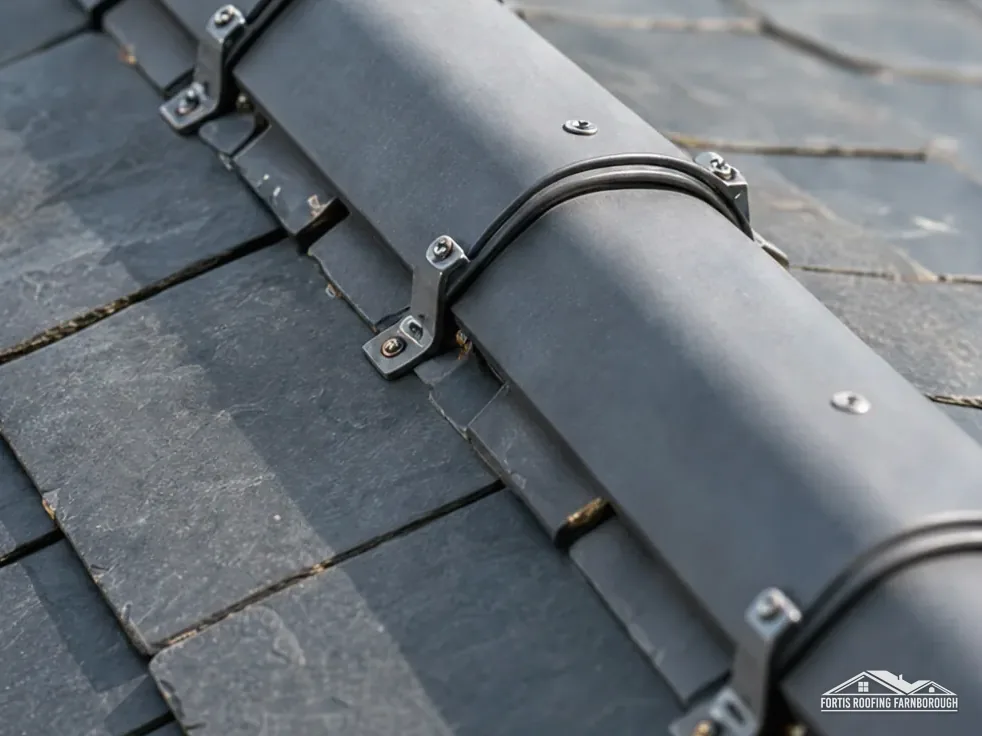
Slate and tile are the two coverings named, and they age in different ways. Slate seldom wears through, but its fixings corrode and slipped slates let water in. Tile soaks up moisture and can crack in frost, and its nibs break. A village with both needs a survey that looks for different faults on different slopes.
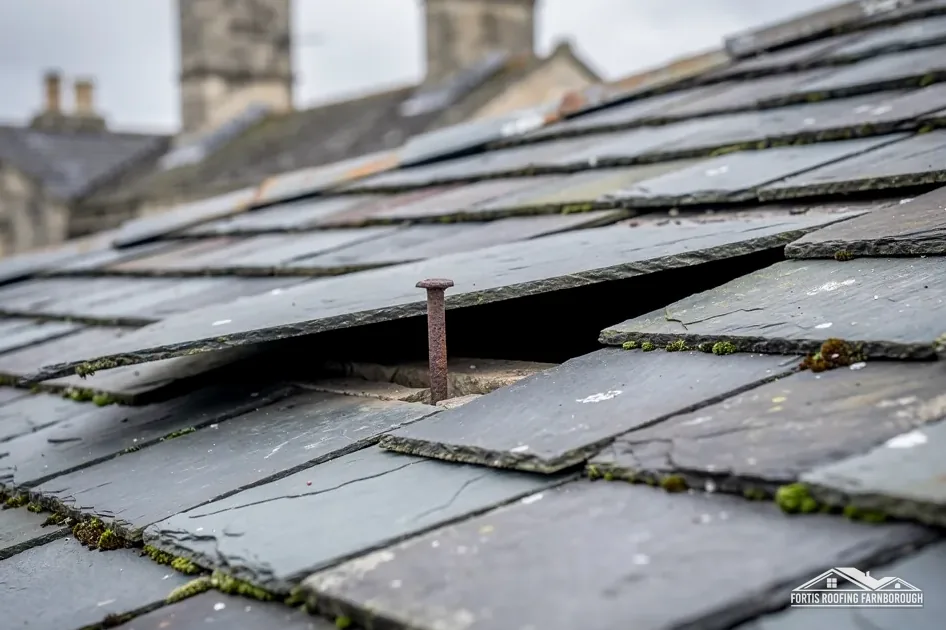
Slate shows its age through slipped slates, rust around the nail holes and broken corners. A roof with a handful of slipped slates can often be put right by refixing them, whereas nails rusted through across a whole slope mean a bigger job. On tile the signs are cracking, delamination and ridge bedding that has failed.
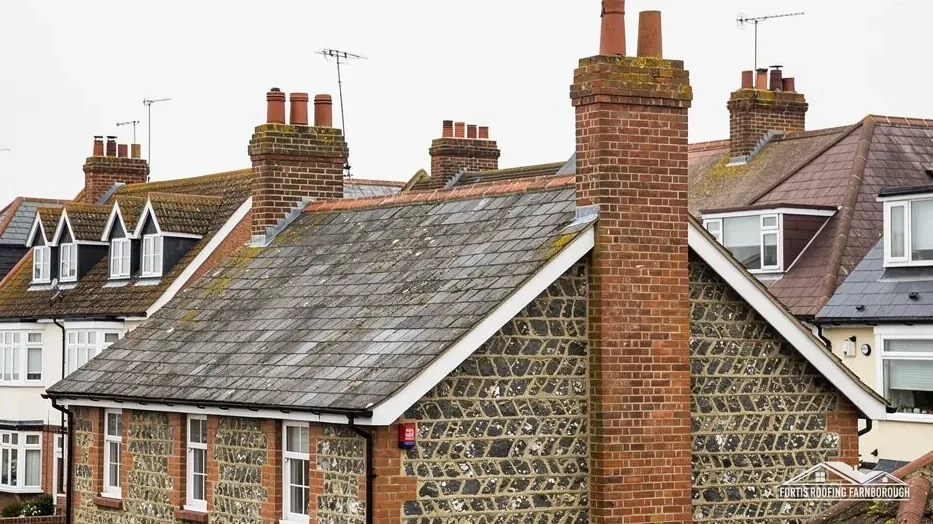
Brick cottages put up in the same decades share their weak points. Chimney stacks serving two rooms back to back lose their flashings. Valleys where a rear wing meets the main roof wear thin. Eaves gutters sag under leaf litter from the trees round the Great Park, and a sagging run keeps water on the fascia instead of carrying it away.
A cottage roof is small, but a small roof is not a small risk. One failed flashing can send water down a wall for years before a stain shows, which is why a survey that finds it early saves money.
The slate roofing page explains how slates are graded and refixed, and the pitched roofing page covers tile repairs.
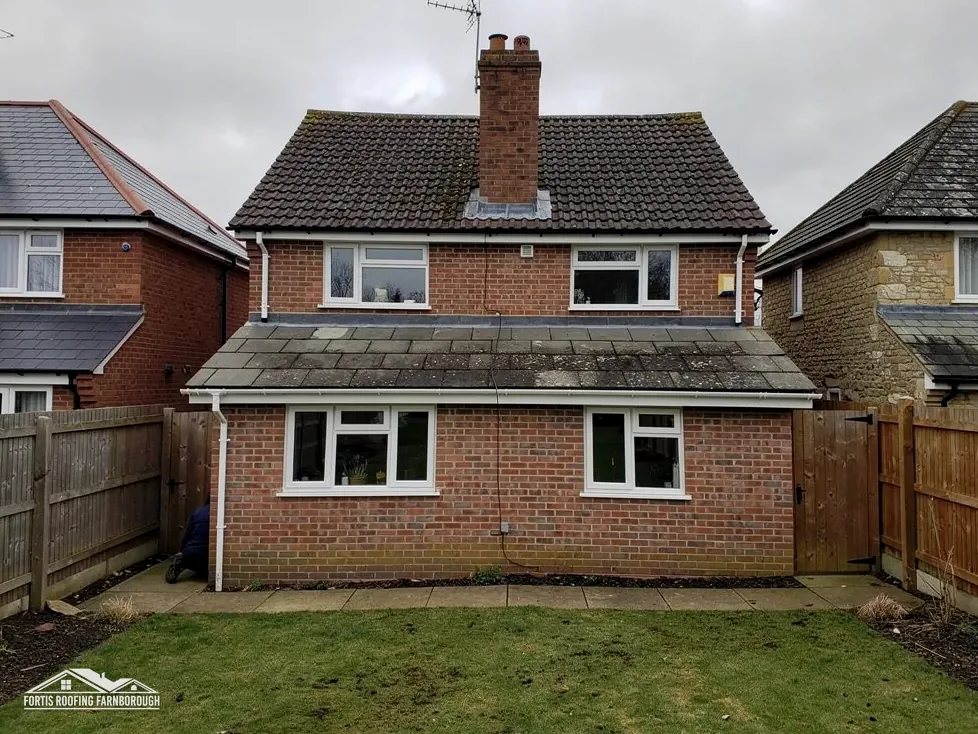
A brick cottage may have been re-covered since the county history was written, perhaps more than once, so the covering on each slope is logged on its own, and the notes say which parts look original and which look later. That distinction helps when a repair has to match, and shows how much of the roof has been renewed already, which helps you judge what is left.
Not necessarily. A slate roof of that age may still serve if it was well laid and has been repaired, since slate itself seldom wears through. The fixings are what fail. Slipped slates and rusted nails are photographed, the battens checked, and you are told whether refixing will do or a larger job is needed.
Published sources disagree. HomeBuilding gives plain concrete and Double Roman tiles 40 to 50 years, while Marley expects its tiles to last around 60 years and says that is no warranty. The BRE's 60-year minimum applies to clay only. Condition on the day matters most, and a survey records it with photographs.
Only if St Peter's is still an Anglican church in use, which its custodians can confirm. If it is, the ecclesiastical exemption applies and a faculty is needed. Other listed buildings in the village, such as Burfield Lodge, follow the Royal Borough's listed building consent route, and the owner applies.
The closest one on the national map is Englefield Green, about 2.5 km off, and the Royal Borough has 27 across its area. Whether your own street lies inside one is for the council to confirm, and any visible alteration goes to its planning team before a price is set, with the reply kept on your file.
Get your free roof quote
Send your Old Windsor address and what you noticed, and a surveyor will photograph each slope and gutter.
10-year workmanship guarantee, in writing.