Park Street red brick
The 1923 county history found Park Street little altered since the 18th century, with red brick houses and tiled roofs.
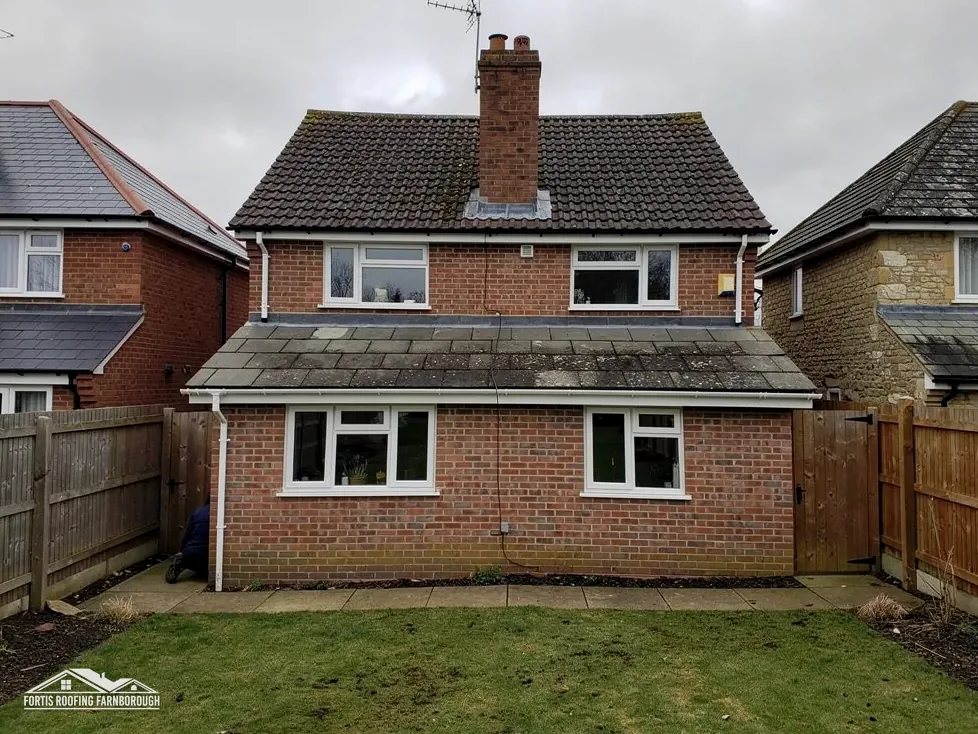
Peg tile on steep pitches, slate on shallow, in a castle town
RBWM's town-centre appraisal records clay peg tile on steeper older Windsor roofs and slate on shallower pitches. Each slope is surveyed for what it carries.
The 1923 county history found Park Street little altered since the 18th century, with red brick houses and tiled roofs.

Houses opposite the castle gateway are almost all late 17th or early 18th century.

RBWM's appraisal records clay peg tile on steeper older roofs and natural slate on shallower pitches.
Map of Windsor with Eton, Datchet, Eton Wick, Old Windsor marked around it.
Map data © OpenStreetMap contributors. Loads only when you ask for it.
Eton faces Windsor across the river to the north, with Datchet east, Slough north, Old Windsor south-east and Dorney north-west; Farnborough is some way to the south-west.
About 17.4 road miles north-east of Farnborough · Royal Borough of Windsor and Maidenhead (unitary).
Windsor, royal borough and old town
Five questions the Royal Borough of Windsor and Maidenhead's rules put before a Windsor roof job, what its appraisal says about peg tile and slate, and how 250 listed buildings and a town-centre direction shape repairs.
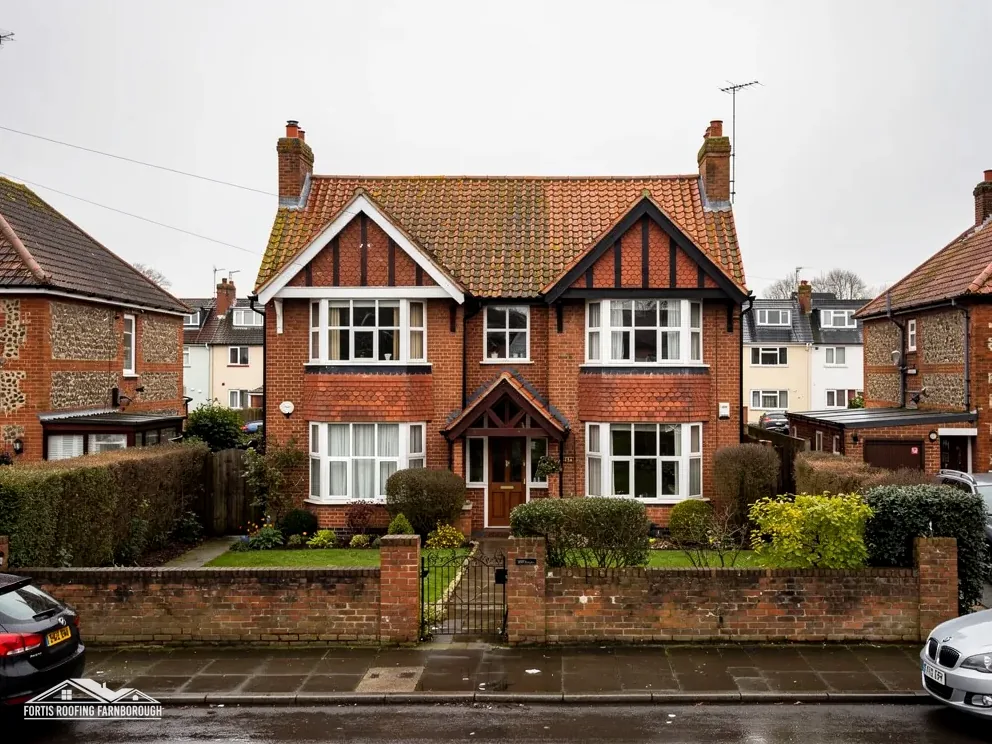
| No. | Chapter | The figure it turns on |
|---|---|---|
| 01 | Five questions before a Windsor roof is touched | 27 conservation areas in the Royal Borough |
| 02 | Peg tile for steep pitches, slate for shallow | Slate introduced in the 18th century |
| 03 | A castle, a Guildhall and 250 listed buildings | 250 listed buildings within 900 m |
Chapter 01 of 03
| Question | Who answers |
|---|---|
| Is it re-tiling, and does the weight change? | The Royal Borough's own building control service |
| Is the house inside a conservation area? | The Royal Borough, from its published list and map |
| Is the building listed? | Historic England list; consent from the Royal Borough |
| Does scaffold stand on the highway? | The Royal Borough, which gives the permission |
| Is it a church in use? | The church's own system, such as a faculty |
Windsor is a castle town on the Thames, 17.4 miles by road north-east from Farnborough, counted from the A325 Farnborough Road. It is run by the Royal Borough of Windsor and Maidenhead, known as RBWM, a unitary council with no county tier above it. One council therefore covers planning, building control, highways and scaffold permission, and the questions a roof raises can be put to it in a single place.
On a Windsor house we ask five questions in the same order, because each narrows the next. First, is the work re-tiling, and would the weight change? RBWM's own pages treat re-tiling, and re-tiling with a different weight of tile, as roof work it may want to inspect. Second, is the house in a conservation area? RBWM says it has 27 designated conservation areas in the borough. Third, is the building listed? Fourth, will scaffold stand on the highway? Fifth, is it a church in use?
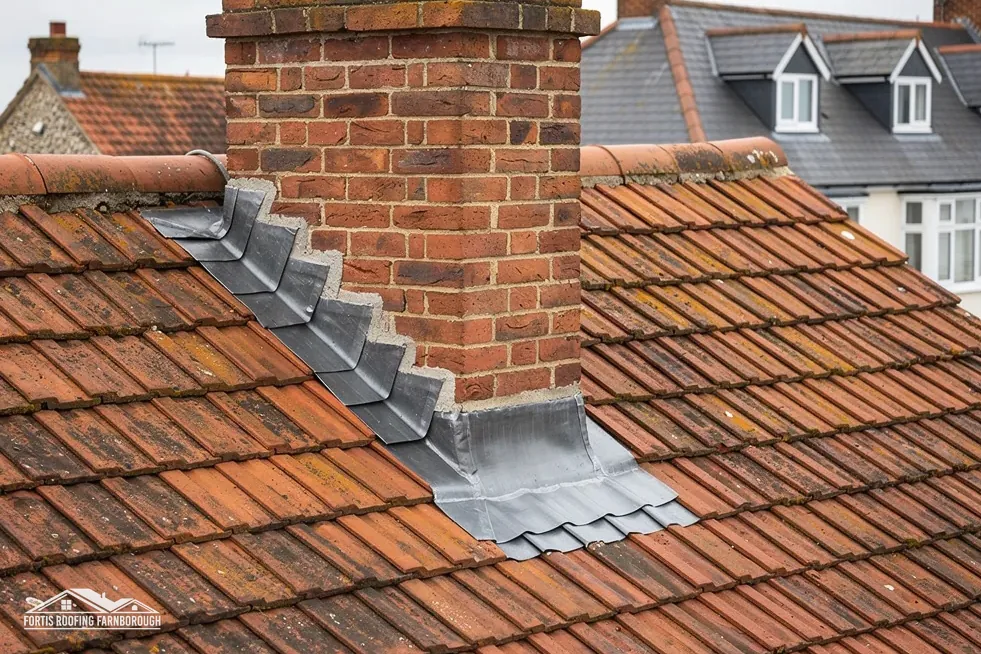
Taken in that order, the answers for an ordinary house come quickly. Each house gets the same first visit: the pitch of every slope, the covering, the ridge and hips, the stacks, the lead and the gutters, with a photograph of each. On a terrace we also note the shared junctions. A repair that stays under the Planning Portal's 25 per cent of the building envelope and 50 per cent of the roof, on an unlisted house outside any conservation area, goes ahead with no application.
Under the Royal Borough's scaffolding guidance, poles or hoardings placed on the highway need the council's permission first, and the most the council can fine for breaching a scaffolding licence is £5,000. No fee and no applicant are given there. In a narrow old street the scaffold layout can decide the whole programme, so the footway and the carriageway are measured on the first visit and the plan allows for deliveries and visitors.
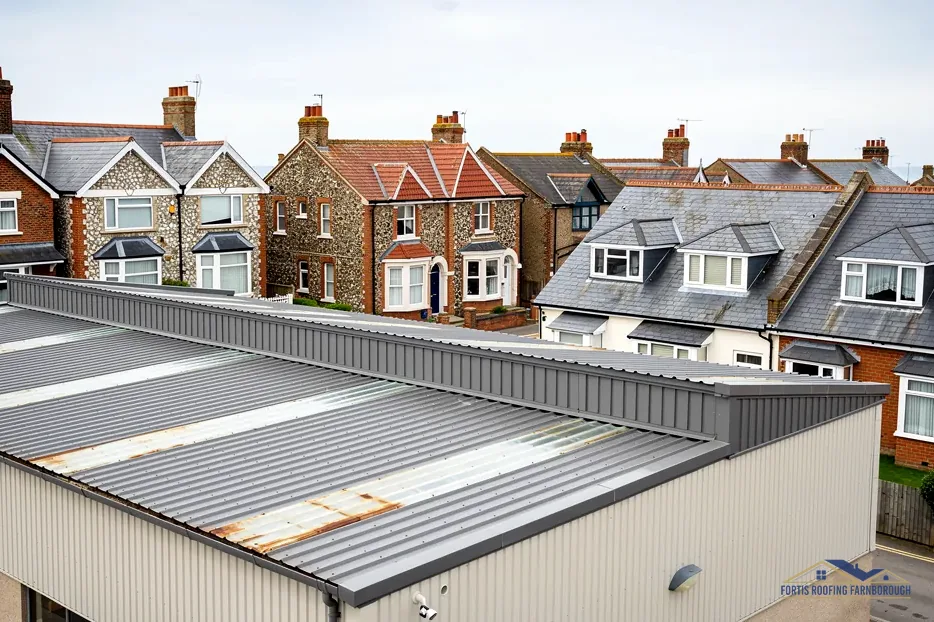
A busy town centre adds traffic and passers-by, and the plan allows for them: a protected walkway, a clear entrance and set working hours. Our commercial roofing page covers shops and offices, and the same planning applies to a roof above a business.
Chapter 02 of 03
Windsor's building story in four facts
RBWM's Windsor Town Centre Conservation Area Appraisal records that clay peg tile is common on the steeper older roofs, with natural slate, a material introduced in the 18th century, used on shallower pitches. The pitch of a roof limits what can cover it: Marley gives 35 degrees as the minimum for its plain concrete tile, and Cupa, citing BS 5534, says natural slate needs at least 20 degrees. A roof's slope and its covering therefore belong together, and a change of one can force a change of the other.
The 1923 county history said Park Street had probably altered little since the close of the 18th century, its houses principally of red brick with tiled roofs, and that the houses in Church Street opposite the castle gateway are almost without exception of the late 17th or early 18th century. Where a house in a terrace shares a ridge or a party-wall junction with its neighbour, a repair on one roof can reach the next.
Shared junctions and the ridge and hip lines are photographed along their whole length, and comment on the next roof goes no further than our own view allows. The report is yours, and with it you and your neighbour can both see the same picture and decide whether to act together.
The appraisal says Windsor is hemmed in by the Home and Great Parks, so its modern expansion has been westward to Dedworth and Clewer, and that between 1950 and 1980 the town saw its largest scale of non-domestic building. A stock of buildings from those decades includes shops, offices and units whose roofs are surveyed as commercial roofs, with falls, outlets and upstands checked.
Minimum pitches
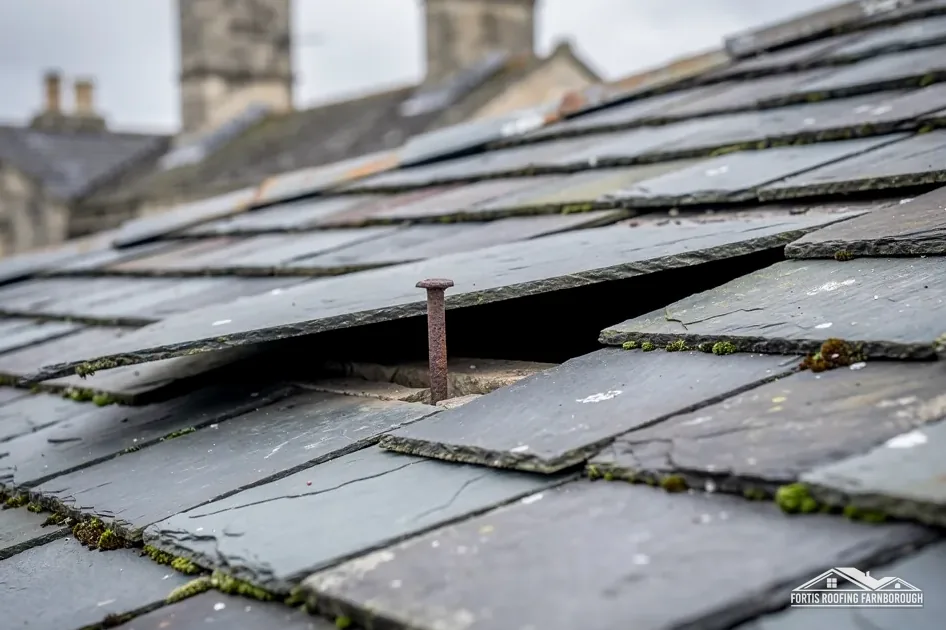
Where a covering across a whole slope has worn out, our pitched roofing page covers how peg tiles are refixed or replaced, and our slate roofing page covers slate. The survey photographs show which route your roof needs. On a shallow slate roof the fixing matters as much as the slate itself, since nails or hooks hold each one and a slipped slate can point to a rusted fixing. We photograph the fixings and say whether the fault is local or runs across the slope.
Chapter 03 of 03
| Designation | In Windsor | For roof work |
|---|---|---|
| Article 4 direction | Windsor Town Centre (exterior painting of buildings) | Ask RBWM what it covers for your address |
| Grade I listed | Guildhall (NHLE 1117752) | Listed building consent for works affecting its character |
| Grade II* listed | 12 to 16, Park Street (NHLE 1280741) | Listed building consent for works affecting its character |
| Grade II listed church in use | Church of All Saints (NHLE 1319326) | Church of England faculty, not listed building consent |
| Conservation area | Windsor Town Centre, on the RBWM appraisal list | Changes to the look checked with RBWM |
Historic England's list counts 250 listed buildings within about 900 m of the centre of Windsor, and that number includes Windsor Castle and the buildings within its walls, listed Grade I, and the Guildhall, also Grade I. 12 to 16, Park Street is Grade II*. With so many listed buildings close together, a house may well stand beside one, so the listing question is not an afterthought here. It is the first thing we look up.
Listing means consent before works that affect a building's character as a building of special interest, inside or out, with planning permission alongside it if that is also needed. A roofer who starts without consent puts the owner at risk, and the consent process can outlast the repair itself. We check the list for the address before the survey, ask who owns the roof, and prepare photographs and a written description for the application. Listed or not, any Windsor roof benefits from a dated photographic record. It is what a buyer's surveyor will ask for, and if a storm ever damages the roof it helps to show an insurer what condition the roof was in beforehand. An application is stronger with evidence, and the council's conservation staff can see exactly which tiles, which ridge and which stack are involved.

RBWM's own list of Article 4 directions includes Windsor Town Centre, described as the defined area of the historic town centre and covering exterior painting of buildings. Paint is the subject of that entry, and roofs are not mentioned. Any other Article 4 question for a Windsor address goes to the council, and its answer sits in the survey file beside a copy of our question.
All Saints, a Grade II listed church, is still a Church of England place of worship, so repairs to its roof need a faculty. Within a conservation area, section 55 of the Town and Country Planning Act 1990 treats a like-for-like repair as no development, whereas a new covering, ridge or stack changes it. RBWM's planners are asked first, and you are told what they say before the price is fixed, so no one is surprised by a condition that arrives late.
RBWM's appraisal records clay peg tile on steeper older roofs and natural slate on shallower pitches. We measure the pitch, name the covering on each slope and repair like for like. A different material changes the look of the street, so RBWM's planners are asked before any change is priced, and you hear their answer in writing.
RBWM states that it has 27 designated conservation areas and has published an appraisal for Windsor town centre. Look up one house on the borough map. Putting back the same tiles or slates is not development under section 55, while a new covering alters the building's appearance and is put to RBWM's planners first.
RBWM's guidance lists re-tiling or re-felting among roof work to ask about, and flags re-tiling that changes the roof's weight. We treat that as RBWM's position for its own addresses and ask the council before any re-cover. For small jobs the Planning Portal's limits of 25 per cent of the envelope and 50 per cent of the roof still apply.
RBWM's guidance says scaffold or hoardings on the highway need the council's permission, with a ceiling of £5,000 on fines for breaches of a scaffolding licence. No fee and no applicant are named, so the scaffolder and we settle who applies after the survey, and access is planned around the street.
Get your free roof quote
Tell us your Windsor street and the roof you can see from it, and a survey visit follows.
10-year workmanship guarantee, in writing.